Crystal defects in silicon represent promising building blocks for future photonic technologies, but creating consistently reliable, near-infrared light sources remains a significant hurdle. Carolina Crosta, Riccardo Nardin, Patrick Daoust, and colleagues now demonstrate a method for gently generating these light-emitting defects using light ion irradiation. The team confirms the formation of optically-active defects, known as C-centers, which exhibit fluorescence precisely within the crucial 1550nm telecom window, and importantly, these defects display long-lived excitonic states. This achievement, extended to germanium-on-silicon heterostructures, offers a pathway to seamlessly integrate these light sources into advanced photonic platforms and represents a substantial step towards realising practical, light-based technologies.
Defect Creation in Silicon and Germanium Materials
This research details the creation and characterization of defects in silicon and germanium-on-silicon materials, with potential applications in quantum technologies like single-photon emitters and quantum memories. Researchers explored methods for defect creation, including ion implantation, proton irradiation, femtosecond laser ablation, and high-energy electron irradiation, investigating both pure silicon crystals and germanium layers grown on silicon substrates. They employed photoluminescence and excitation spectroscopy to analyze resulting defects, and used Monte Carlo simulations to model the defect creation process and predict material behavior. The research successfully identified and characterized various defects in both materials, demonstrating some control over their creation and properties by adjusting creation methods and material parameters. Investigations into temperature dependence revealed insights into defect stability and potential operating conditions, highlighting the importance of material quality, specifically carbon and oxygen content, in controlling defect formation. The team also explored hydrogen peroxide etching to remove germanium layers and isolate defects, furthering control over the material structure.
Focused Ion Beam Creates Silicon Light Emitters
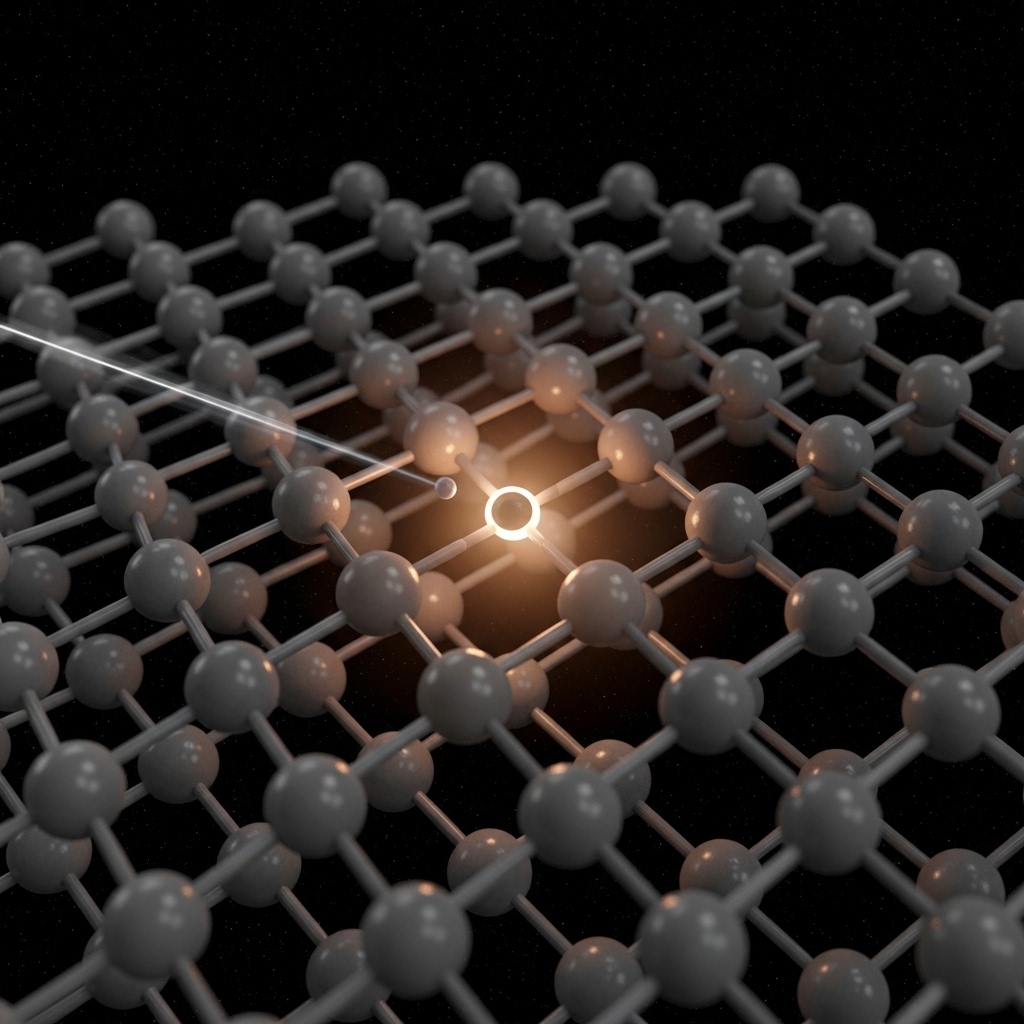
Scientists engineered a method to generate near-infrared light emitters within silicon, utilizing focused ion beams to create atomic-scale defects. They harnessed hydrogen and helium ions, each with energies around 1 MeV, to gently introduce defects into crystalline silicon, aiming to create optically-active centers suitable for telecommunications. Prior to experimentation, the team used software modeling to predict the distribution of vacancies created by the ions at varying depths within the silicon, optimizing the irradiation process. These simulations revealed that hydrogen ions penetrate deeper into silicon compared to helium ions at the same energy.
Raman spectroscopy assessed structural damage, revealing no significant changes in the silicon’s atomic order before and after ion irradiation. Low-temperature photoluminescence measurements identified a prominent emission line at 1569nm in intrinsic silicon, definitively attributed to the C-center defect complex, and a sharp peak at 1278nm, corresponding to the G-center, confirming the generation of multiple optically-active defects. These results demonstrate the successful implementation of controlled ion irradiation to generate C-centers within silicon, paving the way for integrated photonics and long-haul secure communications.
Near-Infrared Emission from Ion-Irradiated Silicon
This work demonstrates the generation of near-infrared light emitters in silicon using light ion irradiation, a significant step towards integrating photonics with existing silicon technology. Scientists utilized hydrogen and helium ions to gently create optically-active defects within crystalline silicon, achieving emission matching the crucial 1550nm telecom window. Experiments revealed that 1 MeV hydrogen ions create a larger volume of vacancies compared to helium ions at the same energy. Raman spectroscopy confirmed that the ion irradiation process does not disrupt the long-range atomic order of the silicon, but subtly perturbs the structure, yielding optically-active point defects.
Investigations into different silicon doping types showed that irradiation with a specific ion dose consistently induced a broad photoluminescence signal. Notably, a sharp emission peak at 1278nm, characteristic of G-centers, emerged in irradiated intrinsic silicon, while a strong emission at 1569nm definitively originated from the C-center. The research team proposes that the formation of C-centers, consisting of interstitial oxygen-carbon pairs, is influenced by oxygen contamination levels within the silicon.
C-Centers Created in Silicon Heterostructures
Researchers have successfully generated light-emitting defects, known as C-centers, within silicon and germanium-on-silicon heterostructures using focused ion irradiation. Through careful control of ion type and energy, the team demonstrated the creation of these defects, which exhibit fluorescence at wavelengths crucial for telecommunications, around 1550 nanometers. Time-resolved measurements confirmed the presence of long-lived excitonic states, validating the formation of these C-centers. This work extends beyond bulk silicon, demonstrating the ability to create C-centers within germanium-on-silicon structures, offering a promising platform for advanced integrated photonics. Analysis of the defect fluorescence and temperature-dependent measurements revealed details about the energy levels and thermal behavior of these C-centers.
👉 More information
🗞 Formation of C-centers in Si-based systems by light ion irradiation
🧠 ArXiv: https://arxiv.org/abs/2510.12690