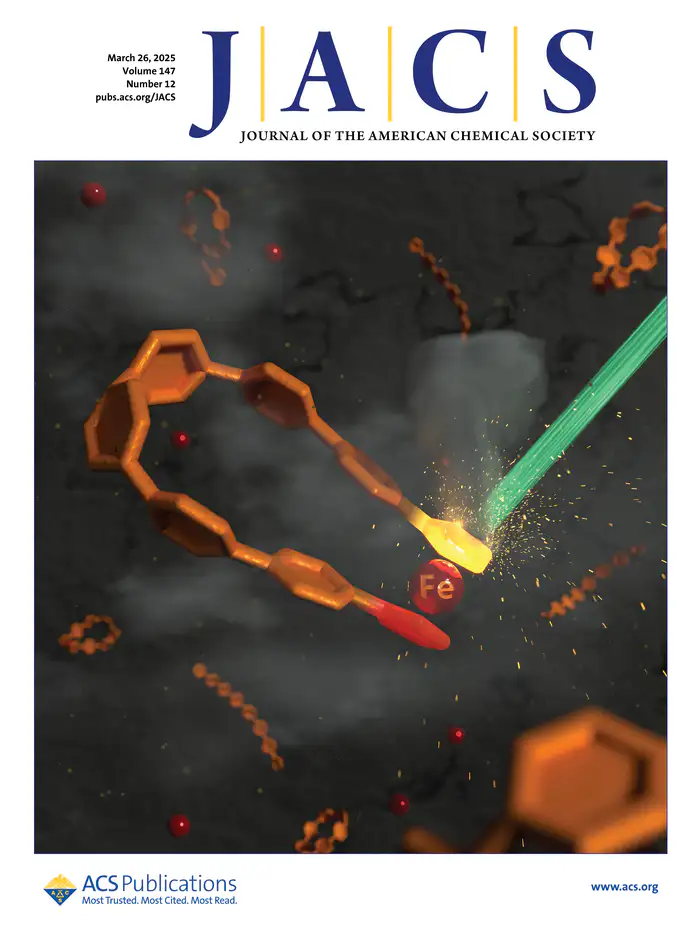
Dr. Tom Olomek at the University of Amsterdam and Dr. Peter Tacko at the University of Zurich have developed a novel carbon nanohoop system for controlled iron release using light. Their research, published in the Journal of the American Chemical Society (JACS), focuses on photocages and their application in regulating iron levels, crucial for biological processes like oxygen transport and energy production. The system integrates ferrocene into a strained carbon nanohoop, enabling efficient photorelease of iron ions upon green light exposure. This advancement offers potential applications in responsive materials development across supramolecular, organometallic, and polymer chemistry.
Drs. Tom Olomek and Peter Tacko’s research introduces a novel system for controlled iron release using a carbon nano hoops structure. This innovation addresses the critical need for precise regulation of iron in biological systems, where improper levels can lead to various health issues.
At the core of their work is ferrocene, an organometallic complex known for its stability. By embedding ferrocene into a strained carbon nanohoop, the researchers created a system that transforms this stable compound into one capable of controlled photorelease. The strain induced by the nanohoop structure makes ferrocene susceptible to light activation.
The mechanism involves green light irradiation, which triggers a structural change in the nanohoop. This leads to the release of Fe²⁺ ions with high efficiency, even in water-rich environments. The process is efficient, as evidenced by significant quantum yields, demonstrating the system’s capability for precise and controlled iron delivery.
Beyond its immediate application in biological systems, this technology holds potential for broader applications. It could serve as a foundation for developing responsive materials in fields such as supramolecular chemistry and polymer science, offering new avenues for material innovation and functionality.
The Carbon Nanohoop Structure
The carbon nanohoop structure developed by Drs. Tom Olomek and Peter Tacko consists of a cycloparaphenylene framework with six benzene rings, connecting two cyclopentadienyl ligands that encapsulate ferrocene. This configuration introduces significant strain into the system, transforming the inherently stable ferrocene complex into one capable of controlled photorelease.
This system’s efficiency is remarkable, as evidenced by quantum yields that demonstrate a threefold increase in reactivity compared to unstrained ferrocene systems. This enhancement underscores the effectiveness of the strained nano hoop structure in facilitating light-activated processes.
Photorelease Mechanism
Upon exposure to green light, the nanohoop undergoes an excited state transition into a triplet state. This state facilitates interaction with external ligands such as phenanthroline or water molecules, leading to bond dissociation and the release of Fe²⁺ ions in the form of [Fe(phen)₃]²⁺. The process is highly efficient, even in aqueous environments, making it suitable for biological applications.
Applications Beyond Iron Release
Beyond iron delivery, this technology opens avenues for controlling metal ion release across various scientific domains. Potential applications include advancements in supramolecular chemistry and polymer science, where responsive materials could be developed to meet diverse functional requirements.
The strain-induced photorelease mechanism involves embedding ferrocene into a carbon nanohoop structure, introducing significant mechanical stress. This strain transforms the stable ferrocene complex into one activatable by green light. Upon irradiation, the system undergoes an excited state transition to a triplet state, facilitating interaction with external ligands or solvent molecules. These interactions lead to bond dissociation and the release of Fe²⁺ ions in specific forms, such as [Fe(phen)₃]²⁺. The process is highly efficient, even in aqueous environments, making it suitable for applications requiring precise iron delivery. This mechanism effectively leverages strain to enable controlled photorelease, demonstrating a novel approach to metal ion regulation.
More information
External Link: Click Here For More