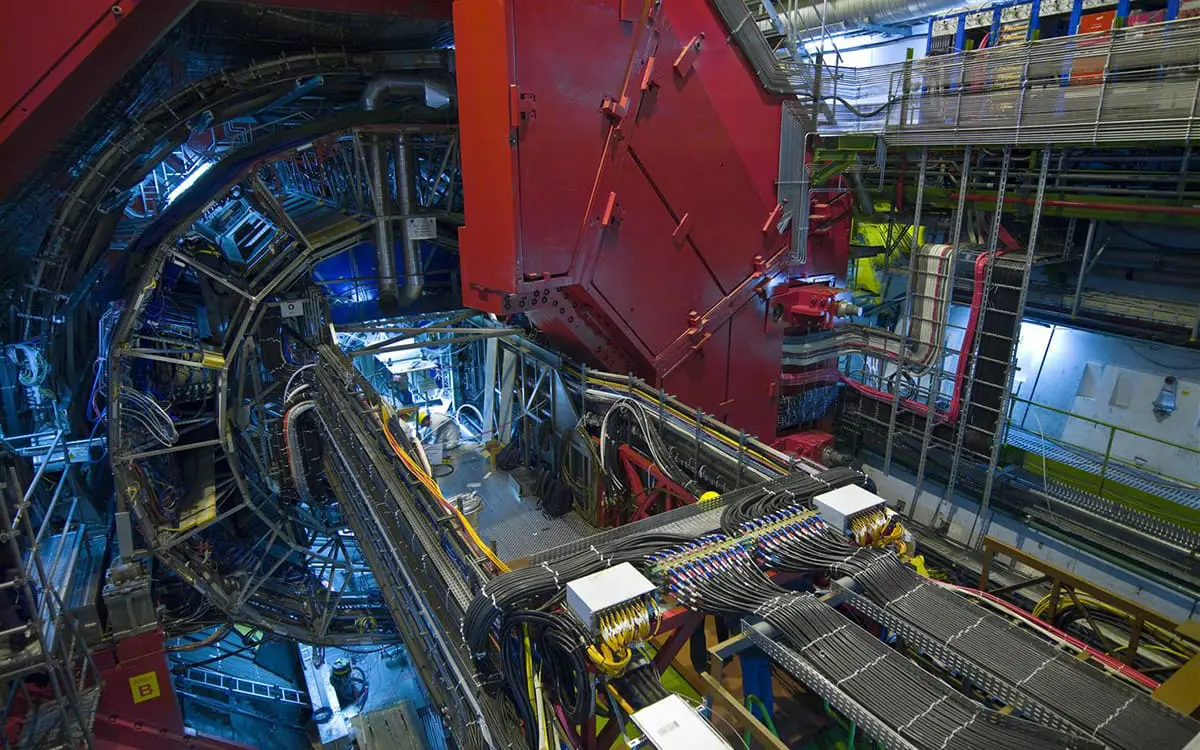
Researchers at the University of Kansas, led by experimental nuclear physicist Daniel Tapia Takaki, have made a groundbreaking discovery at CERN’s Large Hadron Collider. Using the ALICE experiment, they have found evidence of gluonic quantum fluctuations at the subnucleon level in heavy nuclei for the first time.
Gluons are elementary particles that hold quarks and anti-quarks together to form protons and neutrons, making up about 98% of visible matter in the universe. The team’s findings, published in Physical Review Letters, suggest a phenomenon called gluon saturation, where gluons become densely packed.
This discovery has significant implications for our understanding of quantum chromodynamics, the prevailing theory of quarks and gluons. The research was conducted in collaboration with the Prague ALICE team, led by Guillermo Contreras, and involved international cooperation between the University of Kansas and Czech Technical University in Prague.
Unveiling Gluonic Quantum Fluctuations at the Subnucleon Level
The Large Hadron Collider (LHC) at CERN has been instrumental in pushing the boundaries of our understanding of the universe. A recent breakthrough discovery by a team of physicists led by Daniel Tapia Takaki from the University of Kansas has shed light on the presence of gluonic quantum fluctuations at the subnucleon level in heavy nuclei. This finding, published in Physical Review Letters, marks a significant milestone in the study of Quantum Chromodynamics (QCD), the theory that describes the behavior of quarks and gluons.
Gluons, the elementary particles responsible for holding quarks and anti-quarks together to form protons and neutrons, play a crucial role in approximately 98% of all visible matter in the universe. The phenomenon of gluon saturation, a dynamic equilibrium between the production and annihilation of gluons, is predicted by QCD. However, experimental evidence is still needed to determine the onset of gluon saturation, which is one of the primary motivations for constructing dedicated QCD facilities such as the future Electron-Ion Collider at Brookhaven National Laboratory.
Probing Gluon Saturation through Ultra-Peripheral Heavy-Ion Collisions
Tapia Takaki’s team has been studying collisions between light particles (photons) and heavy nuclei to better understand how gluons behave when packed closely together. By focusing on the creation of a specific particle called a J/psi meson, made up of a charm quark and an antiquark, they have gained insights into the behavior of gluons in these high-energy collisions. The more energy in these collisions, the easier it is to detect what’s happening inside the nucleus.
One of the key discoveries based on data from the ALICE project suggests that these collisions show signs of gluon saturation, where gluons become densely packed. However, other experimental explanations like “shadowing” could also explain the results. To dig deeper, the KU team explored new ways to study this phenomenon at CERN, including looking at collisions where the J/psi meson is produced in a slightly different way.
Uncovering Gluonic Hotspots within Nuclei
The latest research from Tapia Takaki’s group has established several measured points of this rare process. The ALICE collaboration has shown that incoherent J/psi meson production can only be accurately described when introducing nucleon substructure fluctuations within nuclei in the form of gluonic hotspots into the models. These fluctuations, never seen before, are likely connected to the presence of gluonic saturated matter.
The team’s findings have significant implications for our understanding of QCD and the behavior of gluons at the subnucleon level. The discovery of gluonic quantum fluctuations opens up new avenues for research, including the study of ultra-peripheral heavy-ion collisions (UPCs). Tapia Takaki’s group has made leading contributions to this field, establishing a research community on UPCs and organizing the first international workshop on the physics of UPCs in Mexico last year.
Training the Next Generation of Physicists
The research was carried out in collaboration with the Prague ALICE team, led by Guillermo Contreras. The partnership between KU and Czech Technical University in Prague has facilitated this cooperation, providing valuable training opportunities for students. Graduate student David Grund from Prague contributed to this work during a research visit at KU, while Vendulka Filola is currently visiting KU to continue investigating incoherent J/psi with new data.
Future studies, with larger data samples, will provide a deeper understanding of gluon saturation effects and shed further light on the mysteries of QCD. The discovery of gluonic quantum fluctuations at the subnucleon level marks an exciting milestone in this journey, pushing the boundaries of our knowledge and paving the way for new breakthroughs in the field.
External Link: Click Here For More