

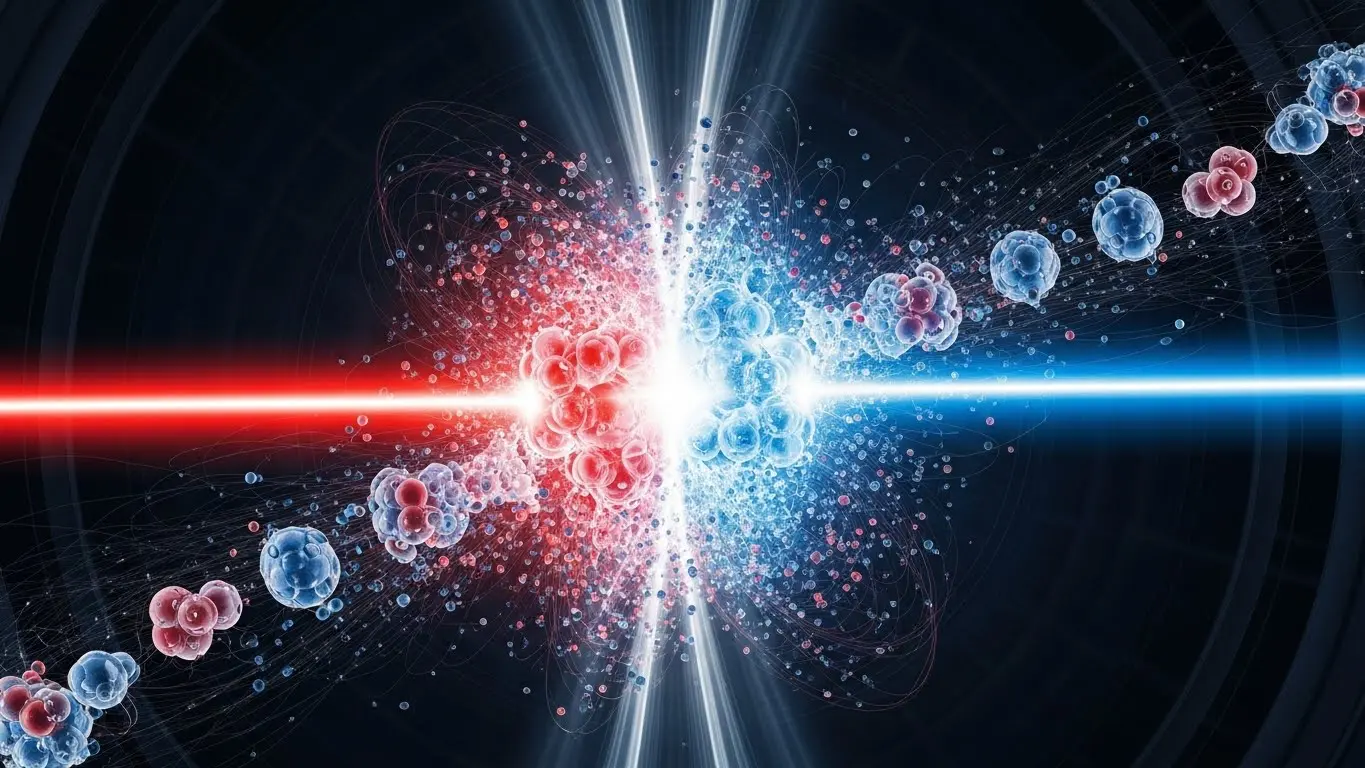
Prof. Krzysztof Kutak and Dr. Sandor Lokos from the Institute of Nuclear Physics of the Polish Academy of Sciences (IFJ PAN) in Cracow have validated a new model of hadron production using data collected from the LHC accelerator’s ALICE, ATLAS, CMS, and LHCb experiments. Their research demonstrates that the entropy of interacting quarks and gluons in high-energy proton collisions is virtually identical to the entropy of the resulting hadrons. This finding supports an improved dipole model—an evolution of dense gluon systems based on equations connected to complexity theory—which accounts for subleading effects relevant at lower collision energies. This confirms predictions regarding the behavior of partons during these interactions.
Proton Collisions and Quark-Gluon Interactions
High-energy proton collisions at the LHC involve quarks and gluons – particles within protons – undergoing complex interactions. These interactions create a “boiling sea” of quarks and gluons, including virtual particles, before “cooling down” and forming new hadrons. Researchers investigated whether the entropy – a measure of disorder – of these interacting partons differed from the entropy of the resulting hadrons. The study focused on understanding how entropy changes throughout the collision process, from the initial quark-gluon phase to the final hadron state.
The research team utilized data from the LHC’s ALICE, ATLAS, CMS, and LHCb experiments, covering collision energies from 0.2 to 13 teraelectronvolts. They employed a generalized dipole model—an existing framework for describing the evolution of dense gluon systems—to estimate parton entropy. Results indicate the generalized model accurately describes the data across a wider range of energies than previous models. This validated the hypothesis that the entropy of interacting quarks and gluons is virtually identical to the entropy of the hadrons produced.
Surprisingly, the study confirmed the Kharzeev-Levin formula, showing no significant entropy difference between the parton and hadron phases. This finding is linked to the unitarity of quantum mechanics – the principle that probability and information are conserved. While seemingly counterintuitive, this consistency with unitarity reinforces fundamental principles at play within these high-energy collisions. Future LHC upgrades and the Electron-Ion Collider will enable further investigation of these dense gluon systems.
Dipole Models and Entropy Estimation
Dipole models are used to describe the evolution of dense gluon systems in high-energy physics. These models represent each gluon as a quark-antiquark pair, forming a dipole with color charge. Scientists, including Prof. Kutak, have refined these models by expanding existing ones with subleading effects, improving accuracy at lower collision energies. This progress was achieved by recognizing a connection between the equations of dipole models and principles within complexity theory, allowing for more accurate entropy estimations of partons.
Researchers at IFJ PAN have confirmed that the entropy of interacting quarks and gluons in proton collisions is virtually identical to the entropy of the resulting hadrons. This finding validates a generalized dipole model, which more accurately describes data across a wide range of proton collision energies—from 0.2 to 13 teraelectronvolts—than previous models. The work, published in Physical Review D, utilizes data from the ALICE, ATLAS, CMS, and LHCb experiments at the LHC accelerator.
This surprising result aligns with the Kharzeev-Levin formula and is a consequence of the unitarity of quantum mechanics. Unitarity ensures the preservation of probability and information within quantum systems. While expected theoretically, observing this principle in real-world hadron data provides a strong confirmation of the underlying quantum framework governing these high-energy collisions and allows for entropy estimations of partons.
In high-energy physics, so-called dipole models have been used for some time to describe the evolution of dense gluon systems. These models assume that each gluon can be represented by a quark-antiquark pair that forms a dipole of two colours – here we are not talking about ordinary colours, but the colour charge that is a quantum property of gluons.
Prof. Krzysztof Kutak
Verification with LHC Collision Data
Recent research from the Institute of Nuclear Physics of the Polish Academy of Sciences (IFJ PAN) confirms the validity of a generalized dipole model through analysis of data from the LHC accelerator. Scientists, Prof. Krzysztof Kutak and Dr. Sandor Lokos, utilized collision data spanning from 0.2 to 13 teraelectronvolts—the LHC’s maximum energy—from the ALICE, ATLAS, CMS, and LHCb experiments. The results demonstrate the model more accurately describes existing data and functions across a wider range of collision energies than previous models.
The study focused on verifying whether the entropy of interacting quarks and gluons differs from the entropy of the hadrons produced in high-energy proton collisions. Findings indicate these entropies are virtually identical, aligning with the Kharzeev-Levin formula. This surprising result is linked to a fundamental principle of quantum mechanics: unitarity—the preservation of probability and information—and observed in real data on produced hadrons for the first time.
Further verification of the generalized dipole model is anticipated after the LHC accelerator upgrade and with data from the Electron–Ion Collider (EIC) currently under construction. The upgraded ALICE detector will allow study of denser gluon interaction areas, while the EIC—colliding electrons with protons—will enable the study of dense gluon systems within single protons, offering valuable data for validating the model’s predictions.
Unitarity and Quantum Mechanics Principles
Recent research from the Institute of Nuclear Physics of the Polish Academy of Sciences (IFJ PAN) confirms that the entropy of interacting quarks and gluons in high-energy proton collisions is virtually identical to the entropy of the resulting hadrons. This finding, presented in Physical Review D, validates a generalized dipole model—an evolution of previous models—by accurately describing data across a wide energy range, from 0.2 to 13 teraelectronvolts as measured by the LHC’s ALICE, ATLAS, CMS, and LHCb experiments.
The confirmation of this entropy equivalence is surprising to some physicists, but is fundamentally linked to the principle of unitarity in quantum mechanics. Unitarity dictates that the equations governing quantum system evolution must preserve the sum of probabilities of all transitions—meaning neither probability nor information can be created or lost. This principle, foundational to quantum chromodynamics, is now observed in real-world hadron collision data, providing insight into parton entropy across a range of energies.
Further verification of the generalized dipole model is planned with the upgraded LHC and the new Electron-Ion Collider (EIC). The improved ALICE detector will allow study of denser gluon interaction areas, while the EIC—colliding electrons with protons—will enable investigation of these dense systems within single protons. This will allow scientists to continue testing the implications of unitarity and refine our understanding of the complex interactions within proton collisions.


