The interaction between light and microscopic particles, known as levitated optomechanics, is rapidly emerging as a powerful platform for both fundamental physics research and the development of highly sensitive sensors. Researchers, including M. Rademacher and A. Pontin from University College London and CNR-INO respectively, alongside J. M. H. Gosling and colleagues, are now expanding this field by investigating not only the linear movement of these levitated objects, but also their rotational motion. This work recognises that these particles, unlike those studied in traditional optomechanics, possess six degrees of freedom, three translational and three rotational, and that controlling these additional movements unlocks a new realm of optomechanical interactions. By comprehensively examining this ‘roto-translational’ motion, the team demonstrates how it can be harnessed to enhance the precision of measurements, explore new quantum phenomena, and develop innovative characterisation techniques for microscopic particles, ultimately broadening the scope and potential of levitated optomechanics.
Levitated nanoparticles serve as a testing ground for fundamental physics and for the development of sensors with exquisite sensitivity. The system’s utility stems from its extreme isolation from the environment and the relatively few degrees of freedom that a levitated object possesses. Current work focuses on the three translational degrees of freedom, but understanding the induced rotational motion of levitated objects is becoming increasingly important, particularly in optical trapping fields, and also in magnetic and electric traps. These additional degrees of freedom offer a new avenue for exploration.
Optical Trapping, Levitation and Nanoparticle Control
Optical trapping and levitation utilize light, typically from lasers, to hold and manipulate microscopic objects. This technique forms the central theme of a growing body of research. Researchers employ optical forces to capture and control particles, often using hollow-core fiber loading for efficient capture. Sympathetic cooling, where nanoparticles are cooled by coupling them to colder media, is also a key technique. The interaction between multiple trapped particles, known as optical binding, is another area of investigation.
Utilizing counter-propagating beams of light enhances trapping and control. This research spans a wide range of applications, including precision measurement and sensing. Levitated particles function as highly sensitive gyroscopes and are being explored for gravitational wave and dark matter detection. They also serve as extremely sensitive force and displacement sensors. Furthermore, this field contributes to fundamental physics research, particularly in quantum mechanics.
Researchers are exploring macroscopic quantum phenomena, such as superposition and entanglement, with levitated particles, even creating Schrödinger cat states with macroscopic objects. They also investigate decoherence, the collapse of quantum superpositions, in macroscopic systems, and study systems driven far from equilibrium. Applications extend to materials science and nanotechnology, enabling precise nanoparticle manipulation and utilizing nanodiamonds as sensors and quantum systems. Levitated superfluid helium droplets are also under investigation. Optomechanics, the study of the interaction between light and mechanical motion, benefits greatly from levitated particles, which provide ideal systems for these studies.
Current research focuses on backaction suppression, reducing measurement disturbance, and mitigating thermal effects. Achieving and maintaining ultra-high vacuum is crucial for extending coherence times. Researchers are also exploring double-well potentials to enhance sensitivity and developing wideband trapping techniques. This rapidly evolving field aims to push the boundaries of sensing, measurement, and our understanding of the fundamental laws of nature.
Simultaneous Control of Translation and Rotation
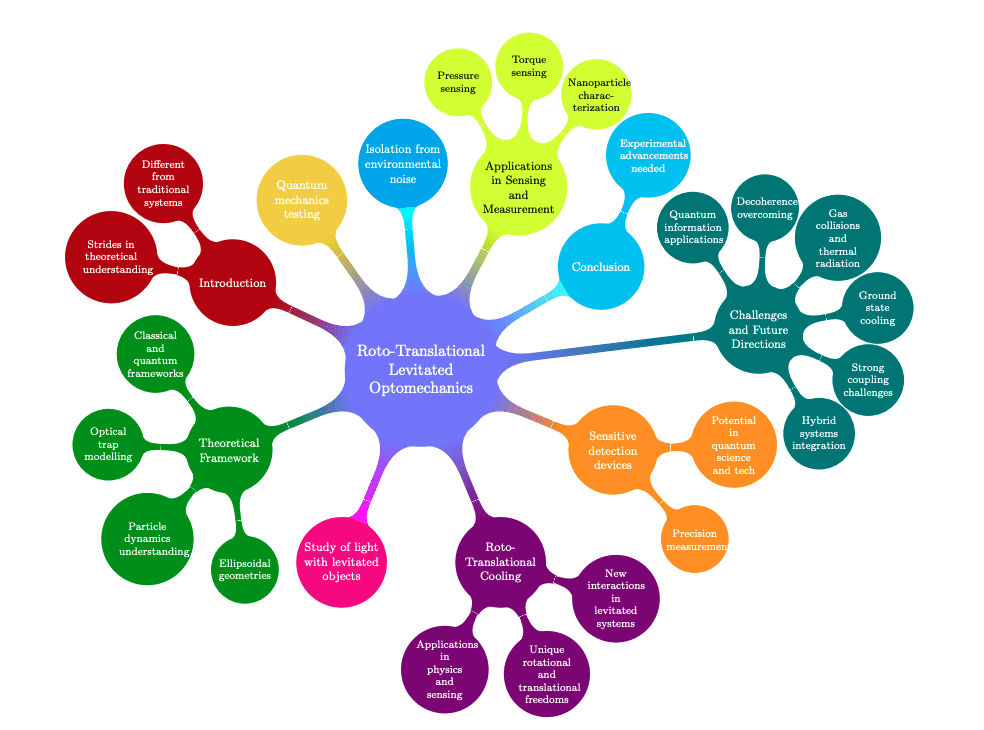
Levitated optomechanics explores the interaction between light and small objects suspended in a vacuum, offering a uniquely isolated platform for both fundamental physics research and the development of highly sensitive sensors. Unlike traditional optomechanical systems physically attached to supporting structures, levitated systems dramatically reduce environmental disturbances and simplify experimental control. While initial research focused on controlling the translational motion of these particles, recent work has expanded to investigate the simultaneous control of both translational and rotational motion, unlocking a richer set of physical phenomena. This combined roto-translational control is crucial because levitated particles possess inherent rotational degrees of freedom that significantly influence their behavior within optical traps.
Understanding and manipulating these rotations requires a sophisticated theoretical framework that bridges classical and quantum descriptions of particle dynamics, particularly for particles with complex, non-spherical shapes. Researchers have developed detailed models of how light interacts with these anisotropic particles, predicting how polarized light can induce and control both translational and rotational motion. Cooling these rotational and translational motions to extremely low temperatures enables precise manipulation and measurement of the particles’ position and orientation. This precise control opens up exciting possibilities for testing fundamental physics, including exploring the limits of quantum mechanics with macroscopic objects.
Furthermore, the extreme sensitivity of these systems makes them ideal candidates for developing novel sensors capable of detecting minute forces and torques. The isolation from environmental noise inherent in levitated systems allows for measurements with unprecedented precision. Researchers are exploring ways to integrate these systems with other technologies, such as nitrogen-vacancy centers in diamonds, to create hybrid quantum devices. Overcoming challenges related to achieving strong coupling between rotational and translational degrees of freedom, and mitigating decoherence effects, will be crucial for realizing the full potential of this field, particularly in the realm of quantum information processing and advanced sensing technologies.
Roto-Translational Dynamics in Levitated Optomechanics
Levitated optomechanics utilizes light to trap and control tiny objects, offering a uniquely isolated system for both fundamental physics research and sensor development. Researchers are expanding beyond studying only the linear motion of these levitated particles, increasingly focusing on their rotational movement and the interplay between rotation and translation. Understanding this combined roto-translational motion reveals new optomechanical interactions and broadens the potential applications of this technology. The work establishes a framework for analysing the induced rotational motion of anisotropic particles within optical traps, bridging classical and more formal theoretical approaches.
This allows for a deeper understanding of how particle shape influences the observed motion and how this motion can be controlled. Current research explores the creation of non-classical states of motion and the development of improved particle characterization techniques, demonstrating the growing sophistication of the field. Future work will likely focus on refining theoretical models and experimental techniques to address remaining challenges, and on exploring the potential of levitated optomechanics for quantum technologies and highly sensitive sensing applications.
👉 More information
🗞 Roto-translational optomechanics
🧠 ArXiv: https://arxiv.org/abs/2507.20905