The Julia Language is one of the most up-and-coming languages data scientists are raving about. It has many features that data scientists love and some built-in functions that can easily handle quantum ” stuff, ” such as linear algebra. Now, JuliaAcademy has made its Julia courses available for free. Here, we delve into the Julia Language to understand what it is, how it performs, and how you might use it in your project.
Julia is a high-level, high-performance dynamic programming language for technical computing. It has been designed with performance in mind, making it suitable for computationally intensive tasks. Julia’s syntax is clear and expressive, providing the ease of use found in languages like Python and MATLAB while delivering the computational power of languages like C or Fortran. One of Julia’s defining features is its ability to execute code written in multiple languages, providing an easy route for code integration.
Julia Language and its Key Capabilities
Beyond its performance benefits, Julia offers many built-in mathematical libraries and capabilities. Its rich ecosystem includes tools for linear algebra, statistics, optimization, machine learning, and more. This allows scientists and researchers to focus on the core challenges of their projects rather than getting bogged down in the technicalities of implementing mathematical and statistical functions.
Julia Langauge’s Contribution to Quantum Computing
Quantum computing is a cutting-edge field, and research in this area requires tools to handle the complexities of quantum mechanics. Julia is making a significant mark in this field due to its flexibility and performance. There are specific Julia packages, such as Yao.jl, QuTip.jl, and QuantumOptics.jl, that have been developed to support quantum computing simulations and research.
These packages facilitate the modeling of quantum circuits, quantum algorithms, and more, providing researchers with the tools to explore, experiment with, and push the boundaries of quantum computation. Additionally, the ease of interfacing with other languages in Julia ensures that researchers can integrate their quantum simulations with other critical systems, databases, or visualization tools without much hassle.
Key Features of the Julia Language Compared to Python
Performance: Julia has been designed for high performance from the ground up. Thanks to its just-in-time (JIT) compiler, it can approach and sometimes even match the performance of languages like C or Fortran.
- Dynamic Typing: Just like Python, Julia is dynamically typed. This provides flexibility in writing code without having to specify data types explicitly.
- Native Parallelism and Concurrency: Julia was built with parallelism and concurrency in mind, offering native tools to handle multiple tasks simultaneously.
- Ease of Use: With a syntax familiar to users of other scientific computing environments, many find Julia intuitive and user-friendly.
- Interoperability with Other Languages: Julia can easily call C, Fortran, and Python functions, making it a versatile tool for projects that might span across different languages.
- Rich Standard Library: Julia’s standard library provides a wide array of mathematical functions and operations, making it an ideal choice for scientific computations.
- Open Source: Just like Python, Julia is open source. This ensures a transparent, community-driven approach to its development.
- Multiple Dispatch: This feature enables method definitions for a function to be based on multiple argument types, leading to highly generic yet efficient code.
- Macro System: Julia has a powerful macro system, reminiscent of Lisp, allowing developers to generate code programmatically.
- Community and Packages: The Julia community is active and vibrant, continuously contributing packages that enhance its capabilities. For quantum computing, there are several Julia packages available to aid researchers in their work.
Julia Language Courses and Certificates
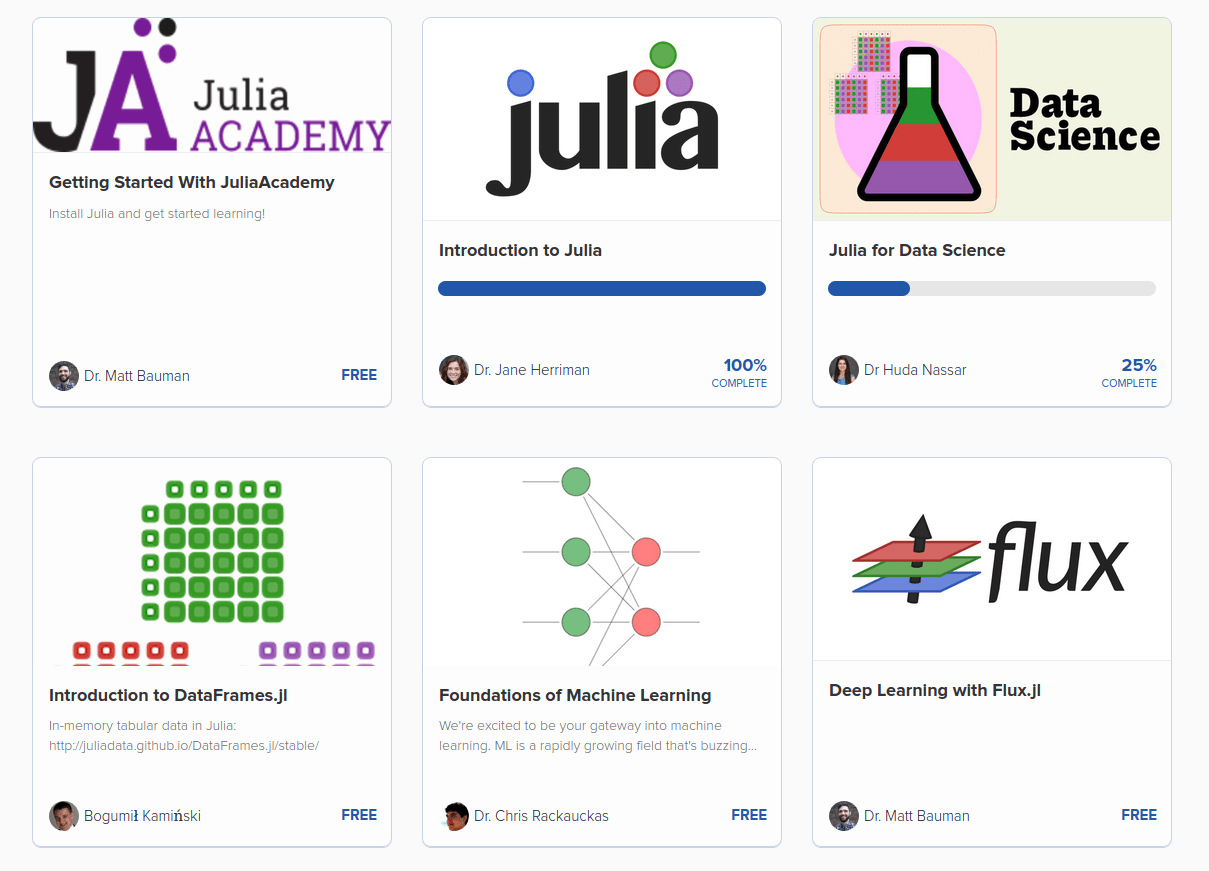
What better way of learning about the Julia Language than with a course which aims to teach you the everything from the fundamentals to the applications where you can apply that new knowledge to areas like quantum computing. Maybe you have a project in mind, or simply want a toy project to cement that knowledge. Julia provides a number of online courses to help you learn the Julia Language, and these are typically available free. So if you are looking to start a new project or thinking about an alternative to the Python Language, you might just consider the Julia Language and get some help with the Julia Academy.