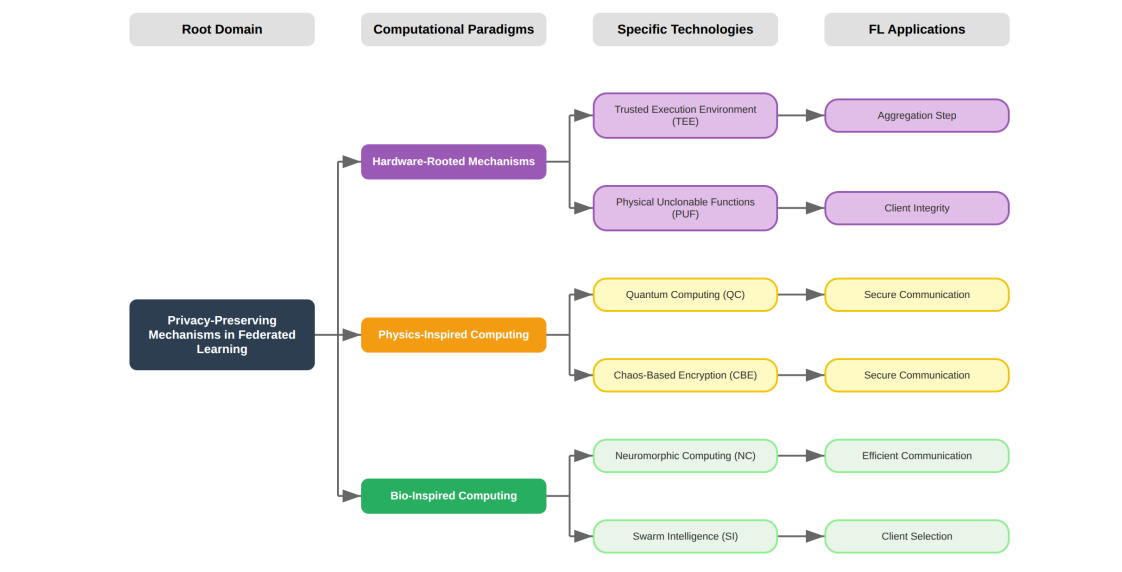
Federated Learning offers a powerful new approach to collaborative machine learning, enabling model training across vast networks of devices while preserving data privacy, and is increasingly important for harnessing the potential of the Internet of Things. However, current privacy-preserving techniques often create significant computational burdens and struggle to scale effectively. Amr Akmal Abouelmagd and Amr Hilal, both from Tennessee Technological University, investigate emerging paradigms that promise to overcome these limitations, exploring technologies such as Trusted Execution Environments, Physical Unclonable Functions, and innovative approaches based on chaos theory and swarm intelligence. This research assesses the strengths and weaknesses of each technology within the Federated Learning framework, providing a valuable roadmap for building secure and scalable systems that can unlock the full potential of decentralised data.
Centralised data collection presents challenges for leveraging the power of the Internet of Things while maintaining data privacy. Existing privacy-preserving techniques, such as multi-party computation, homomorphic encryption, and differential privacy, often struggle with high computational costs and limited scalability. FL allows machine learning models to train on decentralised data without directly sharing it, but vulnerabilities remain. This work investigates a range of technologies aimed at mitigating these risks, falling into categories including hardware-based security, quantum computing, and software-based algorithmic approaches. Hardware-rooted security leverages trusted execution environments and physical unclonable functions to protect data, while quantum computing explores stronger security guarantees. Software approaches refine existing techniques like differential privacy, and swarm intelligence and Byzantine fault tolerance enhance robustness against malicious actors.
Researchers are actively investigating trusted execution environments to create secure enclaves for processing sensitive data during FL. Physical unclonable functions, unique hardware fingerprints, offer authentication and key generation capabilities. Neuromorphic computing, utilising chips like IBM’s TrueNorth and Loihi, explores inherent privacy advantages within spiking neural networks. Swarm learning, a decentralised approach, leverages swarm intelligence for robust and secure model training. This research highlights the need to combine different security technologies to achieve robust privacy and security in FL. No single solution is likely to be sufficient, and emphasis is placed on designing solutions considering both hardware and software aspects. A major focus is on developing FL systems resilient to various attacks, including data poisoning and model inversion, while addressing the challenges of scaling systems to handle large datasets while maintaining privacy and security. Researchers investigated several technologies, revealing significant advancements in secure and scalable FL systems. Specifically, the study focuses on hardware-rooted mechanisms, demonstrating how trusted execution environments can dramatically improve performance. Experiments utilising TEEs achieved a two to ten-fold speedup in multi-round aggregations while simultaneously verifying results, a substantial improvement over existing methods. This acceleration stems from the ability of TEEs to securely store and manage shared keys, allowing for one-step unmasking and verification of model updates without intensive computation within the secure environment, effectively overcoming memory bottlenecks.
Further research introduced FLSecure, a hybrid FL framework integrating blockchain with TEEs to create a more reliable, secure, transparent, scalable, and decentralised system. By leveraging TEEs for secure aggregation within isolated hardware environments, local model updates are protected from unauthorised access and data integrity is maintained. This multi-TEE strategy divides the global aggregation task into smaller subtasks, executed simultaneously, further enhancing efficiency. Researchers are investigating emerging paradigms to enhance both the privacy and efficiency of this distributed learning approach. This work examines the potential of techniques including trusted execution environments, physical unclonable functions, quantum computing, chaos-based encryption, neuromorphic computing, and swarm intelligence within the federated learning pipeline. Each paradigm offers unique strengths and limitations regarding privacy protection, computational cost, and practical implementation.
The investigation reveals that these approaches are at varying levels of maturity, and their value lies in expanding the available toolkit for different application contexts, rather than replacing established methods. Researchers emphasise the need for further refinement and validation under real-world conditions to clarify the trade-offs involved. Future work should focus on translating the conceptual potential of these paradigms into reliable and deployable solutions, and exploring hybrid architectures that integrate multiple approaches to maximise their combined utility and achieve efficient, secure federated learning systems.
👉 More information
🗞 Emerging Paradigms for Securing Federated Learning Systems
🧠 ArXiv: https://arxiv.org/abs/2509.21147