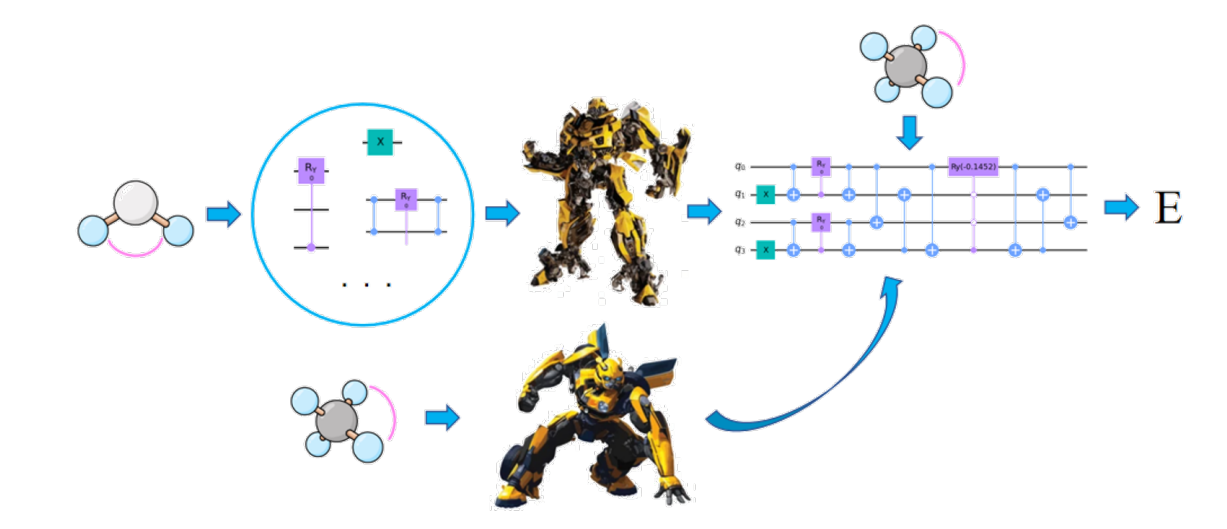
Calculating the ground-state energies of molecules remains a significant challenge in computational chemistry, and researchers continually seek more efficient methods beyond traditional Variational Eigensolver algorithms. Zhi Yin from QureGenAI(AceMapAI) Biotechnology, Ningbo University of Technology, Xiaoran Li, and Shengyu Zhang from Tencent Quantum Lab, along with Xin Li and Xiaojin Zhang from QureGenAI(AceMapAI) Biotechnology, China Pharmaceutical University, now demonstrate a novel approach to this problem using a technique inspired by SMILES notation, a common method for representing molecular structures as text. The team developed a system that represents quantum operators as text, allowing the framework to identify similarities between operators for different molecules and transfer knowledge between them. This transfer learning framework, implemented within a Generative Eigensolver paradigm, substantially reduces the computational cost of ground-state energy calculations, offering a promising pathway towards more efficient hybrid classical-quantum computation for complex molecular systems.
This innovative method focuses on the Unitary Coupled Cluster with Single and Double Excitations (UCCSD), a core technique in quantum chemistry, and aims to reduce the computational cost of simulating molecular systems. By treating these operators as sequences of characters, researchers can quantify similarities between molecules and leverage this knowledge to accelerate calculations, exploring the use of transformer networks to encode and process these textual representations. This approach establishes a framework for transferring knowledge between different molecular systems, potentially eliminating the need for extensive training datasets. The method involves representing quantum operators as strings and then comparing these strings using metrics that quantify their similarity, allowing the team to apply a generative quantum eigensolver (GQE) algorithm more efficiently. The study’s innovation centers on representing quantum operators, specifically those generated by the UCCSD ansatz, as textual patterns. Inspired by the Simplified Molecular Input Line Entry System (SMILES) commonly used in cheminformatics, researchers treat these operators as structured text, allowing them to quantify similarities between operators across different molecules. This approach establishes mappings between source and target molecules, preserving functional relationships while accommodating variations in dimensionality within the GQE model. Experiments demonstrate that this text-based similarity metric facilitates knowledge transfer between molecular systems for ground-state energy calculations, significantly reducing the computational resources required for accurate predictions.
Quantum Circuits Encoded as Text for Transfer Learning
Scientists have developed a novel method for representing quantum operators as text, inspired by the SMILES notation used in computational chemistry, to enable transfer learning within hybrid quantum-classical computations. This work addresses the computational cost of constructing unique operators for each molecular system by leveraging similarities between molecules. The team successfully encoded UCCSD circuits as strings, capturing essential information about each quantum operation, including operation type, parameter values, and acted-upon qubits. This textual representation allows quantum operators to be treated as tokens, opening the door to applying language model techniques to quantum circuit generation.
Experiments demonstrate that this approach enables knowledge transfer between different molecular systems for ground-state energy calculations within a GQE framework. The method utilizes string similarity metrics to quantify the degree of correspondence between operators in source and target molecules, reducing computational redundancy for similar molecules. This baseline implementation establishes methodological feasibility and provides a benchmark for future refinements.
Knowledge Transfer Between Quantum Molecular Systems
This work introduces a novel framework for representing and transferring knowledge between quantum operators, specifically within the UCCSD ansatz used in hybrid quantum-classical computation. Researchers successfully treated these operators as text strings, enabling the establishment of mappings between different molecular systems based on inherent similarities. The results demonstrate that quantum circuit knowledge can be effectively transferred, significantly reducing computational demands while maintaining performance for molecules with comparable structures. This achievement represents a substantial step towards practical quantum-classical algorithms for calculating molecular ground-state energies. By leveraging similarities between molecules, the team reduced the computational resources needed, as evidenced by time reductions observed in their experiments. While the initial findings were obtained using a deliberately conservative approach with a basic implementation, the team highlights the significant potential for further optimization, acknowledging limitations related to the granularity of the text-based representation and the inherent temporal ordering of quantum circuits, suggesting that enhancements to these aspects will likely yield further performance improvements.
🗞 SMILES-Inspired Transfer Learning for Quantum Operators in Generative Quantum Eigensolver
🧠 ArXiv: https://arxiv.org/abs/2509.19715