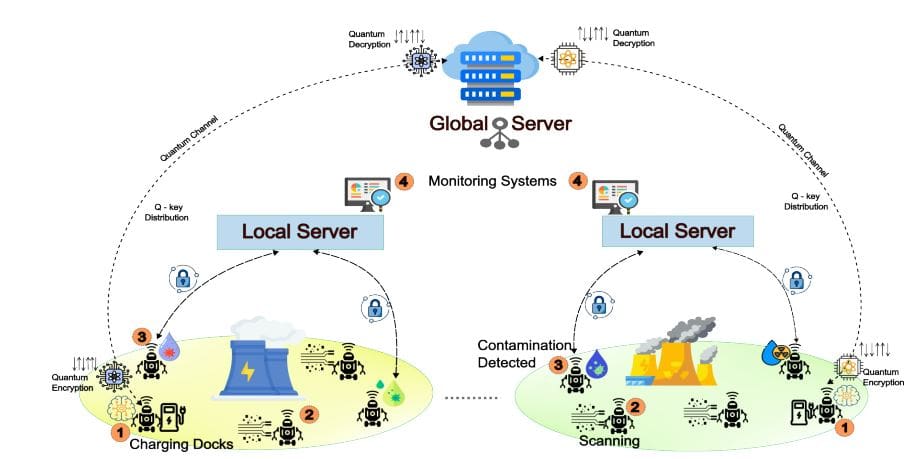
The increasing need for robust safety measures in nuclear power plants drives innovation in remote monitoring and hazard detection, and a team led by Sai Puppala from Southern Illinois University Carbondale and Ismail Hossain and Md Jahangir Alam from the University of Texas at El Paso, et al., presents a significant advance in this field. They introduce Optimus-Q, an adaptive robot designed to autonomously monitor air quality and detect contamination within nuclear facilities, offering a proactive approach to hazard mitigation. The system continuously streams environmental data, predicting potentially dangerous gas emissions, and crucially, employs a federated learning approach that allows multiple robots across different plants to collaboratively improve their predictive accuracy without sharing sensitive data directly. By integrating this with quantum key distribution, the team ensures secure communication of critical operational information, establishing a new standard for safety and responsiveness in hazardous environments.
Robotic Safety, Federated Learning, and Quantum Security
This paper details the design and potential of the Optimus-Q robotic system, integrating robotics, federated learning, and quantum key distribution to address critical needs in high-risk environments like nuclear power plants. The system demonstrates a novel approach to data privacy and distributed intelligence, presenting a comprehensively designed architecture from sensor data acquisition and processing to secure data transmission and model aggregation, with a well-defined contamination detection process. The research justifies the need for such a system, highlighting the risks associated with nuclear power plants and the limitations of traditional monitoring methods, and demonstrates a thoughtful approach to assessing the system’s effectiveness. While the current work relies heavily on simulated results, further detail regarding the specifics of the quantum key distribution implementation, including key generation rate and distance limitations, would strengthen the work.
A more in-depth discussion of the federated learning algorithm used, including the model architecture and strategies for handling non-IID data, would also be beneficial. Considering fault tolerance, addressing how the system would operate in the event of a robot failure, and including a cost analysis of deploying and maintaining the Optimus-Q system would provide valuable insight into its economic feasibility. Future work should prioritize conducting real-world testing of the Optimus-Q system in a controlled environment to identify potential challenges. Providing more details about the quantum key distribution implementation, including mitigation strategies for environmental interference, would also strengthen the work.
Elaborating on the federated learning algorithm used, including strategies for handling non-IID data, would further enhance the research. Discussing fault tolerance mechanisms, such as redundancy and error detection, would address critical reliability concerns. Including a cost analysis of the system, considering hardware, software, deployment, and maintenance, would assess its economic viability.
Robotic Federated Learning for Nuclear Monitoring
The research team engineered the Optimus-Q robot, a sophisticated system designed for autonomous air quality monitoring and contamination detection within nuclear power plants. The robot continuously streams real-time environmental data, specifically monitoring for carbon dioxide, carbon monoxide, and methane, using advanced infrared sensors to predict hazardous gas emissions. To ensure comprehensive coverage, the robot systematically navigates predefined bounding boxes, enabling efficient monitoring of critical areas and optimizing contamination detection processes. A key innovation lies in the implementation of a federated learning approach, allowing the Optimus-Q robot to collaboratively learn from data collected across multiple nuclear power plants without compromising data privacy, creating a global model that significantly enhances its predictive capabilities.
Scientists integrated Quantum Key Distribution (QKD) to secure data transmission between the robot and centralized control systems. This quantum cryptographic technique leverages the principles of quantum mechanics to detect any attempts at eavesdropping, safeguarding sensitive operational information and ensuring data integrity. Through simulations and real-world experiments, the team validated the effectiveness of the Optimus-Q robot, demonstrating its potential to revolutionize monitoring systems and enhance operational safety within nuclear facilities. The study pioneers a robust framework combining adaptive learning, predictive analytics, and secure quantum communication, essential for addressing the unique challenges presented by hazardous environments.
Robotic Monitoring Detects Gases, Improves Safety
The Optimus-Q robot represents a significant advancement in nuclear power plant (NPP) monitoring, delivering enhanced safety and operational efficiency through autonomous data collection and secure communication. This work introduces a robotic system equipped with advanced infrared sensors capable of continuously streaming real-time environmental data, specifically identifying hazardous gases including carbon dioxide, carbon monoxide, and methane. Experiments demonstrate the robot’s ability to detect these gases in real-time, facilitating timely safety measures and proactive hazard mitigation within NPP environments. The research team implemented a federated learning approach, enabling Optimus-Q to collaborate with other systems across multiple NPPs and improve its predictive capabilities without compromising data privacy.
Simulations across two NPP setups demonstrate that Optimus-Q significantly improves contamination monitoring accuracy and efficiency, representing a substantial improvement over traditional methods. Furthermore, the integration of Quantum Key Distribution (QKD) strengthens data security during model exchange, addressing critical information security concerns inherent in sensitive operational environments. This ensures secure communication and protects vital data from unauthorized access. The system’s methodology combines systematic navigation patterns with algorithms to facilitate efficient coverage of designated areas, optimizing contamination monitoring processes and maximizing data collection effectiveness. This achievement illustrates the potential of combining robotics, federated learning, and quantum-secured communication to build intelligent, resilient monitoring systems for high-stakes environments.
Robotic System Enhances Nuclear Plant Safety
This research presents Optimus-Q, an advanced robotic system designed to significantly improve safety and monitoring capabilities within nuclear power plants. The team successfully integrated real-time environmental data processing, predictive analytics, and secure communication protocols into a single, autonomous platform. Through simulations conducted across multiple plant setups, Optimus-Q demonstrates enhanced accuracy and efficiency in contamination monitoring, identifying hazardous gases such as carbon dioxide, carbon monoxide, and methane. A key achievement lies in the system’s federated learning approach, which allows the robot to improve its predictive capabilities by learning from data across different nuclear facilities without compromising data privacy.
Furthermore, the incorporation of Quantum Key Distribution strengthens data security during model exchange, addressing critical information security concerns inherent in these sensitive environments. The authors acknowledge that future work will focus on deploying Optimus-Q in physical testbeds, optimising the latency of the quantum key distribution system, and expanding the framework to incorporate multi-modal sensing and decision-support capabilities. This work illustrates the potential of combining robotics, federated learning, and quantum-secured communication to create intelligent and resilient monitoring systems for high-stakes environments.
👉 More information
🗞 Optimus-Q: Utilizing Federated Learning in Adaptive Robots for Intelligent Nuclear Power Plant Operations through Quantum Cryptography
🧠 ArXiv: https://arxiv.org/abs/2511.15614