

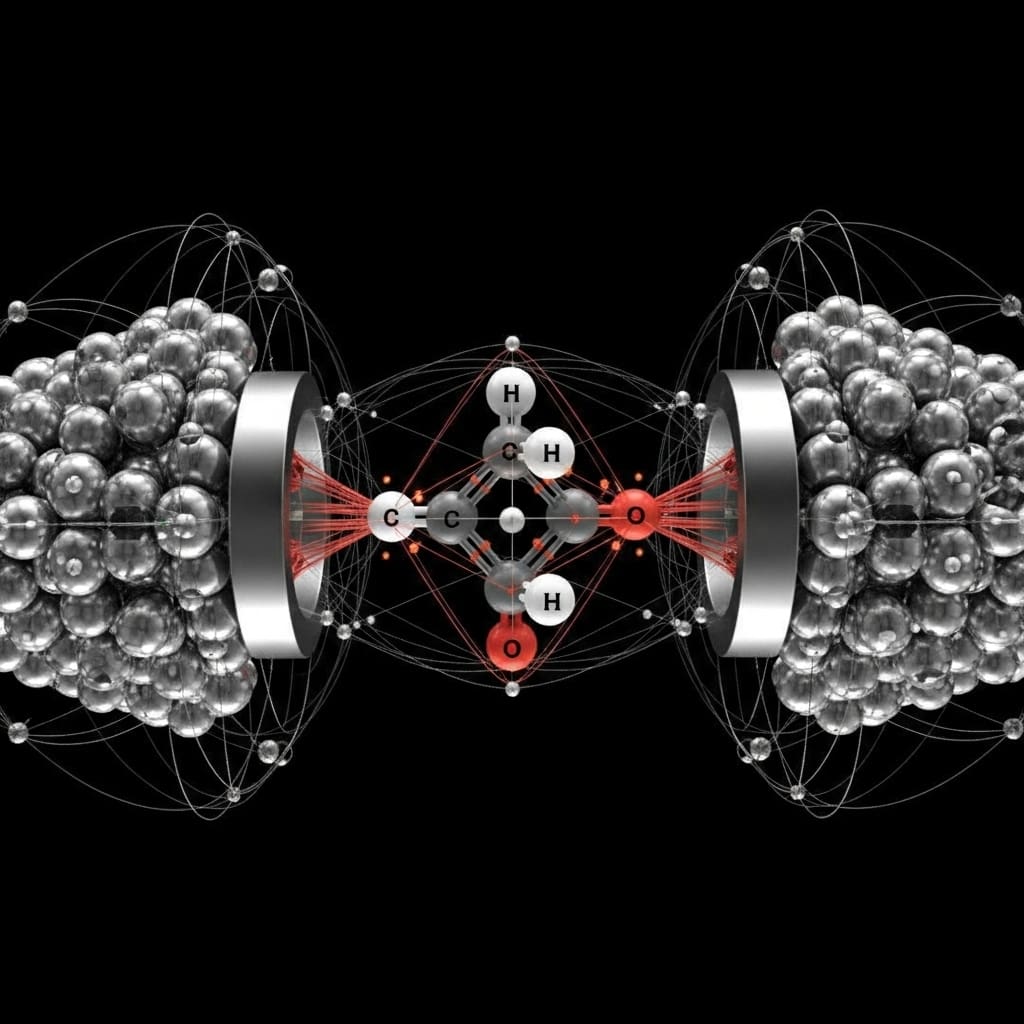
Scientists are tackling the long-standing problem of quantitatively determining the microscopic properties of molecular magnets using scanning tunneling spectroscopy. Greta Lupi, Adolfo O Fumega, and Mohammad Amini, all from the Department of Applied Physics at Aalto University, alongside R Drost, P Liljeroth, and Jose L Lado et al, have pioneered a new machine learning strategy called molecular Hamiltonian learning. This innovative approach directly infers the Hamiltonian parameters of single adsorbed molecules from setpoint-dependent scanning tunneling spectroscopy data , essentially, how the spectra change with tip distance. By training the algorithm on theoretical spectra incorporating crucial effects like spin-orbit coupling, this research establishes a flexible and automated method for reconstructing Hamiltonians, transforming spectroscopy into a powerful tool for atomic-scale quantitative characterisation.
Learning Molecular Hamiltonians from STM-IETS data
This breakthrough addresses a fundamental challenge in quantitatively extracting detailed information about a molecule’s spin and orbital excitations, traditionally requiring complex manual analysis and restrictive assumptions. This innovative technique transforms setpoint-dependent spectroscopy from a qualitative observation into a quantitative tool for understanding molecular quantum magnetism, molecular spintronics, and the potential for molecular spin qubits. The study establishes that the Hamiltonian can be described by a combination of crystal field, Coulomb interaction, and spin-orbit coupling terms, each contributing to the observed excitation spectrum. Specifically, the crystal field Hamiltonian is decomposed into setpoint-independent and setpoint-dependent components, allowing the algorithm to disentangle intrinsic molecular properties from tip-induced perturbations.
This approach allows for the extraction of key parameters such as crystal field splitting, spin, orbit coupling strength, orbital energies, and substrate-induced orbital mixing, all crucial for understanding the molecule’s electronic structure and its response to external stimuli. Importantly, the algorithm’s reliance on theoretical training data ensures its robustness and applicability to a wide range of molecular systems, paving the way for automated, quantitative characterization of nanoscale quantum phenomena and accelerating the development of advanced molecular devices. This training phase generated a comprehensive library of theoretical spectra against which experimental data could be compared and analysed. Experiments employed a realistic multiorbital model to simulate the behaviour of FePc on SnTe, accurately capturing the complex interplay of quantum mechanical effects. The methodology describes a multiorbital Hamiltonian, expressed as H = HCF(z) + HCoulomb + HSOC, where HCF(z) represents the crystal field Hamiltonian dependent on tip-sample distance, HCoulomb describes many-body Coulomb interactions, and HSOC accounts for spin-orbit coupling. This approach enables the extraction of key quantities, including crystal field splitting, spin-orbit coupling strength, orbital energies, and substrate-induced orbital mixing, offering unprecedented insight into the electronic structure of adsorbed molecules.
Machine learning decodes molecular Hamiltonians from STM-IETS data
Data shows the algorithm’s flexibility and automation in reconstructing Hamiltonians, transforming setpoint-dependent spectroscopy into a quantitative tool for nanoscale analysis. Results demonstrate the successful application of this methodology to FePc on SnTe, allowing scientists to map interfacial screening, chemical gating, and substrate coupling effects. Tests prove the algorithm’s capability to discern subtle interactions within nanoscale quantum many-body systems. The breakthrough delivers a versatile route to uncover microscopic quantum behavior at the single-molecule limit, with potential applications extending beyond SnTe to various materials and interfaces.
Measurements of the extracted parameters provide insights into the electronic structure and magnetic properties of the adsorbed molecule and its interaction with the substrate. Scientists recorded that the source code and datasets are publicly available, facilitating further research and development in this field. The study acknowledges financial support from the European Research Council and the Research Council of Finland, alongside contributions from the InstituteQ, Jane and Aatos Erkko Foundation, Finnish Centre of Excellence in Quantum Materials QMAT, and the Finnish Quantum Flagship. This work positions STM-enabled Hamiltonian learning as a powerful technique for probing the quantum world at the atomic scale, promising advancements in molecular spintronics and materials science.
Machine learning infers molecular parameters from STM-IETS data
This represents a significant advancement in the field, transforming setpoint-dependent spectroscopy from a qualitative observation into a quantitative analytical technique. The authors acknowledge a limitation in that the current implementation relies heavily on the accuracy of the initial theoretical model used for training, and further refinement may be needed to account for more complex molecular systems or surface conditions. Future research could focus on extending the algorithm to analyse a wider range of molecules and substrates, and on incorporating experimental data directly into the training process to improve its robustness and generalizability.
👉 More information
🗞 Molecular Hamiltonian learning from setpoint-dependent scanning tunneling spectroscopy
🧠 ArXiv: https://arxiv.org/abs/2601.19371


