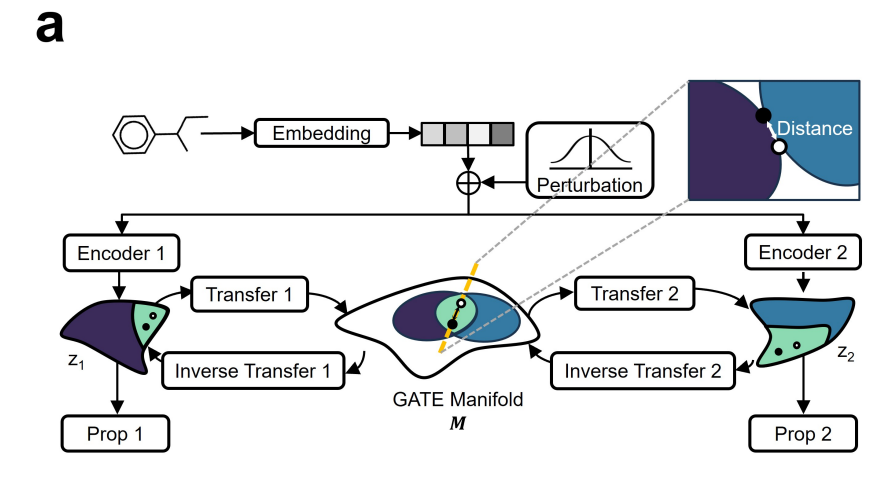
Artificial intelligence increasingly accelerates the search for new materials, but current models often struggle when applied to problems beyond their initial training. Hyunseung Kim, Dae-Woong Jeong, and Changyoung Park, along with their colleagues, address this limitation by presenting GATE (Geometrically Aligned Transfer Encoder), a new AI framework that learns 34 different material properties simultaneously. This approach allows GATE to identify relationships between these properties, reducing errors that commonly occur when evaluating materials based on multiple criteria, and significantly improving the efficiency of materials screening. To demonstrate its versatility, the team applied GATE to a challenging real-world problem, the discovery of effective immersion coolants for data centres, ultimately identifying over 92,000 promising candidate molecules, with four demonstrating performance comparable to, or exceeding, existing commercial coolants through experimental validation. These results establish GATE as a broadly applicable platform, poised to accelerate discovery across a wide range of materials science challenges.
Artificial intelligence has emerged as a powerful accelerator of materials discovery, yet most existing models remain problem-specific, requiring additional data collection and retraining for each new property. By aligning these properties within a shared geometric space, GATE captures cross-property correlations that reduce disjoint-property bias, a key factor causing false negatives in multi-criteria screening. The framework effectively predicts properties with high accuracy and significantly improves the efficiency of materials screening processes, offering a substantial advancement in computational materials science.
AI Predicts Novel Immersion Cooling Fluids
This research details the development and application of an AI-driven platform for the rapid discovery of novel immersion cooling fluids. Researchers developed GATE (Geometrically Aligned Transfer Encoder) to predict the properties of potential immersion cooling fluids, allowing for in silico screening of a vast chemical space and accelerating the discovery process. The AI platform screened millions of compounds to identify promising candidates, and synthesized compounds largely matched the AI-predicted properties, demonstrating the model’s accuracy. The research identified several compounds that outperform existing immersion cooling fluids, and the AI-driven approach significantly reduced the time and cost associated with discovering new materials. This demonstrates the potential of AI to accelerate materials discovery and highlights the benefits of multi-task learning and geometric representations for molecular property prediction.
AI Learns 34 Material Properties Simultaneously
Scientists have developed GATE, a new artificial intelligence framework that simultaneously learns 34 distinct physicochemical properties, encompassing thermal, electrical, mechanical, and optical characteristics. This innovative approach aligns molecular representations across different properties, enabling knowledge transfer and reducing disjoint-property bias. The work establishes a generalizable AI platform applicable across diverse materials discovery tasks without the need for problem-specific retraining. Experiments demonstrate GATE’s capability in discovering immersion cooling fluids, confirming four molecules with performance comparable to, or exceeding, existing commercial coolants. The framework’s strength lies in its ability to learn correlations between properties, improving prediction accuracy, particularly when data is limited. By training on an expert-curated set of 34 properties, GATE functions as a unified foundation for accelerating materials discovery across multiple domains.
Geometric Alignment Accelerates Materials Discovery
This research demonstrates a significant advance in artificial intelligence for materials discovery with the development of GATE, a generalizable framework capable of simultaneously learning 34 diverse physicochemical properties. By aligning these properties within a shared geometric space, GATE captures crucial correlations often missed by conventional, single-task learning models, thereby reducing the tendency to identify false positive candidates. Validating this approach, the team successfully applied GATE to the challenging real-world problem of discovering immersion cooling fluids, identifying tens of thousands of promising molecules without any model retraining. The results show that GATE consistently outperforms single-task learning, achieving improvements in correlation with experimental values for specific heat capacity. The study highlights and mitigates the issue of “disjoint-property bias”, where independently trained models often fail to identify compounds that satisfy multiple criteria simultaneously.
🗞 Towards a Generalizable AI for Materials Discovery: Validation through Immersion Coolant Screening
🧠 ArXiv: https://arxiv.org/abs/2510.23371