

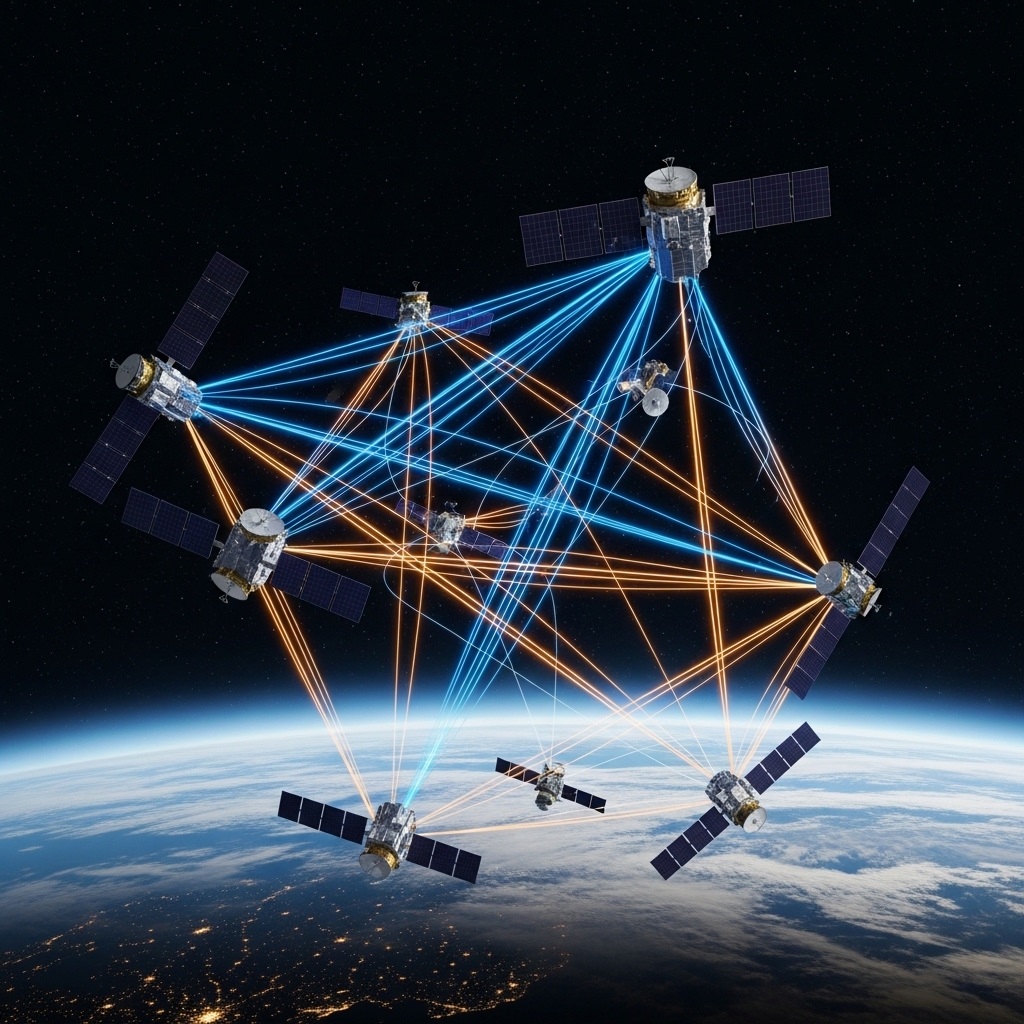
Researchers are tackling the complex challenge of managing connectivity and data routing within low Earth orbit (LEO) mega-constellations, crucial for expanding global communications. Zhouyou Gu, alongside Jinho Choi from the University of Adelaide, and Tony Q. S. Quek, Jihong Park et al. from the Singapore University of Technology and Design, present a novel approach to optimise laser inter-satellite link (LISL) management, addressing limitations imposed by equipment constraints and constantly changing network topologies. Their work is significant because it introduces DeepLaDu, a deep learning framework guided by Lagrangian duality, which allows for real-time, scalable solutions to joint connectivity, routing, and flow-rate allocation , achieving up to 20% higher throughput than existing methods while dramatically reducing computational time.
DeepLaDu optimises LEO satellite laser networks for improved
Scientists have developed a new deep learning framework, DeepLaDu, to optimise laser inter-satellite links (LISLs) in low Earth orbit (LEO) mega-constellations, enabling high-capacity backbone connectivity for non-terrestrial networks. The research addresses the complex challenge of managing these networks, which are hampered by limited laser communication terminals, mechanical pointing constraints, and rapidly changing network topologies. This work focuses on the joint optimisation of LISL connection establishment, traffic routing, and flow-rate allocation, considering heterogeneous global traffic demand and the availability of gateway access points. Researchers formulated the problem as a mixed-integer optimisation over large-scale, time-varying constellation graphs, then employed a Lagrangian dual decomposition to interpret per-link dual variables as congestion prices that coordinate connectivity and routing decisions.
To overcome the computational limitations of iterative dual updates, the team achieved a breakthrough by training a graph neural network (GNN) to directly infer these per-link congestion prices from the constellation state in a single forward pass. DeepLaDu utilises a subgradient-based edge-level loss function to enable scalable and stable training, a crucial step for handling the complexity of LEO mega-constellations. The study rigorously analysed the convergence and computational complexity of this approach, demonstrating its potential for real-time operation in dynamic LEO networks. Evaluation using realistic Starlink-like constellations, incorporating both optical and traffic constraints, revealed that DeepLaDu achieves up to 20% higher throughput compared to existing non-joint or heuristic methods.
Furthermore, the framework matches the performance of iterative dual optimisation while reducing computation time by orders of magnitude, making it suitable for the stringent demands of dynamic LEO networks. The core innovation lies in leveraging the structure of the optimisation problem through Lagrangian duality, decomposing the decision space and enabling the GNN to focus on efficiently predicting congestion prices. This allows for rapid computation of LISL connections, traffic routing, and flow-rate allocation using established subproblem solvers, including maximum weight matching, shortest-path routing, and linear programming. The research establishes a pathway towards more efficient and responsive non-terrestrial networks, paving the way for improved global internet access and communication capabilities.
Deep Learning for LEO Constellation Link Management offers
Scientists developed DeepLaDu, a Lagrangian duality-guided deep learning framework to address the challenges of managing laser inter-satellite links (LISLs) in low Earth orbit (LEO) mega-constellations. The research team formulated the problem as a mixed-integer optimization considering heterogeneous global traffic demand and gateway availability, then decomposed it using a Lagrangian dual approach. To circumvent the latency issues associated with iterative dual updates, they engineered a graph neural network (GNN) capable of directly inferring per-link congestion prices from the constellation state in a single forward pass. This innovative approach bypasses the need for repeated calculations, enabling real-time operation within the dynamic LEO environment.
Experiments employed realistic Starlink-like constellations to validate the methodology, incorporating both optical and traffic constraints. The GNN architecture was trained using a subgradient-based edge-level loss function, providing direct feedback on congestion prices for each link, a departure from previous methods relying on coarser graph or node-level metrics. This precise feedback mechanism facilitates efficient convergence, even with large constellation sizes and continually changing topologies. Researchers harnessed maximum weight matching, shortest-path routing, and linear programming as subproblem solvers to compute LISL connections, traffic routing, and flow-rate allocation, respectively, after the GNN predicted congestion prices.
The study pioneered a method for scalable and stable training by leveraging the structure of the optimization problem to decompose the decision space. By relaxing per-link capacity constraints, the dual formulation assigns an edge-wise variable representing congestion price, guiding connection establishment and routing decisions. The team analysed the convergence and computational complexity of DeepLaDu, demonstrating polynomial scaling with constellation size, crucial for real-time performance. Simulation results revealed that DeepLaDu achieves up to 20% higher throughput compared to non-joint or heuristic baselines, while matching the performance of iterative dual optimization with significantly reduced computation time.
This technique reveals a substantial improvement in network efficiency, allowing for dynamic reconfiguration of connections and routes under stringent time constraints. The system delivers processing times of tens of milliseconds, well within the coherent time of the constellation graphs, ensuring practical applicability in rapidly evolving LEO networks. Theoretical analysis confirms that DeepLaDu converges to a stationary point, further validating its robustness and reliability.
DeepLaDu boosts LEO network throughput significantly, improving connectivity
Scientists have developed DeepLaDu, a novel Lagrangian duality-guided deep learning framework, to optimise laser inter-satellite link (LISL) management in low Earth orbit (LEO) mega-constellations. The research addresses the complex problem of jointly establishing LISL connections, routing traffic, and allocating flow rates under heterogeneous global traffic demand and varying gateway availability. Experiments revealed that DeepLaDu achieves up to 20% higher network throughput compared to non-joint or heuristic baseline approaches. This performance matches that of iterative dual optimisation, but with significantly reduced computational time, making it suitable for real-time operation in dynamic LEO networks.
The team measured network throughput across realistic Starlink-like constellations, demonstrating a substantial improvement in data transmission efficiency. DeepLaDu employs a graph neural network (GNN) to directly infer per-link congestion prices from the constellation state in a single forward pass, bypassing the prohibitive latency of iterative dual updates. Scalable and stable training was enabled through a subgradient-based edge-level loss function within the DeepLaDu framework. Analysis of the approach confirmed its convergence and computational complexity, paving the way for practical implementation.
Results demonstrate that the GNN accurately predicts congestion prices, effectively coordinating connectivity and routing decisions across the constellation. The study formulated the problem as a mixed-integer optimisation over large-scale, time-varying constellations, then leveraged Lagrangian dual decomposition to interpret per-link dual variables as congestion prices. Tests prove that DeepLaDu’s ability to rapidly compute these prices is crucial for adapting to the dynamic nature of LEO networks, where link feasibility and traffic hotspots change constantly. Measurements confirm that the framework can handle the constraints imposed by limited laser communication terminals and mechanical pointing limitations, crucial factors in LISL operation. The breakthrough delivers a solution that addresses the challenges of scarce resources and the need for high-capacity inter-satellite transport without spectrum congestion. Furthermore, the research highlights the potential for DeepLaDu to optimise traffic flow in scenarios with imbalanced user populations and geographically varied gateway locations, ensuring efficient resource utilisation across the network.
DeepLaDu streamlines LEO constellation link management with automated
Researchers have developed DeepLaDu, a novel graph learning framework designed to manage laser inter-satellite links (LISLs) in large, dynamic low Earth orbit (LEO) mega-constellations. This approach addresses the complex challenge of simultaneously establishing connections, routing traffic, and allocating flow rates amidst fluctuating network conditions and limited resources. By employing Lagrangian dual decomposition, the framework unifies these tasks through interpretable dual variables, effectively representing congestion prices that coordinate connectivity and routing decisions. The core innovation lies in replacing iterative optimization processes with a single-step graph neural network (GNN) inference, significantly reducing computational time while maintaining performance comparable to traditional methods.
Simulations using realistic Starlink-like constellations demonstrate that DeepLaDu achieves up to 20% higher throughput than existing heuristic or non-joint baseline approaches. The method also scales polynomially with constellation size and operates within the “coherent time” of the network, a critical factor given the rapid movement of satellites. The authors acknowledge limitations related to the assumption of perfect traffic prediction and link availability, as well as the potential for further refinement of the GNN architecture. Future research directions include incorporating uncertainty into these predictions, enabling continual learning as constellation states evolve, and exploring distributed implementations for onboard satellite execution. This work offers a scalable and interpretable solution for real-time resource coordination, not only for LEO mega-constellations but also for broader non-terrestrial network backbones, paving the way for more efficient and robust space-based communication systems.
👉 More information
🗞 Duality-Guided Graph Learning for Real-Time Joint Connectivity and Routing in LEO Mega-Constellations
🧠 ArXiv: https://arxiv.org/abs/2601.21921

