

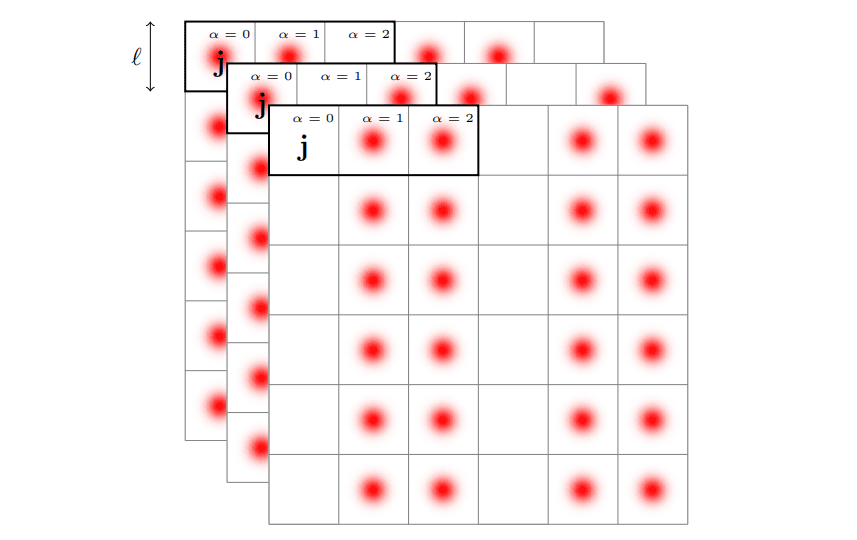
Understanding the behaviour of fermions, particles that underpin much of chemistry and materials science, requires accurately modelling the interactions between them, a task complicated when these particles exist in continuous space rather than on a grid. Andreas Bluhm from the University of Grenoble Alpes, alongside Marius Lemm and Tim Möbus from the University of Tübingen, and colleagues, now present a new algorithm that successfully learns these interactions, even for complex Coulomb potentials in any dimension. This achievement overcomes significant mathematical hurdles posed by the infinite-dimensional nature of continuous space and the unbounded speed of information propagation within the system, offering a unified and robust approach applicable to a wide range of physically relevant potentials. The resulting method promises to advance the characterisation of charged particles and lays the groundwork for a versatile toolkit to explore the behaviour of complex fermionic systems.
They present a modular algorithm designed to learn these potentials, offering a new approach to understanding interactions within these systems. The research focuses on developing a computational technique capable of accurately identifying the external potential governing the behaviour of fermions in a continuous space, representing a significant advancement in the field and potentially enabling further investigations into fermionic behaviour in any dimension. The framework addresses the challenges of an infinite-dimensional state space and the unbounded nature of the Laplacian operator through novel optimisation methods, information-propagation bounds, and assumptions about the regularity of the external potential. This algorithm provides a unified and robust approach applicable to both Coulomb interactions and other physically relevant potentials, with potential applications in characterizing charged particles and ions.
The team demonstrated the algorithm’s effectiveness by applying it to the Coulomb potential, leveraging the harmonicity of this potential and Newton’s shell theorem to ensure stability during the learning process. They achieved precise estimations of both the charge number and spatial location of a single Coulomb potential, relying on local averages calculated from prepared quantum states. The algorithm’s performance is influenced by the irregularity of the potential being probed, as highly irregular potentials require more particles for accurate assessment, impacting the overall evolution time.
Fermionic Systems, Mathematical Foundations Established
This document details the mathematical foundations of a non-interacting fermionic system, establishing the precise definitions and mathematical tools needed to formulate and study such a system. It provides a rigorous mathematical framework crucial for ensuring the validity of subsequent calculations or approximations. The core of the document details the mathematical machinery used to prove results related to the Hamiltonian and its spectral properties, relying on functional analysis, operator theory, and spectral theory. Taylor expansion is used to approximate the time evolution of operators, and key theorems relate the expectation value of the potential energy to the derivatives of operators, providing bounds crucial for establishing convergence and ensuring solutions exist. Local Resolution of the Identity is also employed, culminating in an estimate on the time evolution of the Hamiltonian.
The second part of the document provides the mathematical foundation for dealing with many-fermion systems using the second quantization formalism, avoiding the complexities of many-particle wavefunctions. The Fock space, describing the states of a many-fermion system, is defined, along with annihilation and creation operators used to add or remove fermions. The Canonical Anti-Commutation Relations, defining property of fermionic systems, are also established, defining the Hamiltonian in terms of these operators. This work provides a mathematically rigorous foundation for studying non-interacting fermionic systems, essential for modeling the behaviour of electrons in materials and for performing accurate calculations of molecular properties, exemplifying mathematical physics where rigorous tools are used to study physical systems.
External Potential Reconstruction in Free-Fermion Models
The researchers developed a new algorithm for determining external potentials within continuous-space free-fermion models, successfully addressing challenges posed by the infinite-dimensional state space and unbounded nature of the Laplacian operator in continuous systems. Their approach combines novel optimization techniques and information-propagation bounds, alongside assumptions about the regularity of the external potential, to create a robust and unified method applicable to both Coulomb interactions and other physically relevant potentials, with potential applications in characterizing the charge and position of nuclei and ions.
The team demonstrated the algorithm’s effectiveness by applying it to the specific case of the Coulomb potential, leveraging the harmonicity of this potential and Newton’s shell theorem to ensure stability during the learning process. They achieved precise estimations of both the charge number and spatial location of a single Coulomb potential, relying on local averages calculated from prepared quantum states. The algorithm’s precision is linked to the regularity of the external potential, and highly irregular potentials necessitate a greater number of particles for accurate probing, increasing computational demands. Future work may focus on mitigating the impact of potential irregularity and exploring methods to reduce the computational cost associated with highly complex systems, envisioning this work as a foundation for a scalable toolkit to investigate fermionic systems governed by continuous-space interactions.
👉 More information
🗞 Learning Coulomb Potentials and Beyond with Fermions in Continuous Space
🧠 ArXiv: https://arxiv.org/abs/2510.08471

