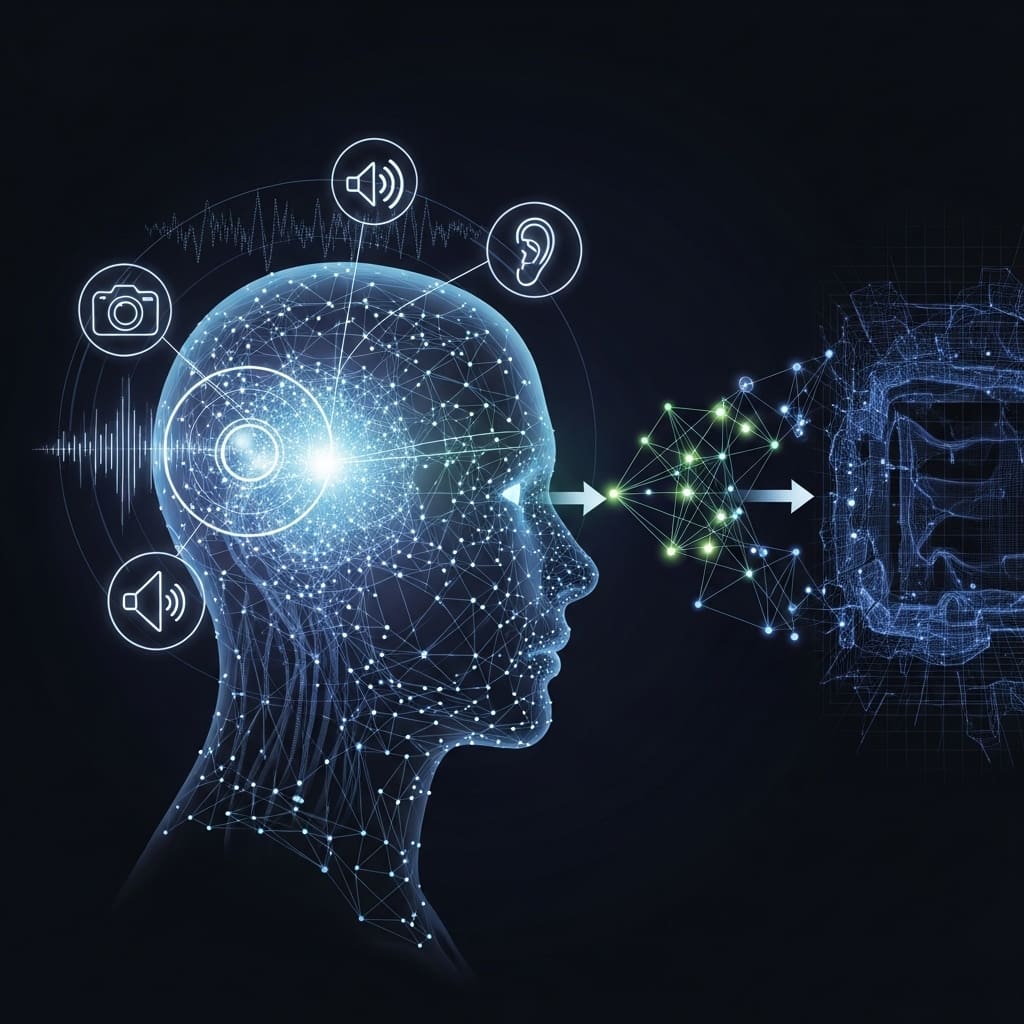
Scientists are tackling the challenge of building continually learning perception systems, but current research largely concentrates on single tasks. Bo Yuan, Danpei Zhao (from Beihang University and the Tianmushan Laboratory), Wentao Li, Tian Li, and Zhiguo Jiang et al. present a significant advance by extending continual learning to continual panoptic perception , a method integrating multiple tasks and data types, such as images and text. This research addresses not only the well-known problem of ‘catastrophic forgetting’ but also the new issue of semantic confusion when learning from multiple sources, ultimately enhancing comprehensive image understanding at pixel, instance, and image levels. Their novel model, featuring a collaborative cross-modal encoder and malleable knowledge inheritance, demonstrates superior performance on complex, fine-grained continual learning tasks and allows the system to evolve without needing to store past examples , a crucial step towards truly intelligent and adaptable machines.
Continual panoptic perception overcomes semantic obfuscation
Scientists have demonstrated a significant advancement in continual learning (CL) by extending its capabilities to continual panoptic perception (CPP), integrating multimodal and multi-task learning for enhanced image understanding. The research addresses limitations in existing CL methods, which predominantly focus on single-task scenarios, restricting their potential in more complex, real-world applications. Beyond the well-known issue of catastrophic forgetting, the team tackled semantic obfuscation that arises when combining multiple tasks and data types, leading to model degradation during incremental training steps. This work formalises the CL task within multimodal scenarios and proposes an end-to-end CPP model designed for comprehensive image perception through joint interpretation at pixel, instance, and image levels.
Concretely, the CPP model features a collaborative cross-modal encoder (CCE) that efficiently embeds multimodal data, enabling shared feature extraction across different modalities. To combat catastrophic forgetting and maintain performance across incremental tasks, researchers propose a malleable knowledge inheritance module utilising both contrastive feature distillation and instance distillation, a task-interactive boosting manner designed to preserve previously learned information. Furthermore, a novel cross-modal consistency constraint is introduced and integrated into CPP+, ensuring robust multimodal semantic alignment during model updates under multi-task incremental scenarios. This constraint actively synchronises learning across modalities, preventing semantic drift and improving overall performance.
Additionally, the proposed model incorporates an asymmetric pseudo-labelling mechanism, allowing the model to evolve and learn without requiring exemplar replay, a common technique that demands substantial memory resources and raises privacy concerns. Extensive experiments conducted on multimodal datasets and diverse CL tasks demonstrate the superiority of the proposed model, particularly in fine-grained CL tasks where subtle distinctions are crucial for accurate perception. The team achieved improved performance by facilitating a shared image encoder for multimodal interpretation, effectively bridging the gap between different data sources. Experiments reveal that the CPP model excels in class-incremental pixel classification, instance segmentation, and image captioning, showcasing its versatility and adaptability to complex panoptic perception tasks. The innovative combination of CCE, MCKD, CBC, and SAPL establishes a robust framework for continual learning in multimodal and multi-task settings, opening new avenues for intelligent perception systems in applications such as automated piloting and satellite-based remote sensing. This breakthrough establishes a pathway for AI systems to continually adapt and improve their understanding of the world, without the need for constant retraining or extensive data storage.
Cross-modal embedding and knowledge inheritance for CPP
Scientists pioneered a novel approach to continual learning (CL) extending it to continual panoptic perception (CPP), integrating multimodal and multi-task learning for comprehensive image understanding. The research team formalised the CL task in multimodal scenarios and engineered an end-to-end CPP model featuring a collaborative cross-modal encoder (CCE) for multimodal embedding. This CCE module extracts image features alongside multimodal incremental annotations, projecting them into a masked embedding space. Experiments employed diverse datasets and CL tasks to demonstrate the model’s superiority, particularly in fine-grained learning scenarios.
To address catastrophic forgetting, the study developed a malleable knowledge inheritance module utilising contrastive feature distillation and instance distillation, a task-interactive boosting manner. This technique facilitates knowledge transfer between tasks, preserving previously learned information while adapting to new data. Furthermore, researchers proposed a cross-modal consistency constraint and implemented CPP+, ensuring semantic coherence during multi-task incremental learning. The CPP+ architecture integrates multimodal embeddings within an end-to-end model, enhancing robustness and performance.
The team also innovated with an asymmetric pseudo-labeling mechanism, enabling model evolution without requiring exemplar replay. This method generates pseudo-labels from unlabeled data, providing additional training signals and reducing the need for storing previous examples. Specifically, the system delivers a self-supervised learning approach, minimising memory costs and addressing privacy concerns. The approach achieves class-incremental pixel classification, instance segmentation, and image captioning simultaneously, demonstrating its versatility. Extensive experiments were conducted on multimodal datasets, evaluating the model’s performance across various CL tasks.
The study meticulously measured performance gains, demonstrating the superiority of CPP and CPP+ over existing methods. The proposed model consistently outperformed baseline approaches, achieving significant improvements in both stability and plasticity, crucial aspects of continual learning. This work establishes a new benchmark for multimodal and multi-task CL, paving the way for more intelligent and adaptable perception systems.
Multimodal CPP achieves unified scene understanding through diverse
Scientists have developed a novel continual panoptic perception (CPP) model, extending continual learning to multimodal and multi-task scenarios for comprehensive image understanding. The research formalizes continual learning in multimodal settings and introduces an end-to-end CPP model featuring a collaborative cross-modal encoder (CCE) for effective multimodal embedding. Experiments demonstrate the model’s ability to perform pixel-level classification, instance-level segmentation, and image-level captioning synchronously, representing a significant step towards holistic scene interpretation. The team measured performance using a malleable knowledge inheritance module, employing contrastive feature distillation and instance distillation to mitigate catastrophic forgetting through task-interactive boosting.
Results demonstrate that this approach effectively preserves previously learned knowledge while adapting to new tasks, a critical challenge in continual learning systems. Furthermore, a cross-modal consistency constraint was implemented and refined as CPP+, ensuring robust multimodal semantic understanding during incremental training under multi-task conditions. Measurements confirm that this constraint harmonizes cross-modal interpretation, enhancing perceptual coherence and overall system stability. Tests prove the efficacy of an asymmetric pseudo-labeling manner incorporated into the model, enabling continuous evolution without requiring exemplar replay, a common limitation of many continual learning techniques.
Extensive experiments conducted on multimodal datasets and diverse continual learning tasks reveal the superiority of the proposed model, particularly in fine-grained learning scenarios. The work successfully integrates an end-to-end continual learning framework, validated through comprehensive experimentation, and proves the feasibility of joint optimization across multimodal continual learning tasks. Specifically, the study defines the multimodal continual learning task using a dataset D = {(xi, yi, ri)}, where xi represents a C×H×W image, yi denotes the H×W mask annotation, and ri is the corresponding caption. At each step ‘t’, Dt signifies the incremental training data, while C0:t−1 represents previously learned classes and Ct denotes the classes for current incremental learning. The research establishes a foundation for future advancements in intelligent perception systems capable of continuous learning and adaptation in complex, real-world environment.
Cross-modal CPP+ surpasses continual learning limits, achieving state-of-the-art
Scientists have developed a new continual panoptic perception (CPP) model to address challenges in continual learning, extending it to multimodal and multi-task scenarios. This research formalises continual learning in multimodal settings and introduces an end-to-end model featuring a collaborative cross-modal encoder (CCE) and a malleable knowledge inheritance module, achieved through contrastive and instance distillation, to mitigate catastrophic forgetting. Furthermore, a cross-modal consistency constraint and asymmetric pseudo-labelling enhance semantic preservation and model evolution without requiring exemplar replay. Extensive experimentation on multimodal datasets demonstrates the superiority of the proposed CPP+ architecture, particularly in fine-grained continual learning tasks.
The findings suggest that instance recognition benefits significantly from semantic stability, while fine-grained semantic recognition remains vulnerable to incremental shifts, aligning with the hypothesis that these tasks rely on global and fine-grained feature relationships rather than single-task pixel dependencies. Pseudo-labelling proves a promising strategy for alleviating catastrophic forgetting in exemplar-free conditions, dynamically balancing historical and incremental knowledge, although trade-offs exist between retaining old knowledge and adapting to new information. The model also exhibits robustness to different class learning orders, maintaining consistent performance across varied incremental learning sequences. Acknowledging limitations, the authors note intricate trade-offs in multimodal continual learning, where modality-specific feature drifts and task heterogeneity can amplify optimization conflicts. Future research could explore methods to further refine the balance between preserving past knowledge and incorporating new information, potentially through adaptive weighting schemes or more sophisticated regularization techniques. These advancements promise to enhance the robustness and adaptability of intelligent perception systems in complex, real-world environments.
🗞 Evolving Without Ending: Unifying Multimodal Incremental Learning for Continual Panoptic Perception
🧠 ArXiv: https://arxiv.org/abs/2601.15643