

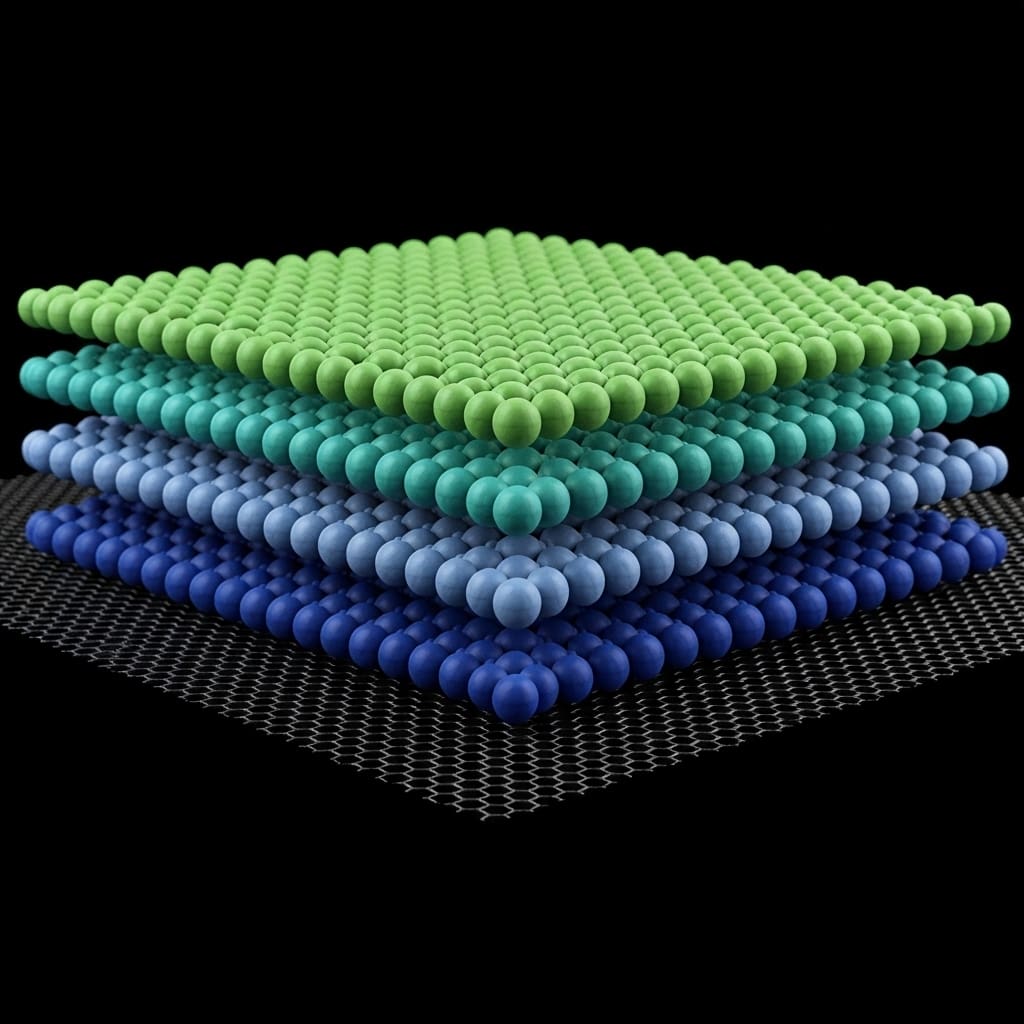
Researchers have long understood that controlling the epitaxial growth of organic semiconductors is vital for optimising their structural and electronic characteristics. Devanshu Varshney (Masaryk University), Pavel Procházka and Veronika Stará (CEITEC, Brno University of Technology) alongside Mykhailo Shestopalov, Jan Kunc and Jiří Novák et al. now reveal how interfacial coupling dictates the molecular epitaxy of 2,3,6,7,10,11-hexamethoxytriphenylene (HMTP) on graphene supported by silicon carbide. Their work, utilising low-energy electron microscopy and X-ray diffraction, demonstrates that while HMTP readily forms highly ordered layers on single-layer graphene, growth on the underlying buffer layer is initially disordered. Significantly, the team discovered that hydrogen intercalation can decouple this buffer layer, effectively recreating a freestanding monolayer and enabling epitaxial growth, offering a scalable method for controlling organic thin-film crystallinity on this important substrate.
The research team achieved highly ordered molecular films of 2,3,6,7,10,11-hexamethoxytriphenylene (HMTP) by meticulously controlling the substrate’s surface.
This study reveals that HMTP forms epitaxial layers on single-layer graphene, but growth on the carbon buffer layer initially results in amorphous films that evolve into polycrystalline structures with weak substrate orientation. The team employed a combination of low-energy electron microscopy and diffraction, alongside X-ray diffraction, to track HMTP ordering from the initial layer to complete thin films.
Experiments show that the intrinsic heterogeneity of graphene grown on SiC, where decoupled graphene coexists with a covalently bound buffer layer, significantly impacts molecular ordering. Specifically, the buffer layer disrupts the formation of crystalline films, while single-layer graphene promotes epitaxial growth.
Crucially, researchers discovered that hydrogen intercalation effectively decouples the buffer layer, transforming it into quasi-freestanding single-layer graphene and subsequently restoring epitaxial growth of HMTP. This process demonstrates that engineering the interface via hydrogen intercalation offers a scalable method for controlling the crystallinity of organic thin films on graphene.
The work establishes that interfacial coupling governs molecular epitaxy and opens avenues for improved organic electronic devices. This breakthrough reveals a pathway to wafer-scale control of organic molecular epitaxy, with potential applications in high-performance organic transistors and optoelectronic devices.
By manipulating the interface between the organic semiconductor and the graphene/SiC substrate, the study provides a fundamental understanding of how to optimise thin-film crystallinity. The ability to decouple the buffer layer and restore epitaxial growth represents a significant advancement in materials science, paving the way for more efficient and reliable organic electronic technologies. The findings demonstrate that precise control over the substrate interface is paramount for achieving high-quality organic semiconductor films.
Epitaxial graphene synthesis and HMTP thin film deposition parameters are crucial for device performance
Scientists investigated the epitaxial growth of 2,3,6,7,10,11-hexamethoxytriphenylene (HMTP) on graphene, focusing on the impact of interfacial coupling on molecular ordering. The research team synthesised epitaxial graphene via thermal decomposition of SiC in a 1 atmosphere argon atmosphere, utilising commercial 6H-SiC:V semi-insulating wafers diced into 5×5 mm² samples.
These substrates underwent cleaning with acetone, isopropanol, and distilled water before being subjected to a two-step furnace process. Initially, a buffer layer formed at 1600°C for 5 minutes, followed by single-layer graphene (SLG) formation at 1650°C for 5 minutes. Crucially, quasi-free-standing SLG was fabricated through hydrogen intercalation of the buffer layer at 1120°C, building upon previously established growth protocols.
HMTP thin films, with a nominal thickness of 28, 33nm, were deposited using an effusion cell operating at 175°C within a chamber maintained at 5 ×10⁻¹⁰ mbar. Prior to deposition, HMTP powder was thoroughly degassed, and substrates were annealed under ultra-high vacuum at 550°C for 10 minutes to eliminate surface contaminants.
During deposition, substrates remained below 30°C, with a deposition rate of approximately 5 Å/min maintained for 60 minutes across all substrates. For low-energy electron microscopy (LEEM) experiments, HMTP growth was monitored in situ up to a nominal thickness of ~3.5nm, employing a deposition rate of ~0.5 Å/min.
X-ray diffraction (XRD) measurements were performed using a Rigaku SmartLab 3X-ray diffractometer with a rotating Cu anode (wavelength 0.154nm) and a five-circle goniometer. The incident X-ray beam was collimated and monochromatized using a parabolic multilayer mirror, with slit configurations tailored for azimuthal, symmetric, and rocking scans to optimise resolution. Atomic Force Microscopy (AFM) employed tapping mode with a Bruker Dimension Icon microscope, processed using Gwyddion software, while Raman spectroscopy utilised a WITec alpha300 RSA confocal micro-Raman system with a 532nm excitation laser at 20mW power.
HMTP molecular layer ordering and crystallographic texture on graphene and silicon carbide are strongly correlated
Scientists have demonstrated that interfacial coupling governs molecular epitaxy on graphene/SiC, revealing a scalable route to control organic thin-film crystallinity. The research team tracked the ordering of the molecular donor, 2,3,6,7,10,11-hexamethoxytriphenylene (HMTP), from initial layers to thin films using low-energy electron microscopy and diffraction alongside X-ray diffraction.
Results demonstrate that HMTP forms highly ordered epitaxial layers on single-layer graphene, while growth on the carbon buffer layer initiates as amorphous before evolving into polycrystalline films with weak substrate orientation. Experiments revealed that HMTP thin films, with thicknesses ranging from 28 to 33nm, exhibit distinct crystallographic textures depending on the substrate.
X-ray diffraction pole figures and azimuthal scans were used to analyse the film texture, while rocking scans quantified crystal mosaicity both in-plane and out-of-plane. Azimuthal scans of the HMTP 1011 reflections on single-layer graphene displayed sharp spots centered at a polar angle of 31.7°, indicating strong in-plane alignment.
Conversely, measurements on the buffer layer showed a ring-shaped band of enhanced intensity at the same polar angle, signifying a less ordered polycrystalline structure. Specifically, the azimuthal scan for graphene showed a clear six-fold symmetry, while the buffer layer scan exhibited a broadened, diffuse pattern.
Crucially, hydrogen intercalation decoupled the buffer layer, converting it into quasi-freestanding single-layer graphene and restoring epitaxial growth of HMTP. This process effectively eliminated the interfacial coupling, allowing for wafer-scale control of organic molecular epitaxy. Data shows that the structural model of bulk HMTP crystals, with its in-plane molecular arrangement and interlayer stacking geometry, aligns with the observed diffraction patterns on graphene.
The team measured the inclination of the 1011 planes at 31.7° relative to the HMTP direction perpendicular to the sample surface, confirming the epitaxial relationship. These findings demonstrate that interface engineering via hydrogen intercalation provides a pathway to achieve highly ordered organic semiconductor thin films with controlled crystallinity.
HMTP Growth Control via Substrate Decoupling and Interfacial Coupling offers precise film manipulation
Scientists have demonstrated that the growth of organic semiconductors is critically influenced by the substrate upon which they are deposited. Research focused on the molecular donor, 2,3,6,7,10,11-hexamethoxytriphenylene (HMTP), revealing significant differences in its ordering when grown on single-layer graphene versus a residual buffer layer on silicon carbide.
Using low-energy electron microscopy and X-ray diffraction, the team tracked HMTP’s arrangement from initial layers to thin films, establishing a clear correlation between interfacial coupling and epitaxial growth. HMTP forms highly ordered layers on single-layer graphene, while growth on the buffer layer initially results in amorphous films that evolve into polycrystalline structures with weak substrate orientation.
Importantly, the researchers found that introducing hydrogen decouples the buffer layer, effectively transforming it into a quasi-freestanding monolayer and enabling epitaxial growth once more. This interface engineering via hydrogen intercalation offers a potentially scalable method for controlling the crystallinity of organic thin films on silicon carbide.
The authors acknowledge that the observed effects are specific to the HMTP molecule and the SiC substrate, limiting the generalizability of the findings. Future work could explore the application of this technique to other organic semiconductors and substrates, potentially broadening its impact on materials science and organic electronics.
👉 More information
🗞 Interfacial Coupling Controls Molecular Epitaxy of HMTP on Graphene/SiC
🧠 ArXiv: https://arxiv.org/abs/2601.22263

