

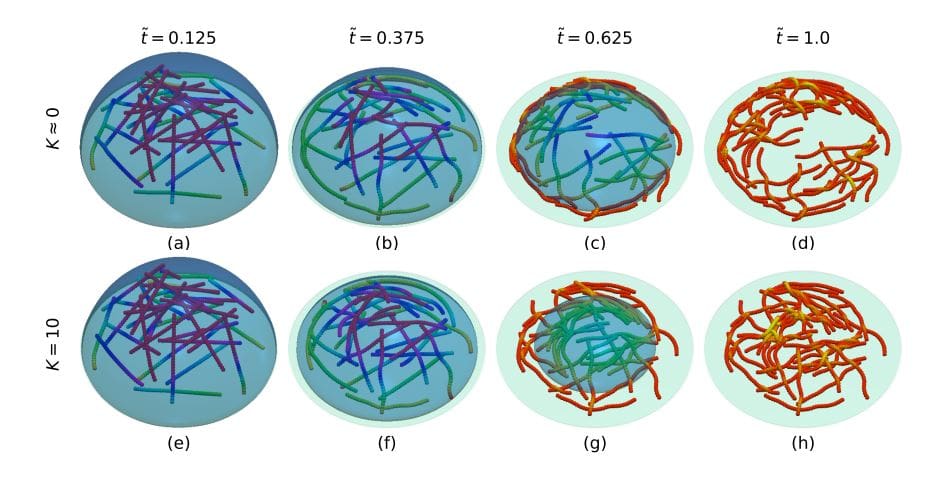
The reliable creation of conductive networks from evaporating droplets is fundamental to advances in flexible sensors and printed electronics, yet controlling the final arrangement of the building-block filaments remains a significant challenge. Johannes Schöttner, Qingguang Xie, and Gaurav Nath, alongside Jens Harting and colleagues at the Helmholtz Institute Erlangen-Nürnberg for Renewable Energy, now demonstrate how filament properties and evaporation conditions fundamentally influence the resulting deposit morphology and electrical conductivity. Their research reveals that carefully controlling the evaporation process, shifting between reaction-limited and diffusion-limited regimes, allows for precise manipulation of filament alignment, suppressing unwanted edge accumulation and promoting the formation of centred, highly conductive deposits. This work establishes a clear link between evaporation kinetics and the resulting microstructure, offering crucial guidelines for optimising the performance of future printed electronic devices.
Cellulose Nanofibril Assembly and Conductivity in Droplets
The self-assembly of filamentous materials during the evaporation of liquid droplets offers a promising route towards fabricating functional thin films. This work investigates how cellulose nanofibrils arrange themselves as a droplet evaporates, linking the resulting structure to its electrical conductivity. Researchers systematically varied droplet size, evaporation speed, and nanofibril concentration to control the final film’s structure and properties, observing the formation of layered structures exhibiting different levels of order and alignment using advanced microscopy techniques. The team discovered that slow evaporation and high nanofibril concentrations encourage the formation of densely packed, highly aligned layers. Electrical conductivity measurements confirmed a strong connection between layer alignment and conductivity, with aligned layers demonstrating significantly higher conductivity than randomly oriented ones. These findings establish a clear relationship between processing conditions, structural features, and functional properties, paving the way for the rational design of high-performance, bio-based electronic materials.
Filament Deposition Patterns During Evaporation
Controlling the deposition of filaments, such as nanowires and nanotubes, from evaporating droplets is crucial for the performance of emerging technologies like flexible sensors and printed electronics. Researchers used computer simulations to investigate how filament length, stiffness, and concentration affect deposition patterns during droplet drying, comparing evaporation processes governed by reaction rates and those limited by diffusion. They found that the resulting flow patterns fundamentally alter filament arrangement. The simulations revealed that diffusion-limited evaporation promotes a more random distribution of filaments, while reaction-limited evaporation leads to a more ordered, coffee-ring-like structure due to the increased influence of surface tension. The models capture the complex interplay between fluid dynamics, filament interactions, and evaporation rates, providing insights into the mechanisms governing deposit formation and allowing for systematic exploration of different conditions.
Filament Evaporation Dictates Deposit Patterns and Properties
This research presents a computational framework for understanding how filaments, such as nanowires and nanotubes, deposit during droplet evaporation, a process critical for creating printed and flexible electronics. Through detailed simulations, scientists demonstrate that the evaporation regime, specifically whether it is reaction-limited or diffusion-limited, fundamentally alters the resulting deposit patterns and electrical properties. Reaction-limited evaporation promotes uniform, centralized deposits, while diffusion-limited evaporation leads to the formation of the coffee-ring effect, compromising network uniformity and connectivity. The team discovered that filament characteristics, including length and stiffness, also play a significant role, with longer filaments favouring tangential alignment and more centralized deposition. Importantly, the simulations reveal a direct link between evaporation kinetics, the resulting microstructure, and the electrical conductivity of the deposited network, showing that tuning these parameters can lower the threshold for electrical conduction and enhance conductivity. Investigations into closely spaced droplets revealed anisotropic deposition, with reduced conductivity on facing sides due to vapor shielding, offering a potential method for experimentally identifying the dominant evaporation regime.
👉 More information
🗞 Self-assembled filament layers in drying sessile droplets: from morphology to electrical conductivity
🧠 ArXiv: https://arxiv.org/abs/2512.13222


