

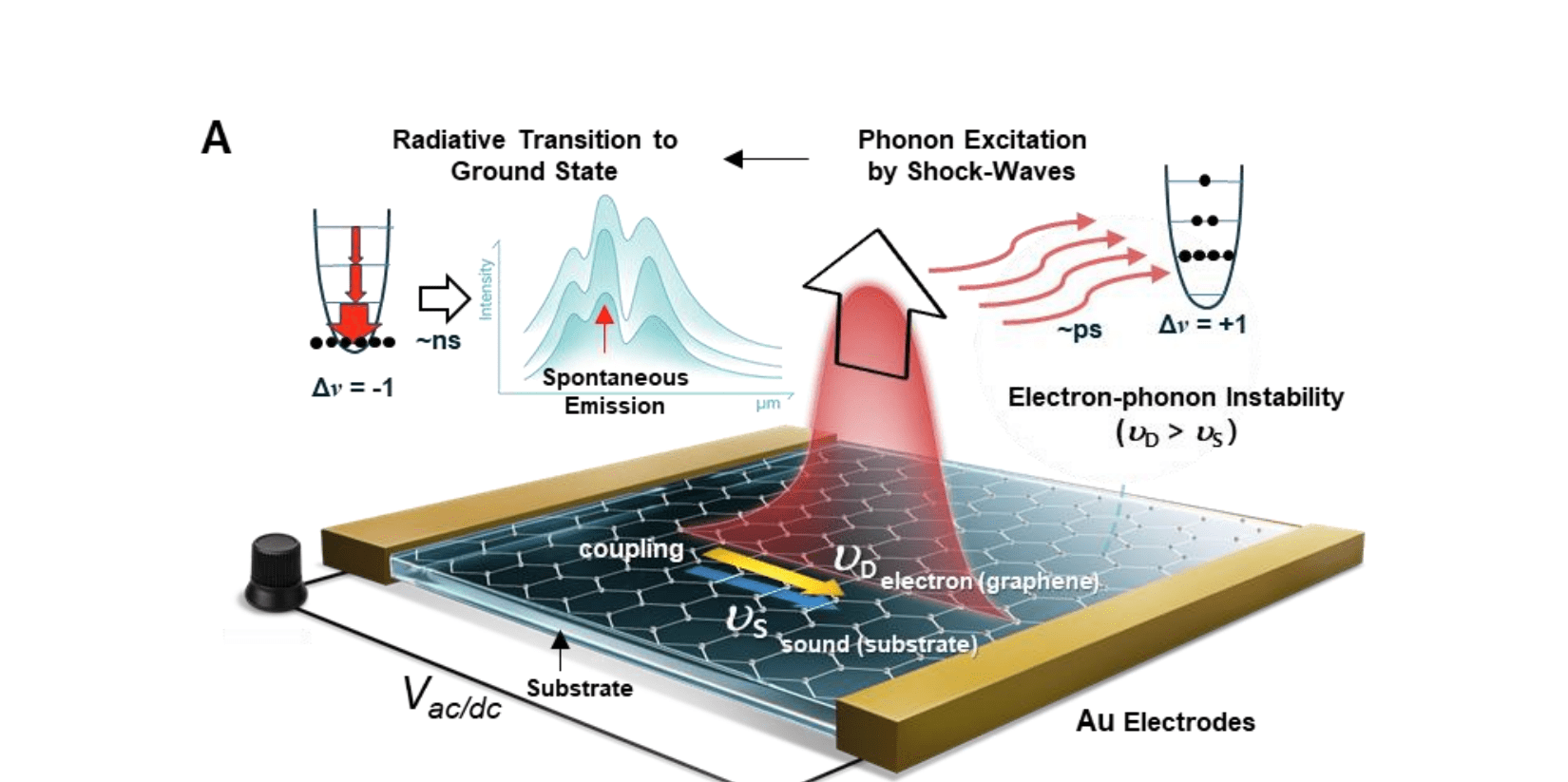
Molecular vibrations resonating with mid-infrared radiation represent a promising pathway for efficient heat delivery in chemical reactions, yet the development of practical applications has been hampered by a lack of powerful, large-area mid-IR sources. Now, Sunhwa Hong from Seoul National University, Moo Jin Kwak from Samsung Research, and Ha Eun Lee from Seoul National University, alongside Yunseok Lee from Graphene Square Inc. and the Advanced Institute of Convergence Technology, and Chan-Jin Kim and Yejun Lee from Seoul National University, report a method for generating intense mid-IR radiation using graphene layers coupled with substrate vibrations. The team demonstrates that applying a high electrical bias to these layers triggers a process involving shock waves at the interface between the graphene and the substrate, effectively amplifying molecular vibrations and resulting in highly efficient thermal energy generation and transfer. This breakthrough promises to significantly reduce power consumption across a wide range of domestic and industrial applications, offering a pathway towards more sustainable energy technologies.
Graphene Heaters For Efficient Mid-Infrared Heating
This research details the fabrication and characterization of graphene-based mid-infrared (MIR) heaters, demonstrating their efficiency and potential in cooking appliances. Graphene heaters provide more uniform heating compared to conventional methods by directly exciting molecular vibrations within the heated material, leading to energy savings and improved cooking quality. Graphene films are created on copper foil within a quartz tube, then carefully transferred to target substrates using a thermal release tape method, allowing for the creation of multilayered structures. Researchers observed that carrier velocity within the graphene can exceed the sound velocity of substrate materials when a voltage is applied, crucial for efficient heating.
Tests demonstrate the graphene toaster consumes approximately 20% less power than conventional toasters, exhibiting a homogeneous temperature distribution and rapid heating capabilities. The resistance of the graphene heater remains constant after repeated heating and cooling cycles, indicating excellent durability. Supplementary photographs showcase foods cooked using the graphene heaters, demonstrating uniform internal coloration. Emission spectra confirm the graphene layer is responsible for the MIR emission, revealing how intensity varies with electrical bias. Supplementary movies show bread toasting, coffee boiling, and vegetables cooking on graphene heaters. In summary, graphene-based MIR heaters offer efficient and uniform heating, leading to energy savings and improved cooking quality. This technology has potential applications in cooking, food processing, and industrial heating, and exhibits excellent long-term reliability.
Layered Graphene for Intense Mid-Infrared Emission
Scientists engineered a novel method for generating mid-infrared (mid-IR) radiation using layered graphene films, achieving intense emission through vibrational excitation of substrate materials. Repeating the process of growing and transferring graphene films creates multilayered structures crucial for enhancing mid-IR emission. To isolate the graphene, researchers remove the copper foil using a chemical etchant, leaving the film adhered to tape. The graphene film is then transferred to target substrates by sandwiching the tape and substrate between rollers and applying mild heat. Gold electrodes are deposited to form a lateral bias across the graphene, inducing current flow and generating heat.
The study explored practical applications in cooking appliances, demonstrating a 20% reduction in power consumption for a graphene-laminated toaster compared to conventional models. The graphene cooker, operating at less than 700W, achieved comparable heating rates to conventional cookers consuming over 1. 3kW, while also exhibiting more uniform internal coloration in cooked foods. This improved uniformity stems from the resonant coupling between the mid-IR wavelength and the fundamental vibrational modes of molecules within food. The graphene heaters also demonstrated excellent long-term reliability, maintaining resistance after repeated heating and cooling cycles.
Graphene Heaters Boost Mid-Infrared Radiation Output
Scientists have achieved a breakthrough in mid-infrared (mid-IR) heating technology, demonstrating a novel emission pathway in graphene Joule-heaters that significantly enhances thermal energy generation and transfer. Experiments demonstrate that the graphene heaters exhibit approximately fivefold greater emission per unit area compared to conventional heaters under optimized conditions, despite operating at lower surface temperatures. The team observed exponential growth of emission with both voltage and temperature, alongside peak positions coinciding with vibrational absorptions of distinct substrates, confirming a non-thermal emission mechanism. This behavior suggests a threshold consistent with Cherenkov-like instability, where electron drift velocity surpasses the substrate’s sound velocity.
Researchers propose that accelerated charge carriers in graphene inject energy into non-equilibrium phonons within the substrate, softening the sound velocity and enabling more efficient excitation. This positive feedback loop intensifies emission, particularly in non-elastomers, while elastomers exhibit a linear relationship between emission intensity and applied voltage. The study establishes a new era of wavelength-selective and energy-efficient mid-IR heating, potentially replacing traditional high-resistance coil-heater technologies and significantly reducing power consumption in homes and industries.
Graphene Bias Generates Intense Mid-Infrared Radiation
This research demonstrates that layers of graphene, when electrically biased, generate intense mid-infrared radiation through a process linked to the excitation of vibrational modes in underlying substrates. High electrical currents induce shock waves at the interface between the graphene and the substrate, effectively amplifying molecular vibrations and leading to spontaneous emission of mid-infrared light. This emission represents a highly efficient means of generating and transferring thermal energy, potentially offering significant reductions in power consumption for various applications. The findings offer a new approach to mid-infrared radiation generation that bypasses the need for external light sources or complex device fabrication.
By directly inducing emission through electrical biasing, the researchers have created a system capable of efficiently targeting specific molecular vibrations, which could be particularly valuable in chemical reactions requiring precise energy input. Further investigation is needed to fully understand the underlying mechanisms and optimise the system’s performance, including exploring different substrate materials and graphene configurations to enhance emission efficiency and control wavelengths. Future work will focus on refining the process and exploring the potential for scalable, energy-efficient thermal management systems based on this principle.
👉 More information
🗞 Molecular vibrational mid-IR radiation amplified by high-biased graphene
🧠 ArXiv: https://arxiv.org/abs/2510.25508

