The emergence of ordered electronic states in graphene-based materials continues to fascinate physicists, and recent work by Sk Asrap Murshed and Bitan Roy, both from Lehigh University, sheds new light on these phenomena. They investigate charge-density waves, specifically a ‘valley-coherent’ form, appearing in quarter metals created from stacked graphene layers, encompassing structures from single layers to more complex arrangements. This research demonstrates that these charge-density waves form distinctive striped patterns, yet exhibit surprising symmetry variations depending on the number of graphene layers present. Crucially, the team establishes a fundamental connection between these electronic orders and the behaviour of magnetism in these materials, revealing a pathway to control and manipulate their properties, and potentially unlocking new functionalities for future electronic devices.
Graphene Layer Interactions and Density Polarization
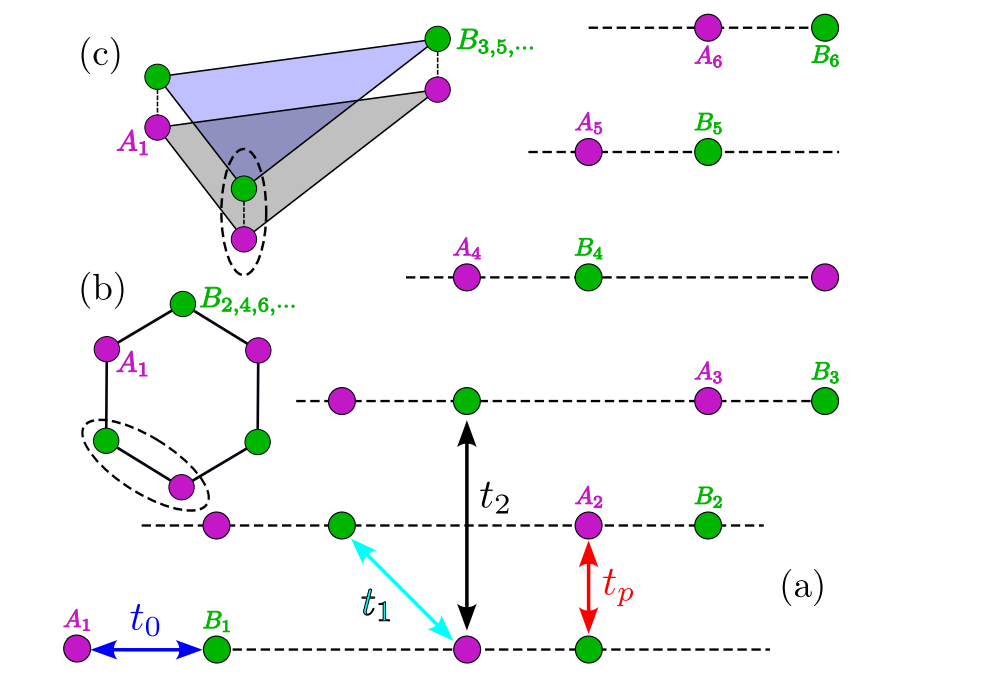
The study investigates valley-coherent charge-density wave (VC-CDW) order in multi-layered graphene, encompassing structures from monolayer to hexalayer. Researchers developed a tight-binding model to describe free-fermions within these chirally-stacked layers, accounting for interactions between sublattices both within and between adjacent layers. Specifically, the model incorporates hopping terms that influence the electronic band structure and the emergence of massless Dirac fermions. To simplify calculations and focus on low-energy behavior, the team integrated out the high-energy sites, resulting in a renormalized Hamiltonian and a continuum model derived by expanding the Hamiltonian around each valley.
This approach captures the behavior of electrons near specific momentum values, and the inclusion of spin degrees of freedom was found to negligibly affect the results due to weak spin-orbit coupling. The resulting low-energy Hamiltonian describes the electronic structure and is expressed in terms of Pauli matrices operating on spin, valley, and layer indices. Researchers demonstrate that the interplay between these parameters leads to a systematic lifting of degeneracy, resulting in fractional metals and annular Fermi rings at low doping, driven by layer polarization and sagging electronic bands. This layer polarization acts as an externally-induced mass order for gapless chiral fermions, creating an isotropic gap near the charge neutrality point. The study establishes a global phase diagram, revealing a transition from metallic phases with four-fold degeneracy to half-metals with two-fold degeneracy, and ultimately to non-degenerate quarter-metals at low doping. This systematic degeneracy lifting is a direct consequence of spontaneous symmetry breaking and the nucleation of ordered states within the material.
Valley-Coherent Charge Density Wave Order Emerges
This work identifies valley-coherent charge-density wave (VC-CDW) order within a non-degenerate quarter-metal, a finding that applies across a family of chirally-stacked graphene layers, including rhombohedral multi-layer, Bernal bilayer, and monolayer structures. This newly discovered phase exhibits broken translational symmetry, manifesting as a modulated charge density with a characteristic periodicity determined by the valley momenta. Notably, the VC-CDW lacks three-fold rotational symmetry in systems with even integer layer counts, displaying a stripe order, while odd layer systems preserve the symmetry. Experiments reveal a confluence of VC-CDW and anomalous Hall orders within the quarter-metal, demonstrating a regime where these two phases coexist. Researchers established that the VC-CDW and anomalous Hall order can lift the residual valley degeneracy of an antiferromagnetically ordered, spin-polarized half-metal when subjected to perpendicular displacement fields. Tests confirm that only the anomalous Hall order exhibits hysteresis in off-diagonal resistivity, a characteristic observed consistently across all systems.
Valley-Coherent Order and Broken Symmetry in Graphene
This research identifies a novel form of electronic order, termed valley-coherent charge-density wave (VC-CDW), present across a family of layered graphene materials, encompassing monolayer, bilayer, and multi-layer structures. The team demonstrates that this order breaks conventional translational symmetry, creating a modulated charge distribution with a periodicity linked to the material’s valley momenta. Importantly, the VC-CDW breaks three-fold rotational symmetry in certain layer configurations, but preserves it in others, resulting in distinct stripe phases depending on the number of graphene layers. The work establishes a fundamental connection between the VC-CDW and anomalous Hall order, revealing how these competing orders can lift the inherent valley degeneracy in antiferromagnetically ordered, spin-polarized materials.
This lifting of degeneracy is achieved through the interplay of layer polarization and the formation of either the VC-CDW or anomalous Hall order, ultimately leading to the creation of a non-degenerate quarter-metal. Researchers acknowledge that the precise conditions for the coexistence of these orders require further investigation, and future work could explore the influence of external factors on the stability and properties of the observed phases. This discovery provides a new understanding of electronic order in graphene heterostructures and offers potential avenues for manipulating their electronic properties.
🗞 Charge-density waves and stripes in quarter metals of graphene heterostructures
🧠 ArXiv: https://arxiv.org/abs/2510.20816