
For decades, the pursuit of room-temperature superconductivity has challenged physicists, as the established theory struggles to explain materials conducting electricity with zero resistance at relatively high temperatures. Annette Bussmann-Holder from the Max-Planck-Institute for Solid State Research, Jürgen Haase from the University of Leipzig, and Hugo Keller from the Physik-Institut der Universität Zürich, alongside their colleagues, now present compelling evidence that nanoscale lattice structures play a crucial, and previously underestimated, role in achieving this phenomenon. Their work investigates the complex interplay between a material’s atomic arrangement and its superconducting properties, revealing that specific nanoscale heterogeneity is intrinsic to the emergence of coherence at elevated temperatures. This research builds on nearly four decades of investigation into high-temperature superconductors and offers a new perspective on manipulating lattice complexity to potentially unlock materials exhibiting superconductivity at or near room temperature, representing a significant step towards practical applications in energy transmission and beyond.
Polarons, Bipolarons and High-Temperature Superconductivity
This compilation of research explores complex oxides, superconductivity, and related phenomena, focusing on understanding the mechanisms behind high-temperature superconductivity, particularly in cuprates, and how charge, spin, and lattice vibrations interact to enable this phenomenon. Researchers investigate how polarons and bipolarons, localized distortions in the crystal lattice, contribute to conductivity and how their behavior changes with temperature and material composition. Lattice dynamics and fluctuations are crucial, as these vibrations mediate interactions between electrons and influence the formation of charge density waves and spin density waves. These materials exhibit significant inhomogeneity at the nanoscale, with distinct regions displaying different electronic and magnetic properties.
Recent work explores creating artificial materials by layering different oxides, aiming to engineer specific properties and potentially enhance superconductivity. Isotope effects, observed through variations in atomic mass, are used to probe the role of lattice vibrations and the nature of charge carriers. Research extends to manganites and nickelates, exploring similar phenomena and comparing their behavior. Lattice fluctuations play a vital role in the electronic properties of these materials, screening interactions between electrons and influencing the formation of charge density waves and spin density waves.
Polarons and bipolarons are often the dominant charge carriers, particularly in materials with lower doping levels, and their localized movement significantly affects conductivity. Nanoscale phase separation and inhomogeneity are common features, arising from charge ordering, spin ordering, or the coexistence of different electronic phases. Competition and coexistence are observed between charge density waves, spin density waves, and superconductivity, depending on doping, temperature, and material composition. Creating artificial heterostructures allows researchers to engineer specific properties and potentially overcome limitations of natural materials, offering a pathway to enhance superconductivity and explore new electronic phases.
Recent work highlights the role of lattice quantum geometry in controlling superconductivity, particularly in heavily overdoped materials. The research follows a clear progression, beginning with early studies emphasizing the role of polarons and lattice vibrations in mediating electron interactions. As experimental techniques improved, researchers discovered that these materials are often inhomogeneous at the nanoscale, with phase separation between different electronic and magnetic states. The focus then shifted to understanding the interplay between different competing orders, such as charge density waves, spin density waves, and superconductivity.
More recently, researchers have begun to explore the use of artificial heterostructures and quantum design principles to engineer specific properties and enhance superconductivity. The latest research points to the importance of lattice quantum geometry in controlling superconductivity, particularly in heavily overdoped materials. The research relies on a variety of experimental and theoretical techniques, including X-ray diffraction, X-ray absorption spectroscopy, Raman spectroscopy, transport measurements, neutron scattering, scanning tunneling microscopy, and theoretical modeling. This compilation provides a comprehensive overview of high-temperature superconductivity, highlighting the importance of lattice dynamics, polarons, inhomogeneity, and quantum design. The ongoing exploration of artificial heterostructures and quantum geometry promises to unlock new insights and pave the way for future technological advancements.
Local Lattice Distortions and Charge Carrier Dynamics
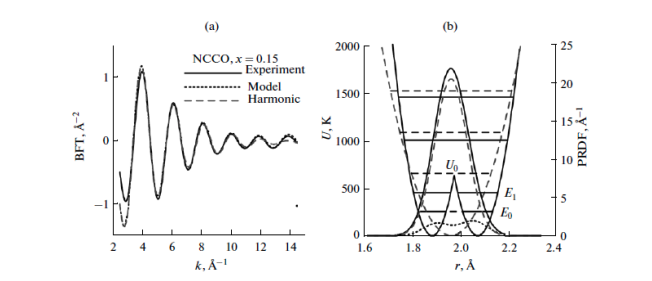
Researchers employed sophisticated experimental techniques to investigate the nanoscale origins of high-temperature superconductivity in complex ceramic oxides. Recognizing the limitations of conventional theories, they focused on subtle, intrinsic inhomogeneities within the material’s crystal lattice, believing these to be crucial for achieving superconductivity at relatively high temperatures. The methodology centers on directly observing these lattice distortions and their relationship to the movement of charge carriers. A key innovation lies in the application of X-ray absorption spectroscopy, a highly sensitive technique capable of probing the local atomic structure with exceptional speed and precision.
This allowed scientists to detect minute differences in the bond lengths within the copper-oxygen planes, revealing the coexistence of two distinct structural arrangements. These arrangements, characterized by varying degrees of tilting in the copper-oxygen plaquettes, indicate regions where added electrons locally distort the lattice, forming polarons. The team demonstrated that these polarons aren’t randomly distributed, but instead organize themselves into striped patterns, creating a “superstripes” phase. Complementing the X-ray spectroscopy, researchers utilized X-ray diffraction to map the spatial arrangement of these superstripes across larger areas of the material.
This revealed a complex, multiscale patterning, demonstrating that the lattice distortions extend from the atomic level to mesoscopic dimensions. By carefully analyzing the intensity and distribution of the diffracted X-rays, they confirmed the existence of nanoscale arrays of distorted and undistorted lattice regions. This detailed structural characterization provides crucial evidence supporting the idea that these nanoscale inhomogeneities are not defects, but rather intrinsic features essential for the emergence of superconductivity. Furthermore, the team developed a theoretical framework, based on the observed nanoscale geometry of the stripes, to explain how these inhomogeneities amplify the superconducting transition temperature. This theory predicts that the arrangement of superconducting and normal regions at the nanoscale creates quantum confinement effects, enhancing the material’s ability to conduct electricity without resistance. The approach emphasizes the importance of understanding the interplay between electronic structure, lattice distortions, and charge ordering at the nanoscale to design new, high-temperature superconducting materials.
Nanoscale Heterogeneity Drives High-Temperature Superconductivity
For nearly four decades, scientists have been building upon the initial discovery of high-temperature superconductivity, moving beyond the well-established theories that adequately describe low-temperature materials. While conventional superconductivity is understood through the BCS theory, explaining how electrons pair up and flow without resistance, this framework fails to account for superconductivity observed at significantly higher temperatures, above 35 Kelvin. Research has increasingly focused on the role of imperfections and complexities within the material’s structure, specifically in ceramic oxides known as high-temperature superconductors, and has now demonstrated that these materials exhibit a level of nanoscale heterogeneity crucial to their function. Early investigations quickly revealed that these materials are not uniform; differing oxygen arrangements within the crystal structure contribute uniquely to the superconducting properties.
This initial finding spurred extensive research into structural variations, identifying stripe-like patterns and phase separation within the materials. These studies demonstrated the coexistence of at least two different superconducting states, suggesting a more complex mechanism than previously understood and highlighting the importance of localized carriers interacting with itinerant ones. This understanding built upon the original hypothesis that localized distortions within the material’s lattice, known as polarons, play a fundamental role in initiating high-temperature superconductivity. Recent work proposes a mechanism involving “Q-balls”, localized condensations of electronic or charge fluctuations, as key to understanding the pseudogap phase, a precursor to superconductivity. These Q-balls form due to instabilities on the material’s Fermi surface, effectively creating regions where electrons pair up more easily and lowering the energy required for superconductivity.
👉 More information
🗞 Nanoscale lattice heterostructure in high Tc superconductors
🧠 ArXiv: https://arxiv.org/abs/2508.08994