

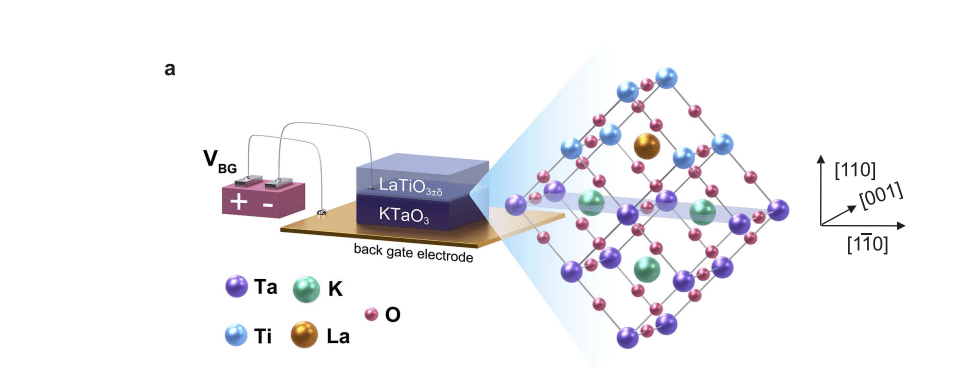
Superconductivity, the ability of a material to conduct electricity with zero resistance, typically weakens in the presence of magnetic fields, but recent research demonstrates a surprising reversal of this effect. D. Maryenko, M. Kawamura, and I. V. Maznichenko, alongside colleagues including S. Ostanin and D. Zhang, report the observation of re-entrant superconductivity, where a magnetic field actually stabilizes superconductivity, at the interface between two carefully layered oxide materials. This phenomenon, previously observed only in specific patterned materials, now appears across a broad range of conditions and, crucially, can be controlled using an external voltage, offering unprecedented experimental flexibility. The team attributes this behaviour to a complex interplay between the material’s electronic structure, strong spin-orbit coupling, and the influence of the magnetic field, establishing a new and versatile platform for investigating unconventional superconductivity in two-dimensional systems and potentially leading to advances in future superconducting technologies.
Suppression of Superconductivity by Field and Vortices
Scientists are investigating how magnetic fields affect superconductivity, focusing on the competing mechanisms of breaking electron pairings and creating vortex formations that diminish superconducting properties. This research explores conditions where superconductivity persists despite substantial magnetic fields, employing theoretical modelling and numerical calculations to determine the critical field at which superconductivity vanishes. The team maps the phase diagram of the superconducting state, specifically examining how the arrangement of Cooper pairs changes under magnetic influence and impacts overall superconducting behavior. Calculations account for material imperfections and disorder, factors known to significantly influence the critical field and the superconducting gap. Results demonstrate that specific material characteristics and magnetic field configurations can enhance the resilience of superconductivity against suppression, potentially leading to more robust superconducting devices.
Interface Superconductivity in Oxide Heterostructures
This research focuses on the emergence of superconductivity at the interfaces between oxide materials like lanthanum titanate and potassium tantalate. Superconductivity arises not from the bulk materials themselves, but at the interface due to unique electronic structures and charge transfer. Electrons become confined to a two-dimensional layer at the interface, enhancing quantum effects and leading to novel superconducting properties. This superconductivity can be tuned by applying strain, electric fields, or carefully controlling the material composition near the interface. The observed superconductivity often deviates from standard theory, suggesting novel pairing mechanisms are at play.
A crucial concept is Rashba spin-orbit coupling, arising from structural asymmetry at the interface and splitting electron spin degeneracy, significantly influencing superconducting properties. This coupling leads to spin-momentum locking, where electron spin is linked to its momentum, potentially resulting in unconventional pairing symmetries. Researchers are also investigating Ising superconductivity, where Cooper pairs possess a net spin, making them sensitive to magnetic fields, and the Fulde-Ferrell-Larkin-Ovchinnikov state, an exotic superconducting state appearing in magnetic fields. Understanding the upper critical field, the magnetic field above which superconductivity is destroyed, is also key.
Re-entrant Superconductivity at Oxide Interfaces
Scientists have discovered a surprising re-entrant superconducting phase at the interface between lanthanum titanate and potassium tantalate, where superconductivity is initially suppressed by a magnetic field but unexpectedly reappears at higher fields. This challenges conventional understandings of superconductivity, which typically predict magnetic fields will destroy the superconducting state, and points to a novel interplay between spin-orbit coupling and a van Hove singularity near the Fermi level. Experiments reveal that the interface exhibits superconductivity until a minimum critical field is reached, at which point it temporarily disappears before re-emerging with increasing magnetic field strength. The team attributes this unusual behavior to the combined effects of strong spin-orbit coupling and a van Hove singularity, a specific feature in the material’s electronic band structure.
Detailed analysis demonstrates that the spin-orbit coupling and magnetic field modify the Fermi surface, leading to a momentum-dependent splitting of the electron spectrum and a deformation of the Fermi surface, particularly pronounced near the van Hove singularity. This results in an asymmetry in the electron momentum distribution, influencing the pairing of electrons that drives superconductivity. Measurements confirm that the magnetic field shifts the minimum in the energy spectrum, increasing the density of states and enhancing the potential for electron pairing. The researchers observed a low resistive peak at intermediate magnetic fields, suggesting the presence of a transient state separating two distinct superconducting phases. This discovery establishes a robust platform for exploring unconventional superconductivity and finite resistivity states in engineered oxide heterostructures, where interfacial symmetry, spin-orbit interaction, and band structure can be precisely tuned. The gate-tunability of the system provides a powerful means to investigate the microscopic origin of re-entrant behavior and phase transitions between superconducting states with potentially different pairing symmetries.
Re-entrant Superconductivity in Oxide Interfaces
This research demonstrates the surprising re-emergence of superconductivity at the interface between lanthanum titanate and potassium tantalate materials, a phenomenon known as re-entrant superconductivity. Typically, magnetic fields suppress superconductivity, but this team observed that increasing the magnetic field actually restores the superconducting state after it had initially been suppressed, challenging conventional understanding of superconductivity. This behavior is attributed to a complex interplay between strong spin-orbit coupling and modifications to the material’s electronic structure driven by the magnetic field. The team’s findings establish a new platform for investigating unconventional superconductivity in two-dimensional materials, offering a system where superconductivity can be tuned using electrostatic gating. The observation of a transient resistive state between superconducting phases suggests the existence of complex electronic behavior within these materials, potentially revealing new insights into the mechanisms governing superconductivity in low-dimensional systems. The gate-tunability of this system provides a powerful tool for probing the origins of re-entrant behavior and for investigating phase transitions between superconducting states with potentially different pairing symmetries.
👉 More information
🗞 Re-entrant superconductivity at an oxide heterointerface
🧠 ArXiv: https://arxiv.org/abs/2510.01682


