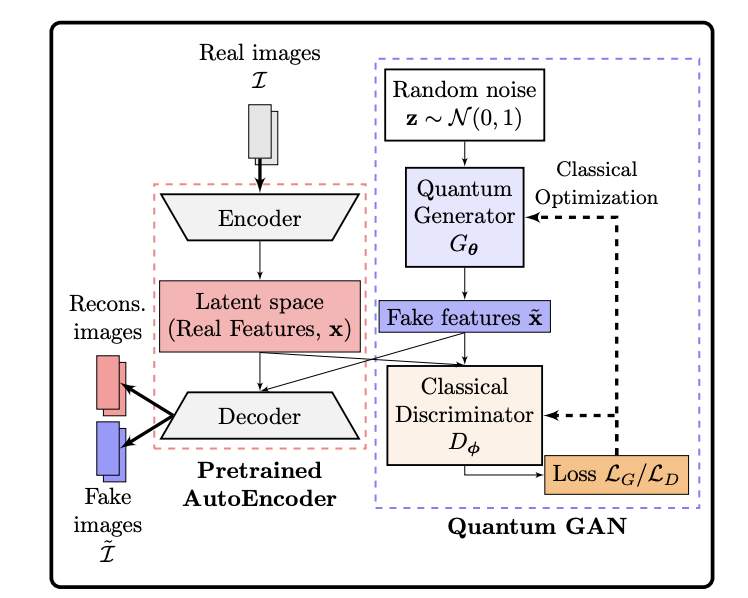
Researchers from the European Organization for Nuclear Research (CERN), Ecole Polytechnique Fédérale de Lausanne (EPFL), and other institutions have developed a hybrid quantum-classical generative model, called Latent Style-based Quantum GAN (LaSt-QGAN), for generating high-quality images. The model uses a classical auto-encoder to reduce the dimensionality of complex images and a quantum GAN to learn the latent representation of the images. The team’s empirical results show that LaSt-QGAN can effectively synthesize images with a better quality level than the classical counterpart using approximately the same resources.
Quantum Generative Modeling: A Hybrid Approach
Quantum generative modeling is a promising field in data analysis, with the potential to offer practical advantages over classical machine learning. However, the generation of large-size images comparable to those produced by classical counterparts remains a significant challenge. This article introduces a novel approach, the Latent Style-based Quantum Generative Adversarial Network (LaSt-QGAN), which employs a hybrid classical-quantum approach to generate complex data.
The LaSt-QGAN Framework
LaSt-QGAN integrates two distinct components: a classical autoencoder and a quantum GAN. The autoencoder, an unsupervised neural network, is used for dimensionality reduction and data compression. It consists of an encoder, which embeds high-dimensional data into a lower-dimensional latent space, and a decoder, which reconstructs the data from these latent features. The quantum GAN serves as a generative model for producing fake features, employing a quantum generator and a classical discriminator.
Empirical Results and Practical Applications
The empirical results demonstrate that LaSt-QGAN can effectively synthesize images with a better quality level than the classical counterpart using approximately the same resources. The quantum GAN is capable of achieving, and in some cases surpassing, the performance of classical GAN in terms of both quality and diversity of the generated samples across all tested datasets while maintaining a similar number of trainable parameters.
Addressing the Barren Plateau Phenomena
The barren plateau phenomena in continuous generative models were also studied. By using a mix of analytical and numerical tools, it was shown that LaSt-QGAN with a polynomially deep generator circuit can be trained with a small angle initialization around the identity. Despite the loss landscape being exponentially flat on average, the strategy allows the model to initialize on a region with substantial gradients and train towards some local minimum.
While the empirical findings constitute a first step to demonstrate the model’s potential for practical applications, it remains an open question whether the interplay between the classical and quantum parts can be quantified. Further investigation of warm-starts in the generative modeling setting is of particular importance for both fundamental and practical aspects. Lastly, the role of a quantum circuit in the continuous generative model as a feature map shares a great similarity in the supervised quantum machine learning with classical data, leaving a great opportunity for future research.
External Link: Click Here For More