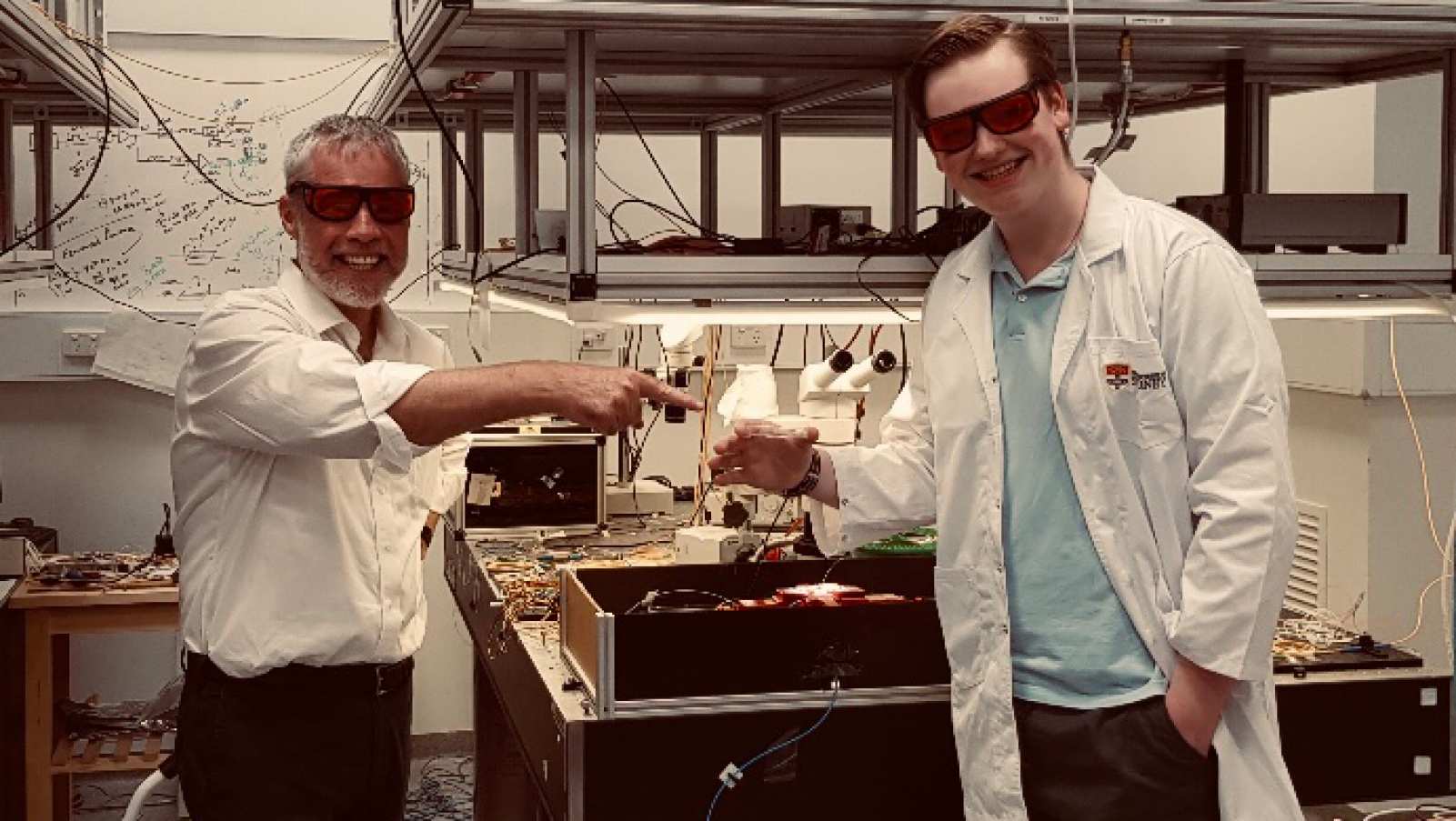
PhD candidate Ryan Russell, alongside researchers at the University of Sydney Nano Institute and School of Physics, has successfully addressed a long-standing challenge in microchip-scale lasers by implementing “photonic bandgap engineering.” The team carved nanoscale features—Bragg gratings exceeding 100 times smaller than a human hair—directly into the laser’s optical cavity, creating a “dead zone” to block the formation of performance-degrading parasitic modes. This innovation eliminates Brillouin cascading, a critical source of noise in Brillouin lasers, and yields exceptionally ‘clean’ light with an ultranarrow spectrum, paving the way for advancements in quantum computing, navigation, and communications technology.
Taming ‘Noisy’ Light in Microchip Lasers
Researchers at the University of Sydney have addressed a key issue in microchip lasers – the emergence of ‘parasitic modes’ that degrade performance. They achieved this by carving nanoscale ‘Bragg gratings’ – essentially tiny speed bumps – into the laser’s optical cavity. This “photonic bandgap engineering” creates a “dead zone” that prevents these unwanted modes from forming, while allowing the desired laser light to function normally. The team’s work focuses on Brillouin lasers, known for their exceptionally pure light.
The implementation of Bragg gratings resulted in significant improvements. Researchers observed a six-fold increase in the minimum threshold for Brillouin lasing – the energy needed to start laser emission. Further, they measured a 2.5-times boost in fundamental laser power, directly demonstrating improved performance. Importantly, these gratings are reconfigurable; they can be written, erased, and adjusted after the device is made, using only laser light, eliminating the need to rebuild the chip.
This method isn’t limited to Brillouin lasers, representing a general framework for controlling light on photonic chips. The team anticipates applications in areas like quantum computers, advanced navigation systems (including GPS), and ultra-fast communications. Professor Eggleton notes this ability to engineer the density of states within the resonator opens doors to new classes of light sources and advanced photonic technologies, establishing Australia’s leadership in integrated photonics.
Photonic Bandgap Engineering and Bragg Gratings
Researchers at the University of Sydney addressed a problem in Brillouin lasers—a build-up of “parasitic modes” that degrade performance—by employing “photonic bandgap engineering.” They created a “dead zone” within the laser’s optical cavity using nanoscale features—specifically, ‘Bragg gratings’—more than 100 times smaller than a human hair. These gratings, named after William and Lawrence Bragg, prevent the formation of these unwanted modes at their origin, allowing for cleaner light production and improved laser performance.
The implementation of Bragg gratings led to significant performance gains. Researchers observed a six-fold increase in the minimum threshold for Brillouin lasing—the energy needed to start laser emission—and a 2.5-times boost in fundamental laser power. Importantly, these gratings are reconfigurable; they can be written, erased, and retuned with laser light without needing to refabricate the device, offering flexibility in operation between single and multi-mode configurations.
This method isn’t limited to Brillouin lasers, but is presented as a “general framework for controlling optical processes on photonic chips.” Engineering the density of states inside a resonator opens possibilities for new light sources and advanced technologies. This research is expected to contribute to cleaner quantum light sources, improved frequency comb lasers, and advancements in fields like communications, precision measurement, and GPS technology.
“Brillouin lasers are among the most coherent light sources, and you can make them at chip-scale,”
Ryan Russell
Inhibition of Brillouin Laser Cascading
Researchers at the University of Sydney addressed the issue of Brillouin cascading – a source of noise in Brillouin lasers – by implementing “photonic bandgap engineering.” They created nanoscale features, specifically Bragg gratings, inside the laser’s optical cavity. These gratings act as a “dead zone” blocking the formation of parasitic modes at their origin, without impeding the primary laser mode. This innovative approach allows for cleaner, more efficient light production crucial for advanced technologies.
The team observed a significant six-fold increase in the minimum threshold for Brillouin lasing when the Bragg gratings were induced. Further, they measured a 2.5-times boost in fundamental laser power, directly demonstrating improved performance with cascading inhibited. Critically, these Bragg gratings are reconfigurable – meaning they can be written, erased, and retuned after device creation using only laser light, eliminating the need for refabrication.
This method isn’t limited to fixing Brillouin lasers; it represents a broader framework for controlling optical processes on photonic chips. The ability to engineer the density of states within a resonator opens doors to new light sources and advanced photonic technologies. This control is critical for building complex optical systems and pushing devices into previously inaccessible performance regimes, potentially impacting quantum computing, communications, and precision sensing.
Reconfigurable Bragg Gratings for Laser Control
Researchers at the University of Sydney have developed a method to improve the purity of light emitted from Brillouin lasers, a crucial step for technologies like quantum computing and advanced GPS. By creating nanoscale “speed bumps”—Bragg gratings—within the laser’s optical cavity, they’ve engineered a “dead zone” that prevents the formation of noisy parasitic light modes. These gratings, named after William and Lawrence Bragg, block these unwanted modes at their origin without affecting the desired light signal, leading to cleaner light output.
The team observed a six-fold increase in the minimum energy required to excite laser emission when the Bragg grating was implemented, and a 2.5-times boost in fundamental laser power. Importantly, these gratings are reconfigurable – they can be written, erased, and retuned with only laser light, eliminating the need to rebuild the device. This allows for on-demand switching between low-noise, single-mode operation and cascaded multi-mode operation, providing greater flexibility.
This method isn’t limited to Brillouin lasers; it offers a general framework for controlling optical processes on photonic chips. Professor Ben Eggleton notes this ability to engineer the density of states inside a resonator unlocks new classes of light sources. The research supports Australia’s leadership in integrated photonics and paves the way for ultra-stable, high-power, low-noise chip-scale lasers for future quantum and communication technologies.