Scientists are tackling the challenges of achieving ultracold atomic samples in microgravity, a crucial step towards advanced space-based sensors and fundamental physics research. Julien Le Mener, Clement Metayer, and Baptiste Battelier from LP2N, Laboratoire Photonique Num erique et Nanosciences, Universit e de Bordeaux, IOGS and CNRS, working with Vincent Jarlaud from Exail and Celia Pelluet from Centre National d’Etudes Spatiales, demonstrate a novel approach using optical dipole traps during parabolic flights. This collaborative effort overcomes limitations associated with traditional atom-chip methods by providing improved optical access and more homogeneous trapping potentials. Their research details an efficient evaporative cooling technique, successfully producing an ultracold gas of rubidium atoms below 100 nK in under four seconds, and represents a significant advancement for deploying precision sensors for geodesy and exploring ultracold atomic physics beyond Earth.
Can atoms be cooled to extraordinarily low temperatures in the weightlessness of space using only light. Experiments aboard parabolic flights have now demonstrated this is possible, achieving temperatures below 100 nanoKelvin with rubidium atoms, opening new avenues for precision sensors and fundamental physics investigations beyond Earth. Scientists are increasingly turning to microgravity environments to explore fundamental physics and develop advanced technologies, but achieving ultracold atomic temperatures in space presents considerable challenges.
Moving Beyond Traditional Atomic Confinement Traps
Limitations of Traditional Atom Chip Trapping Methods
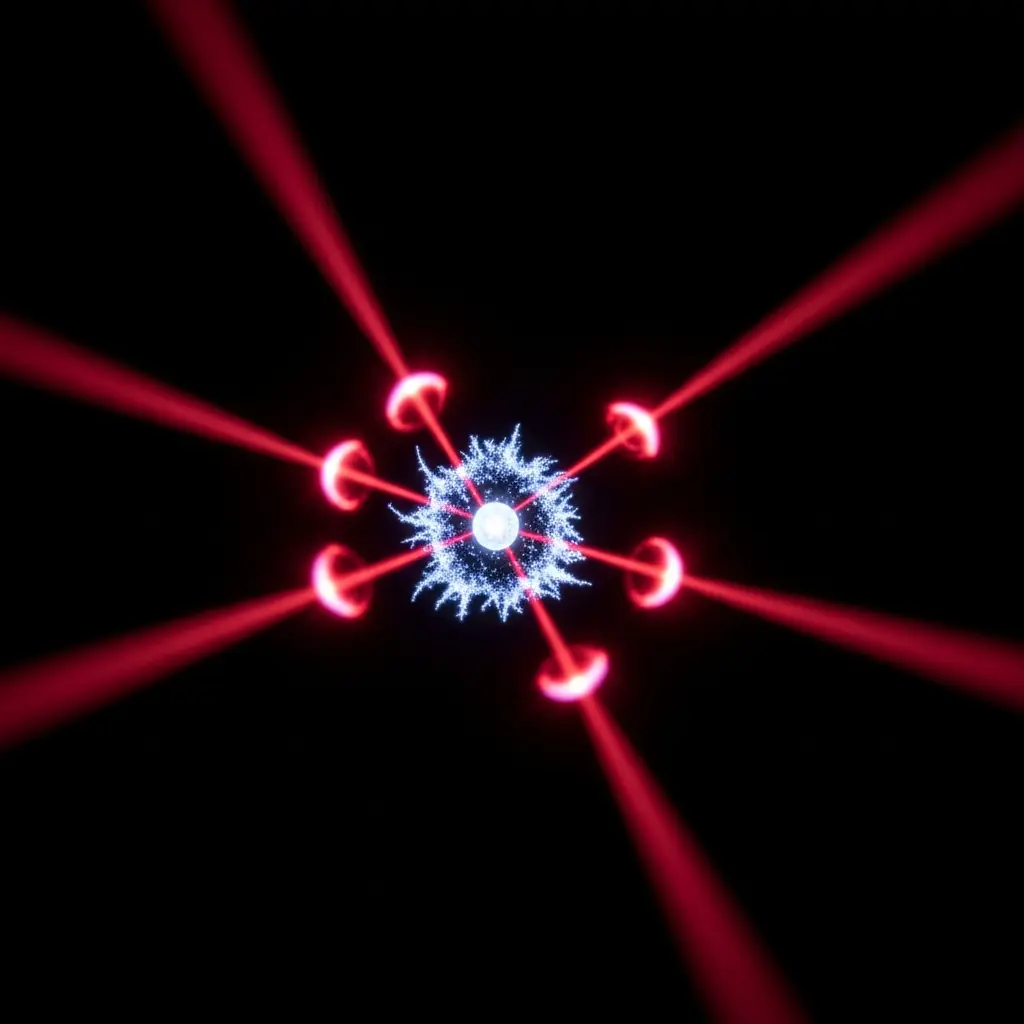
Traditional cold atom experiments often rely on atom chips, which can suffer from limited optical access and uneven magnetic fields. Optical dipole traps, using laser light to confine atoms, offer an alternative, however, generating dense, ultracold samples with these traps has proven difficult in the absence of gravity. Recent work details a method for efficient evaporative cooling of rubidium atoms using two crossed laser beams during parabolic flight, a form of short-duration microgravity achieved by flying in an arc.
This technique combines a large capture volume with rapid trap compression, boosting the initial density of atoms and promoting collisions necessary for cooling. Researchers have successfully produced an ultracold gas of approximately 2.5 × 10⁴ rubidium atoms at a temperature below 100 nK, a mere 0.0001 Kelvin, in under 4 seconds. This experiment overcomes the absence of a gravitational potential by carefully controlling the laser beams, unlike conventional magnetic traps where gravity assists the evaporation process.
A key aspect of this approach involves a “painted potential,” created by spatially modulating the laser beams to initially maximise the volume available for atom capture. Once atoms are loaded, the modulation is reduced, compressing the trap and increasing the collision rate, vital for evaporative cooling. Maintaining a stable trap in microgravity requires precise alignment, as even small variations in acceleration during parabolic flight can misalign the laser beams.
Implementing Real-Time Trap Compensation Systems
Implementing Real-Time Trap Compensation Systems
To address this, a real-time compensation system was implemented, dynamically adjusting the beam positions throughout each experimental sequence. A three-dimensional magneto-optical trap initially captures 1.5 × 10⁸ rubidium atoms, then cooled to 4.5μK using red optical molasses. Beyond achieving ultracold temperatures, this work demonstrates a pathway towards developing quantum sensors for applications in fundamental physics, geodesy, and the study of ultracold atomic phenomena in space.
Enhancing Density with Bimodal Potential Traps
At the heart of the technique lies a bimodal potential, where atoms are initially trapped in both a larger, modulated region and a smaller, more tightly confined area created by the intersecting laser beams. Reducing the spatial modulation increases trap depth, leading to a rise in phase space density, a measure of how densely atoms are packed in terms of both position and momentum.
By carefully balancing trap volume and depth, the researchers achieved a high enough phase space density to initiate efficient evaporative cooling, even with reduced collision rates. Time-of-flight measurements, tracking the expansion of the atomic cloud over up to 100 milliseconds, validated the successful creation of an ultracold atomic sample.
Demonstrated Efficiency in Atom Cooling Potential
Rubidium atom trapping via magneto-optical cooling and time-averaged optical potential formation
A 1550nm amplified fibered telecom laser serves as the primary tool for creating the optical dipole trap. This laser delivers up to 23W of light, spatially modulating it with an acousto-optic modulator (AOM) to expand the capture volume of the trap. Initially, a three-dimensional magneto-optical trap (MOT) loads rubidium atoms into a vacuum chamber, beginning with a two-dimensional MOT and accumulating 1.5 × 10⁸ atoms.
Following MOT loading, red optical molasses cools the atomic cloud to 4.5μK over 9ms. The research then combines grey molasses cooling with trapping within a time-averaged optical potential. Two crossed laser beams form the dipole trap, and the spatial modulation by the AOM allows for strong focusing of the beams on the atoms without diminishing the overall capture volume.
Approximately 6 × 10⁶ atoms are loaded into this dipole trap within 150ms. A real-time compensation system addresses the relative misalignment of the crossed beams caused by variations in acceleration during parabolic flight, realigning their positions throughout each experimental sequence. The trap potential exhibits a double structure along the laser beam propagation directions, providing an additional trapping force due to beam focus.
This configuration is advantageous because the painted potential permits strong focusing without reducing capture volume. Atoms become trapped in this bimodal potential, which increases the initial phase space density. The spatial modulation is then ramped down over 250ms, increasing the trap depth to approximately three times its initial value and further enhancing phase space density.
Measurements confirm that the trap frequency remains consistent with adiabatic compression, with a gain of two orders of magnitude in phase space density achieved during this compression phase. Once this compression is complete, evaporative cooling commences, employing three linear ramps to progressively lower the laser power and decrease trap depth. To support evaporation in the vertical direction, the final laser power is reduced further, leading to a final increase in phase space density.
Efficient Rubidium Atom Capture and Phase Space Density Enhancement via Time-Averaged Optical Potential
Initial atom loading via a magneto-optical trap yielded 1.5 × 10⁸ rubidium atoms, establishing a substantial starting point for subsequent cooling stages. Following laser cooling to 4.5μK in 9 milliseconds, the research team employed a combined grey molasses technique alongside trapping within a time-averaged optical potential, successfully loading approximately 6 × 10⁶ atoms into the dipole trap within 150 milliseconds.
A real-time compensation system addressed beam misalignment caused by parabolic flight acceleration changes, maintaining trap stability throughout the experiment. The implemented time-averaged potential created a bimodal trap structure, featuring a larger volume and compressed region, which increased the initial phase space density and collision rate.
Calculations based on a two-box model predicted a gain in phase space density proportional to the Boltzmann factor, and experiments confirmed a gain of two orders of magnitude during the compression phase, corresponding to a potential energy difference of approximately 5kBTc. Trap frequencies increased during compression, further enhancing conditions for evaporative cooling.
Evaporative cooling proceeded through three linear power ramps, initially increasing the phase space density by one order of magnitude. A final reduction in laser power, unique to the microgravity environment, then drove a further increase in phase space density. Measurements revealed a final atomic gas temperature below 100 nK achieved in less than 4 seconds. The study established scaling laws linking final temperature and phase space density to initial values and atom number, demonstrating the effectiveness of the technique in reduced gravity conditions.
Optical trapping demonstrates stable microgravity cooling of rubidium atoms
Scientists have long sought to create and control ultra-cold atoms in space, yet achieving this has proven remarkably difficult. Previous attempts relied heavily on atom chips, which, while effective, introduce limitations regarding light access and consistent magnetic fields. A team reports success using optical traps, beams of light, to cool rubidium atoms to below 100 nanoKelvin during parabolic flights, simulating weightlessness.
This represents a shift away from magnetic confinement, opening possibilities previously hampered by technical constraints. Maintaining stable traps in microgravity is now demonstrably achievable with this all-optical approach. The researchers employed crossed laser beams, cleverly combining a large capture volume with focused compression to enhance cooling efficiency.
Beyond the technical feat, this work signals a maturing of cold atom technology for deployment outside of terrestrial laboratories. The ability to perform such experiments in space is limited by the complexity of the apparatus and the need for frequent parabolic flights. The implications extend far beyond fundamental physics, paving the way for highly sensitive sensors with potential applications in geodesy and tests of fundamental physical principles.
This technique avoids the magnetic interference that can obscure subtle gravitational signals. Scaling up this technology to create larger, denser clouds remains a challenge, as does extending the duration of the experiment beyond the brief periods afforded by parabolic flight. A convergence of these optical trapping techniques with the growing number of microgravity platforms, including those aboard the International Space Station, is anticipated.
The development of compact, space-qualified lasers will be essential. Current research focuses on demonstrating feasibility, but the next phase will involve building practical devices capable of delivering data with unprecedented precision, potentially reshaping our understanding of gravity and the universe itself.
🗞 Ultracold atoms in a dipole trap in microgravity
🧠 ArXiv: https://arxiv.org/abs/2602.16645