

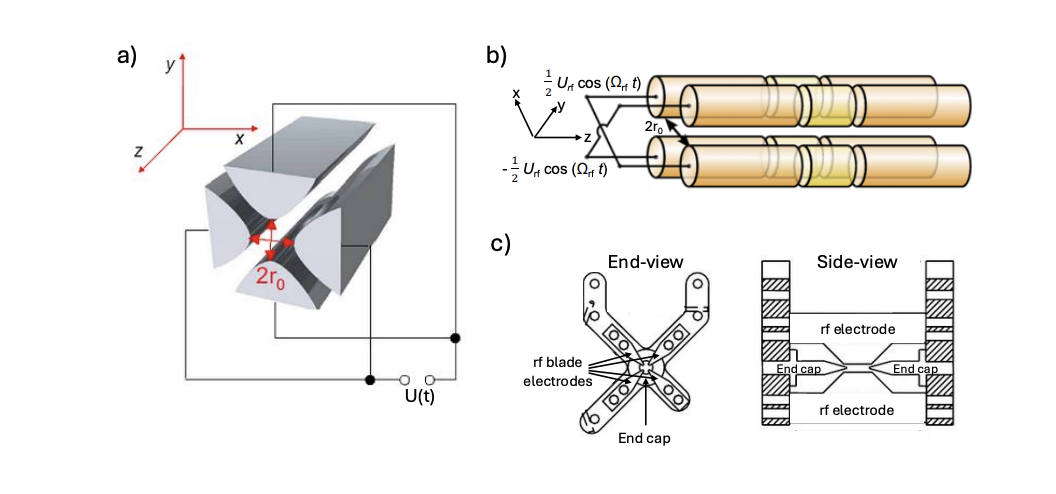
Ion crystals, an exotic form of condensed matter, present a unique opportunity to study the fundamental principles governing interactions between charged particles, and a team led by Giovanna Morigi of the Universität des Saarlandes, John Bollinger from the National Institute of Standards and Technology, and Michael Drewsen from the University of Aarhus, are at the forefront of this research. These crystals form when laser-cooled ions become trapped and arranged by their mutual electrostatic repulsion, creating structures with surprisingly large interparticle distances measured in micrometers. Unlike traditional crystals, ion Coulomb crystals allow researchers to individually manipulate and observe each ion using lasers, offering unprecedented control over the system’s behaviour and dynamics. This level of precision promises to unlock new insights into strongly correlated systems and paves the way for potential applications in quantum information processing and precision measurement.
Trapped ion crystals represent a unique platform for studying condensed matter physics, offering a system where interparticle distances are large, micrometers, yet energy scales are relatively low, on the order of electron volts. These crystals, formed by laser-cooled ions, exhibit crystalline structures arising from the balance between Coulomb repulsion and external confinement. The ability to precisely manipulate and image individual ions with lasers allows for detailed investigation of their dynamic and structural properties in one, two, and three dimensions, including their behaviour when driven away from equilibrium.
Trapped Ion Crystals, Formation and Characterization
Researchers are increasingly interested in the physics of trapped ions, particularly their ability to form ordered structures known as Coulomb crystals. These crystals, held together by electrostatic repulsion rather than chemical bonds, offer a unique window into the behaviour of matter at extremely low densities. Investigations into the formation and characterization of these crystals have revealed fundamental insights into the interplay between Coulomb interactions and external confinement. Researchers have developed sophisticated techniques for characterizing the properties of these crystals, including their vibrational modes, defect structures, and response to external perturbations.
The ability to precisely control and manipulate individual ions within these crystals has opened new avenues for exploring fundamental physics and developing advanced technologies. Researchers can tune the parameters of the trap, apply external forces, and observe the resulting changes in the crystal structure and dynamics. This level of control has enabled significant progress in quantum information processing, with ion crystals serving as promising candidates for building quantum computers. Furthermore, the long-range nature of the Coulomb interaction, unhindered by material screening effects, leads to unusual dynamical properties.
Researchers have observed phenomena like stick-slip motion and kink dynamics, where ions exhibit behaviours not typically seen in conventional solids. Advanced imaging techniques allow researchers to visualize the structure of these crystals with unprecedented detail, revealing the presence of defects, dislocations, and other imperfections. Understanding these imperfections is crucial for developing new technologies. As research progresses, ion Coulomb crystals are poised to play an increasingly important role in both fundamental scientific discovery and the advancement of quantum technologies.
Ion Coulomb Crystals and Wigner Crystallization
Researchers have long been fascinated by the behaviour of charged particles at extremely low densities, a phenomenon predicted by Eugene Wigner in the 1930s, where repulsive forces can overcome kinetic energy and drive the formation of crystalline structures. This ‘Wigner crystallization’ has been observed in various systems, from electrons on liquid helium to collections of ions trapped and cooled using electromagnetic fields. Ion Coulomb crystals, however, represent a particularly compelling and controllable platform for exploring fundamental physics and developing new technologies. Unlike typical crystals found in solid materials, these ion crystals are not held together by shared electrons, but solely by electrostatic repulsion, and exist in a vacuum, free from material imperfections.
This unique environment allows for exceptionally precise control and observation of individual ions, revealing properties distinct from conventional condensed matter systems. Researchers can simulate complex quantum phenomena by manipulating the ions with lasers and observing their collective behaviour. The vibrational modes of these crystals, for example, can be precisely tuned and controlled, offering insights into the dynamics of strongly correlated systems. This level of control has enabled significant progress in quantum information processing, with ion crystals serving as promising candidates for building quantum computers.
Furthermore, the long-range nature of the Coulomb interaction, unhindered by material screening effects, leads to unusual dynamical properties. Researchers have observed phenomena like stick-slip motion and kink dynamics, where ions exhibit behaviours not typically seen in conventional solids. These observations provide valuable tests of theoretical models and deepen our understanding of collective behaviour in strongly correlated systems. As research progresses, ion Coulomb crystals are poised to play an increasingly important role in both fundamental scientific discovery and the advancement of quantum technologies.
Ion Crystals Transition From Linear To Zigzag
This research demonstrates how trapped ion crystals exhibit crystalline structures arising from the balance between Coulomb repulsion and external confinement. The study highlights a structural transition in these ion crystals, revealing how the system changes from a linear arrangement to a zigzag configuration as external parameters are adjusted. This transition is accompanied by a change in symmetry, specifically from an XY symmetry to an Ising symmetry when transverse confinement is anisotropic, effectively “pinning” the zigzag orientation. The researchers developed a Landau potential to describe this transition, demonstrating how the system’s energy landscape changes and how this relates to the emergence of different crystalline structures.
This theoretical framework accurately predicts the observed transition and provides insights into the underlying physics. While the current work provides a detailed theoretical framework and experimental validation of these transitions, the authors acknowledge limitations in extending the model to strongly anisotropic systems or larger ion numbers. Future research directions include exploring more complex geometries and investigating the impact of long-range interactions on the observed phenomena, potentially unlocking new insights into correlated electron systems and quantum materials. These investigations promise to deepen our understanding of fundamental physics and pave the way for new technological applications.
🗞 Ion Coulomb crystals: an exotic form of condensed matter
🧠 ArXiv: https://arxiv.org/abs/2508.07374


