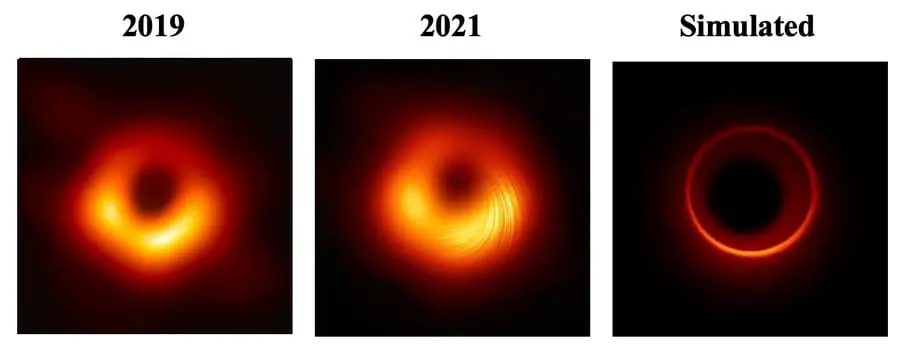
Thanks to a powerful laser communications technology developed at MIT Lincoln Laboratory, scientists are one step closer to capturing unprecedented images of black holes. The TBIRD payload, approximately the size of a tissue box, operates at data rates required to image the thin halos of light around black holes, known as photon rings.
This technology is crucial for extending the Event Horizon Telescope (EHT) into space, allowing for even sharper images of black holes. The EHT, a collection of radio telescopes around the globe, has already produced stunning photos of the black hole at the center of galaxy M87, revealing its magnetic field.
Now, scientists aim to capture the photon ring, which would enable them to test Albert Einstein’s general theory of relativity. Key individuals involved in this work include Jade Wang, assistant leader of Lincoln Laboratory’s Optical and Quantum Communications Group, and Michael Johnson, principal investigator for the Black Hole Explorer mission at the Harvard-Smithsonian Center for Astrophysics.
Imaging Black Holes with TBIRD Technology
The Event Horizon Telescope (EHT) has revolutionized our understanding of black holes, capturing stunning images of these cosmic monsters. However, to further explore the mysteries of black holes, scientists need to overcome significant technical challenges. One such challenge is transferring massive amounts of data from space-based telescopes to Earth for processing. This is where the TeraByte InfraRed Delivery (TBIRD) lasercom payload comes in, offering a solution to this problem.
The Need for Higher Resolution Images
To better understand black holes, astronomers need higher resolution images that can reveal finer details about these objects. The EHT has already provided remarkable insights, but its Earth-based telescopes are limited by the atmosphere and maximum baseline distance of approximately 13,000 kilometers. To overcome these limitations, scientists propose putting at least one telescope in space, as envisioned by the Black Hole Explorer (BHEX) mission.
The Challenge of Data Transfer
The BHEX mission requires a system that can downlink data from the space telescope to Earth at an incredible rate of approximately 100 gigabits per second (Gbps). This is where TBIRD technology comes in, having achieved the fastest data transfer from space, transmitting at a rate of 200 Gbps – 1,000 times faster than typical satellite communication systems.
The TBIRD Solution
The TBIRD lasercom payload, developed by MIT Lincoln Laboratory, offers a novel technology for high-volume data transport from space to ground. This technology has the potential to enable scientists to image the photon ring structure of a black hole for the first time. A lasercom team led by Jade Wang is developing the long-distance, high-rate downlink needed for the BHEX mission in middle Earth orbit (MEO).
Upgrades and Modifications
To support the higher orbit required for the BHEX science mission, the TBIRD payload will undergo upgrades, including a larger aperture size and higher transmit power. Additionally, the TBIRD automatic request protocol will be adjusted to account for the longer round-trip times associated with a mission in MEO.
The Future of Black Hole Research
The combination of TBIRD technology and the BHEX mission has the potential to revolutionize our understanding of black holes. By capturing images of the photon ring, scientists can test Albert Einstein‘s general theory of relativity and gain insights into the turbulent gas falling into a black hole. As Michael Johnson, principal investigator for the BHEX mission, notes, “Laser communications is completely upending our expectations for what astrophysical discoveries are possible from space.”
External Link: Click Here For More