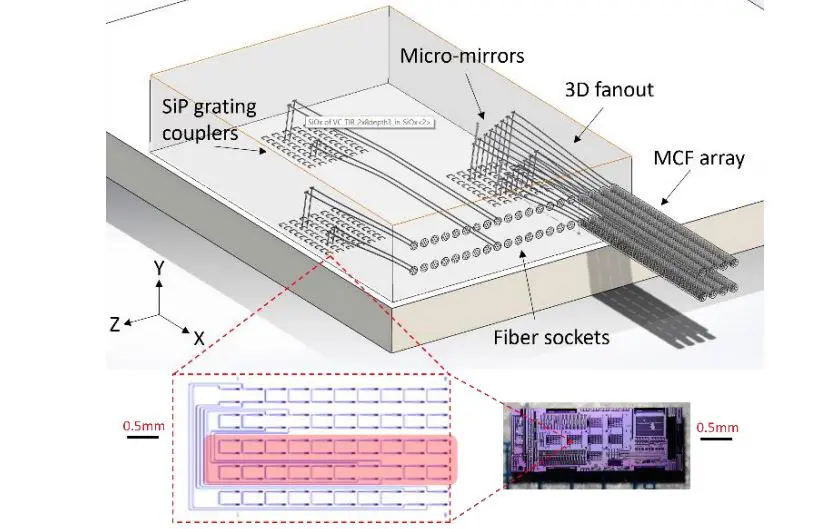
The increasing demand for data transfer speeds drives a need for denser optical connections, and researchers are now demonstrating a novel approach to achieve this. Gligor Djogo, Amir Rahimnouri, and Peter R. Herman, all from the University of Toronto, have pioneered a method for creating compact optical interposers using a femtosecond laser. This technique fabricates intricate photonic circuits within glass, enabling ultra-dense coupling of multiple optical fibres to silicon photonic chips, and represents a significant step towards overcoming bottlenecks in data networks and datacenters. The team successfully routed forty channels from six multi-core fibres onto a silicon chip, achieving low signal loss and a compact design that promises to dramatically increase connection density.
Glass Interposer for Multi-Core Fibers
Researchers developed a novel glass-based interposer chip containing intricate photonic circuits, including waveguides and micro-mirrors, to connect multi-core fibers to silicon photonics. This innovative approach enables ultra-dense routing of optical signals, paving the way for high-bandwidth communication systems. The team harnessed the precision of femtosecond laser writing to fabricate the circuits within a 1mm thick silica glass wafer, utilizing focused laser pulses to inscribe the optical pathways with submicron accuracy. The fabrication process involved carefully controlling laser parameters, such as pulse duration and repetition rate, to create waveguides with minimal loss.
Researchers optimized the design to compensate for aberrations introduced by the glass substrate, ensuring efficient light propagation through three-dimensional paths. Through meticulous optimization and fiber probing techniques, they achieved low-loss writing at a 1550nm wavelength, crucial for telecommunications applications. Micro-mirrors and fiber mounting sockets were created with overlapping laser scans, generating smooth surfaces for efficient light coupling. A final etching step completed the fabrication process, yielding fully etched interposer circuits ready for integration with optical systems. This technology offers a promising solution for overcoming interconnectivity challenges in high-performance computing and telecommunications.
Femtosecond Laser Fabrication of Photonic Interposer Chip
Researchers successfully fabricated a compact photonic interposer chip using femtosecond laser writing in glass, enabling ultra-dense routing of 40 optical channels from six multi-core fibers onto a silicon photonic chip. The design utilizes a two-layer array and vertical coupling. The team precisely controlled a fiber laser delivering ultrashort pulses to inscribe waveguides, micro-mirrors, and fiber sockets within a silica glass wafer. The fabrication process involved careful optimization of laser parameters to minimize propagation losses and ensure efficient light coupling. Researchers achieved low-loss waveguides by aligning laser polarization and controlling scanning speeds. Through meticulous design and testing, they optimized S-bend radii and minimized losses at waveguide intersections. The resulting interposer demonstrated low mirror insertion losses and minimal added loss when coupling fibers to waveguides.
Dense Optical Fanout with Laser-Written Glass
Scientists fabricated a compact optical interposer using femtosecond laser writing in glass, enabling ultra-dense routing of optical signals from multi-core fibers onto silicon photonic chips. The design utilizes waveguides, micro-mirrors, and fiber sockets arranged in a two-layer array for vertical coupling. Extensive testing revealed an average single-pass insertion loss of 5. 0 dB, demonstrating the potential for high-performance optical interconnects. Researchers discovered that minimizing waveguide offsets resulted in the lowest overall fanout loss.
Detailed measurements of insertion loss across all 40 channels revealed a cyclical pattern correlated with guiding layer depths and S-bend offsets. These findings demonstrate the precision and control achievable with laser-written glass circuits. Final packaged interposers achieved a low average channel-by-channel insertion loss, demonstrating the reproducibility and routing flexibility of laser-written optical circuits in three-dimensional volumes. Adjustments to laser-written waveguide depths compensated for surface aberrations and nonlinear propagation effects, further improving coupling efficiency.
High Density Fiber-Chip Coupling Demonstrated
This research demonstrates a robust and high-density platform for vertically coupling multi-core fibers onto silicon photonic chips, achieved through femtosecond laser writing in glass. Scientists successfully fabricated an interposer capable of routing 40 channels from a two-dimensional multi-core fiber array onto a grid of silicon photonic grating couplers, attaining an average single-pass insertion loss of 5. 0 dB. This achievement represents a significant step towards realizing high-density optical interconnects. The flexibility of the fabrication process allows for complex mirror arrangements and waveguide routing, paving the way for customized optical circuits.
Researchers acknowledge that further optimization of the laser beam delivery and exploration of alternative glass compositions could further reduce propagation losses. Future work promises to increase channel numbers and further densify interconnects, addressing a critical bottleneck in the integrated optics and telecommunication industries. This achievement represents a significant step towards overcoming interconnectivity challenges and enabling higher bandwidth communication systems, promising to revolutionize data transmission and processing capabilities.
🗞 Laser Structured Optical Interposer for Ultra-dense Vertical Coupling of Multi-core Fibers to Silicon Photonic Chip
🧠 ArXiv: https://arxiv.org/abs/2512.01972