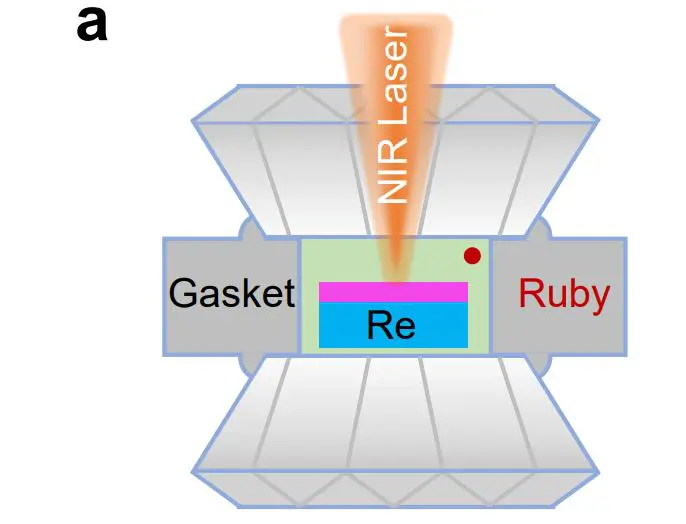
Two-dimensional diamond represents a potentially transformative material for future nanoelectronics and optoelectronic devices, offering superior properties and flexibility compared to traditional bulk diamond. Jiayin Li, Guoshuai Du, and Lili Zhao, along with their colleagues, have now successfully demonstrated the experimental creation of high-quality, two-dimensional diamond with precisely controlled thickness and remarkable characteristics. This achievement, realised through laser heating within a diamond anvil cell, overcomes significant hurdles in the synthesis and control of this material, producing quenched 2D diamond exhibiting exceptionally narrow Raman peaks and intense photoluminescence from key defect centres. Crucially, the team also elucidates the transformation mechanism, revealing that an intermediate rhombohedral phase subtly guides the transition from hexagonal graphite to cubic diamond, offering new insights into the creation of diverse carbon allotropes and their underlying physics.
Graphene Transforms to Tunable Diamond Films
Scientists have pioneered a method for directly transforming few-layer graphene into high-quality, two-dimensional diamond using laser heating within a diamond anvil cell. This innovative technique allows precise control over the thickness and properties of the resulting diamond material, opening new avenues for nanoscale applications. The process selectively converts graphene into diamond while leaving surrounding areas unchanged, and researchers carefully monitored the structural changes using Raman spectroscopy to confirm successful carbon bonding. The synthesized 2D diamond flakes exhibit exceptional crystalline quality, closely matching that of commercial diamond crystals.
Further characterization revealed intense photoluminescence from silicon-vacancy and nitrogen-vacancy color centers, indicating the presence of these quantum emitters within the diamond lattice. Researchers employed mapping techniques to analyze the distribution of these color centers, revealing influences from the synthesis environment. Detailed analysis using high-resolution microscopy revealed the coexistence of both hexagonal and cubic diamond structures within the synthesized material. These observations confirm the successful transition from graphene to diamond under specific conditions, with an intermediate phase potentially mediating the structural change. The team established a clear relationship between the material’s structure and its properties, paving the way for the development of advanced carbon allotropes.
Laser Synthesis of High-Quality 2D Diamond
Scientists have developed a novel method for synthesizing high-quality, two-dimensional diamond using laser heating within a diamond anvil cell. This technique enables precise control over the thickness and properties of the resulting 2D diamond material, extending the possibilities for nanoscale devices. The process involves applying laser energy to few-layer graphene under high pressure, selectively transforming it into diamond. The resulting 2D diamond exhibits exceptional crystalline quality, with a narrow Raman peak linewidth closely approximating that of commercial diamond crystals. Intense photoluminescence from silicon-vacancy and nitrogen-vacancy color centers further confirms the material’s quality.
Researchers employed mapping techniques to analyze the distribution of these color centers, revealing influences from the synthesis environment. Detailed analysis using high-resolution microscopy revealed the coexistence of both hexagonal and cubic diamond structures within the synthesized material. These observations confirm the successful transition from graphene to diamond under specific conditions, with an intermediate phase potentially mediating the structural change. The team established a clear relationship between the material’s structure and its properties, paving the way for the development of advanced carbon allotropes.
Graphene Transforms into High-Quality 2D Diamond
Scientists have achieved the experimental synthesis of high-quality, two-dimensional diamond with controlled thickness using a novel laser-heating technique within a diamond anvil cell. This research demonstrates a method for transforming few-layer graphene into diamond structures, ranging from bilayer to several hundred nanometers in thickness. The resulting 2D diamond exhibits high structural order, as confirmed by Raman spectroscopy. Intense photoluminescence from silicon-vacancy and nitrogen-vacancy color centers further confirms the material’s quality. Detailed analysis of the atomic structures revealed an intermediate phase that plays a crucial role in mediating the transition from hexagonal graphite to cubic diamond.
Researchers established crystallographic relationships demonstrating the structural evolution during the transformation process. The team measured the optical bandgap of the synthesized 2D diamond, finding it to be tunable and dependent on the concentration of sp3 carbon bonding. Tests confirm the exceptional thermal stability of the ultrathin diamond structures. This work provides critical insights into the structural control and transition mechanisms of 2D diamond, paving the way for the development of advanced carbon allotropes and nanoscale devices.
Graphene to Diamond Phase Transition Revealed
This research demonstrates the successful synthesis of high-quality, two-dimensional diamond through a high-pressure, high-temperature process involving laser heating of few-layer graphene. The resulting 2D diamond exhibits well-defined crystalline structure and strong photoluminescence from specific color centers, indicating its potential for optoelectronic applications. Investigations into the material’s properties reveal a clear relationship between its sp3 carbon concentration and both its optical bandgap and thermal stability, offering a pathway to tune these characteristics. The team further elucidated the transformation mechanism from graphene to diamond, identifying an intermediate phase that facilitates the structural transition.
This understanding of the phase transition pathways contributes to a more complete picture of carbon allotrope formation. The achieved synthesis method and resulting material properties lay a foundation for the development of novel carbon materials and broaden their potential applications in various fields. Researchers acknowledge that the thermal stability and optical properties are sensitive to the sp3 carbon concentration, suggesting that precise control over this parameter is crucial for optimizing material performance. Future research may focus on refining the synthesis process to achieve even greater control over sp3 content and exploring the full range of potential applications for this newly synthesized 2D diamond.
🗞 Experimental Demonstration and Transformation Mechanism of Quenchable Two-dimensional Diamond
🧠 ArXiv: https://arxiv.org/abs/2512.12916