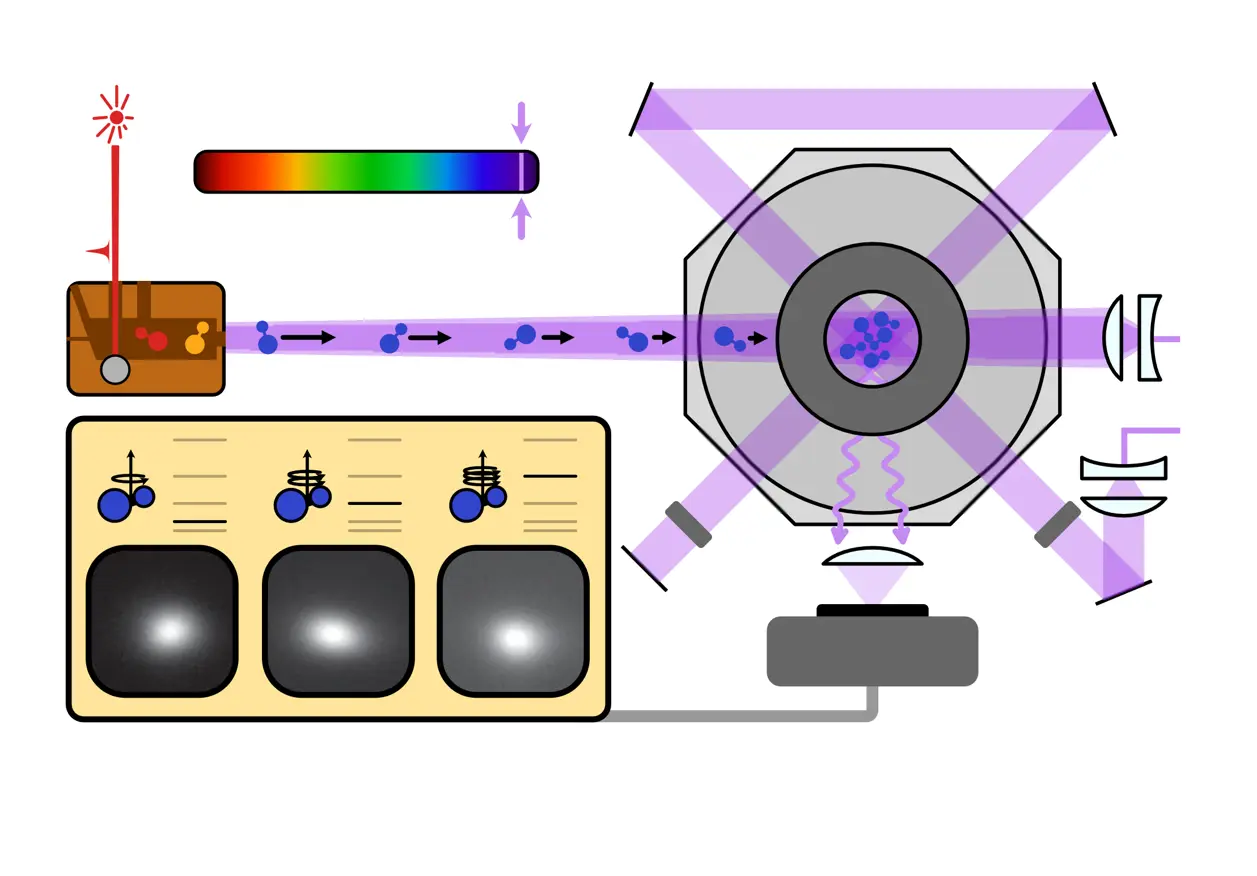
Imagine controlling the movement of individual molecules with light, slowing them to near absolute zero—a new breakthrough from the Fritz Haber Institute is making that vision a reality. Researchers have, for the first time, successfully trapped and laser-cooled a stable molecule, aluminum monofluoride (AlF), opening exciting new avenues in ultracold physics and quantum research. This achievement overcomes significant hurdles in molecular cooling, previously limited to simpler atoms, and allows scientists to probe the fundamental properties of molecules with unprecedented precision. By harnessing the power of deep ultraviolet light, this work not only sets a record for the shortest wavelength used in a molecular trap, but also promises advancements in areas like quantum simulation and spectroscopic measurement.
Laser Cooling and Magneto-Optical Trapping Explained
Researchers at the Fritz Haber Institute have achieved a breakthrough in laser cooling by creating the first magneto-optical trap (MOT) for a stable “closed-shell” molecule: aluminum monofluoride (AlF). This feat required pushing laser technology to its limits, utilizing wavelengths as short as 227.5 nm – the shortest ever used in a MOT. Cooling to millikelvin temperatures—near absolute zero—unlocks the potential for studying quantum mechanics with molecular systems, offering new avenues for precision spectroscopy and quantum simulation.
A key advancement is AlF’s unique electronic structure. Unlike previously trapped molecules, AlF is a “spin-singlet,” possessing a strong chemical bond and inherent stability. This allows researchers to selectively cool and trap molecules in three different rotational levels – a first in laser cooling experiments. The ability to manipulate rotational states expands the possibilities for controlling molecular behavior and conducting more complex quantum experiments, moving beyond the limitations of single-state trapping.
This accomplishment isn’t just about reaching incredibly low temperatures. The stability of AlF minimizes experimental losses due to chemical reactions, a significant hurdle with other laser-cooled molecules. Furthermore, the team anticipates even colder temperatures are achievable by accessing a “metastable” electronic state within AlF. This opens doors to explore fundamental physics and potentially build advanced technologies reliant on precise molecular control.
First Trapping of a Stable “Closed-Shell” Molecule
Researchers at the Fritz Haber Institute have achieved a breakthrough in ultracold physics: the first successful magneto-optical trap (MOT) of a stable “closed-shell” molecule, aluminum monofluoride (AlF). This marks a significant step beyond previous molecular trapping, which focused on reactive species. The team cooled AlF to millikelvin temperatures using lasers at an exceptionally short wavelength of 227.5 nm – a record for this type of trap. This accomplishment paves the way for advanced precision spectroscopy and quantum simulations utilizing a chemically inert molecular system.
The unique properties of AlF – its strong chemical bond and “spin-singlet” electronic structure – make it ideal for ultracold studies. Unlike previous laser-cooled molecules prone to reactions, AlF remains stable, simplifying experimental control. Crucially, the team demonstrated the ability to selectively trap AlF in three different rotational quantum levels – a feat never before achieved. This versatility broadens the potential for exploring molecular quantum behavior and controlling its states with unprecedented precision.
This advancement required overcoming significant technical hurdles, particularly in generating and controlling deep-ultraviolet laser light. The achievement highlights the importance of interdisciplinary collaboration, combining expertise in laser technology, optics, and molecular physics. Future work aims to develop more compact and efficient sources of AlF, potentially leading to practical applications in areas like quantum computing and precision sensing.
Record-Breaking Deep Ultraviolet Laser Technology
Researchers at the Fritz Haber Institute have achieved a breakthrough in ultracold physics by creating the first magneto-optical trap for aluminum monofluoride (AlF), a stable “closed-shell” molecule. This feat required pushing laser technology to its limits, utilizing a record-breaking wavelength of 227.5 nm – the shortest ever used in such a trap. Cooling molecules to near absolute zero unlocks new possibilities for precision spectroscopy and quantum simulation, offering a microscopic view of quantum behavior previously inaccessible with molecules.
The unique properties of AlF—its strong chemical bond and “spin-singlet” electronic structure—made it a challenging but ideal candidate for laser cooling. Unlike previous molecular trapping experiments focusing on reactive species, AlF’s stability minimizes loss due to chemical reactions. Crucially, the team demonstrated the ability to selectively trap AlF in three different rotational quantum levels, a level of control not previously achieved with laser-cooled molecules, expanding potential for quantum control experiments.
This accomplishment represents a significant step forward, requiring eight years of development and strong industry-academic collaboration to innovate deep-ultraviolet laser technology. Future work aims to simplify the AlF source and leverage a long-lived “metastable” electronic state within the molecule to reach even colder temperatures, potentially opening doors to novel quantum phenomena and applications in fields like quantum computing and precision measurement.
Potential for Precision Measurements and Quantum Control
Researchers at the Fritz Haber Institute have achieved a breakthrough in ultracold physics by creating the first magneto-optical trap for aluminum monofluoride (AlF), a stable “closed-shell” molecule. Utilizing lasers at a record-short wavelength of 227.5 nm – deep into the ultraviolet spectrum – they cooled and trapped AlF to millikelvin temperatures. This is significant because AlF’s robust chemical bond and unique electronic structure make it ideal for precision measurements and quantum simulations, overcoming challenges previously limited to reactive molecules.
The ability to selectively trap AlF in three different rotational quantum levels represents a major advancement. Previous laser-cooled molecules were typically limited to a single level, hindering complex experiments. This multi-level control, combined with AlF’s chemical stability, opens pathways to explore molecular behavior with unprecedented precision. Researchers envision a future with compact, affordable AlF sources, potentially mirroring the accessibility of alkali atom traps used in today’s atomic clocks and quantum computers.
This achievement isn’t just about cooling a molecule; it’s about expanding the toolkit for quantum control. AlF possesses a long-lived “metastable” electronic state, offering the potential to reach even colder temperatures and unlock new quantum phenomena. Funded by projects like UVQuanT and CoMoFun, the eight-year effort demonstrates the power of interdisciplinary collaboration and sets the stage for groundbreaking advances in precision spectroscopy and molecular quantum simulation.