Chirality, the property of being non-superimposable on its mirror image, profoundly influences a material’s physical characteristics, yet controlling and studying its effects on electrical behaviour remains a significant challenge. Volodymyr Levytskyi, Ulrich Burkhardt, Markus König, and colleagues at institutions including TU Bergakademie Freiberg and the Max-Planck-Institut für Chemische Physik fester Stoffe now present a detailed investigation into the chiral compound LaRhC, successfully isolating and examining individual enantiomorphs, mirror image forms, of the material. Their work reveals a marked anisotropy, or direction-dependent behaviour, in key properties such as electrical conductivity, thermal expansion, and magnetoresistance, establishing LaRhC as a semiconductor with distinct band gaps depending on the crystallographic direction. This achievement not only demonstrates the possibility of decoupling enantiomorph behaviour within a single material, but also opens new avenues for exploring chirality-driven electronic effects and potentially designing novel chiral devices.
LaRhC2 Lattice Parameters and Energy Gaps
This research presents detailed experimental data on the structural and electrical characteristics of the material LaRhC2. Scientists meticulously measured how the material’s lattice parameters, defining its atomic arrangement, change with temperature, providing insights into its thermal expansion and structural stability. The study also investigated the electrical resistivity of LaRhC2 microdevices, revealing how easily electricity flows through the material. Crucially, the team discovered that the energy required for charge carriers to move through LaRhC2, known as the activation energy, varies depending on the orientation of the microdevice, demonstrating that electrical conductivity is direction-dependent.
Chirality and Structure of LaRhC Investigated
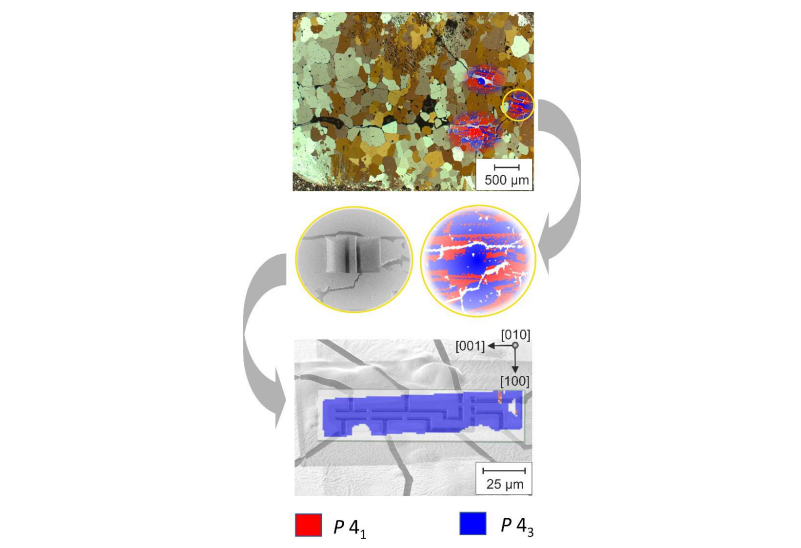
Researchers pioneered a comprehensive approach to investigate the electrical and thermal properties of the chiral material LaRhC. They carefully prepared samples to isolate specimens exhibiting a single handedness, essential for accurate measurements. Using focused ion beam techniques, they extracted tiny cubes and thin slices from polycrystalline samples, enabling precise electrical measurements on these isolated domains. Single-crystal X-ray diffraction, performed at various temperatures, confirmed the material’s chirality and refined its crystal structure. To definitively establish chirality, the team employed electron backscatter diffraction, comparing measured patterns with simulations to distinguish between the mirror-image forms of the material. Electrical resistivity measurements, conducted across a broad temperature range and in strong magnetic fields, revealed how conductivity changes with temperature and magnetic influence.
Chiral LaRhC2 Exhibits Anisotropic Semiconductor Behaviour
The research team successfully obtained single-crystal specimens of LaRhC2, a material exhibiting a chiral crystal structure, and thoroughly characterized its electrical and thermal properties. Using electron backscatter diffraction, scientists identified and isolated individual mirror-image forms of the material, confirming the existence of both left- and right-handed versions. Focused ion beam techniques enabled the extraction of these pure specimens for detailed analysis, revealing LaRhC2 to be a semiconductor with distinct energy gaps depending on the direction of measurement relative to the crystal structure. Measurements of thermal expansion and electrical resistivity demonstrate significant anisotropy, meaning the material’s properties differ depending on the crystallographic direction. This anisotropy arises from the unique arrangement of atoms within the crystal, influencing how it conducts electricity and responds to temperature changes. The analysis revealed a unique structural feature, dumbbell-shaped arrangements of atoms, contributing to the compound’s chiral properties.
Chirality’s Subtle Impact on LaRhC Properties
Researchers successfully isolated and studied individual mirror-image forms of LaRhC, a material possessing a chiral crystal structure, to determine the influence of chirality on its behaviour. Through meticulous preparation of micro-scale specimens using advanced microscopy and microfabrication techniques, the team established that LaRhC is a narrow-band semiconductor with distinct electronic characteristics. Importantly, both mirror-image forms exhibited similar electrical conductivity and a weak sensitivity of electrical resistance to magnetic fields along specific crystallographic directions. The observed anisotropy in electrical resistivity and thermal expansion demonstrates that the material responds differently depending on the orientation of the crystal. These findings reveal that chirality impacts charge transport even in materials lacking the complex properties often associated with chiral systems, expanding understanding beyond more complex materials. This study establishes a robust methodology for investigating the role of chirality in a range of materials, providing a foundation for further exploration of this fundamental property.
🗞 Anisotropy of the chiral, semiconducting phase LaRhC : a handedness resolved study
🧠 ArXiv: https://arxiv.org/abs/2509.21510