The pursuit of novel electronic states in layered materials has led researchers to investigate the unusual properties arising from the interplay of magnetism and topology, and a team led by Guopeng Xu, Nemin Wei from Yale University, and Inti Sodemann Villadiego from Universität Leipzig now reports significant advances in understanding these phenomena. Their work focuses on the behaviour of electrons in specifically designed layered structures, where opposing magnetic fields create unique conditions for the formation of localized excitons and the mixing of Landau levels, a quantum mechanical effect governing electron behaviour in magnetic fields. By employing advanced theoretical calculations, the team, which also includes Chunli Huang from the University of Kentucky, reveals how these interactions lead to enhanced spin correlations and the emergence of quasiparticles with potentially groundbreaking implications for the development of fractional spin Hall insulators and Chern ferromagnets, predicting a complex relationship between material properties and magnetic ordering temperatures. This research offers a crucial step towards designing materials with tailored electronic properties and opens new avenues for exploring exotic quantum states of matter.
Landau Level Mixing and Interaction Corrections
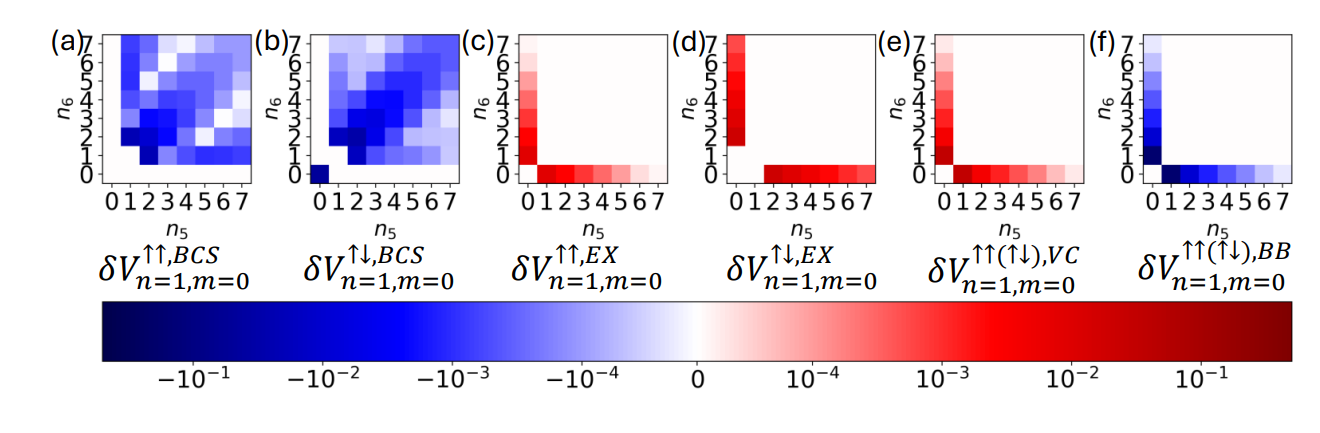
Researchers investigated Landau-level mixing, a crucial phenomenon for understanding electrons in twisted bilayers, employing a sophisticated theoretical approach. They computed corrections to electron interactions, revealing how Landau-level mixing alters these interactions at different electron densities and meticulously analyzed screening effects, revealing a pattern where screening differs depending on the electron’s energy level. In the lowest energy level, short-range spin anisotropy is particularly pronounced. To achieve these results, scientists derived effective interactions, enabling a detailed understanding of how Landau-level mixing modifies fundamental interactions. A key innovation is the demonstration that spin-flip excitations form localized quasiparticles, contrasting with delocalized waves found in conventional materials. Calculations of the excitation spectrum reveal that Landau-level mixing softens these excitations, shifting the lowest energy mode depending on the system’s properties, impacting magnetic order and creating a non-monotonic relationship between ordering temperature and the strength of Landau-level mixing, providing a potential experimental signature for these effects.
Even-Odd Effect Reveals Landau Level Mixing
This work details a comprehensive study of Landau-level mixing in a unique system relevant to the behaviour observed in twisted bilayers. Scientists investigated how electrons behave in these materials, focusing on the interplay of strong spin-orbit coupling and Coulomb interactions. Through a theoretical approach, they computed corrections to specific energy levels, revealing how Landau-level mixing alters the electronic structure at different electron densities. Experiments demonstrated an “even-odd effect” in the lowest energy level, where screening is more pronounced for certain energy levels than others, specifically reduced for even energy levels and less strongly for odd energy levels.
In the lowest energy level, the short-range part of the interaction is comparable across different states, but the strongest spin anisotropy appears in the interactions, with significant implications for realizing materials exhibiting unusual quantum properties. A key finding is that spin-flip excitations form localized quasiparticles, unlike the delocalized waves seen in conventional materials. Scientists computed the excitation spectrum of these quasiparticles, predicting a non-monotonic relationship between the ordering temperature of a specific magnetic order and the Landau-level mixing parameter, observing mode softening where the lowest mode lies at a specific energy level in the lowest energy state and a level crossing shifts the softest mode in a higher energy state, controlling magnetization and influencing the stability of the magnetic state.
Landau Level Mixing and Localized Spin Excitations
This research details how interactions between electrons in twisted bilayers affect their magnetic properties, specifically focusing on the behaviour of Landau levels. The team demonstrates that mixing between these Landau levels generates spin-anisotropic corrections to fundamental interactions, altering how electrons respond to magnetic fields. Importantly, they found that the screening of these interactions exhibits a distinct pattern dependent on the energy level. A key finding is the prediction of localized spin-flip excitations, behaving as quasiparticles unlike the delocalized waves seen in conventional systems. Calculations reveal that Landau-level mixing softens these excitations, influencing the stability of a specific magnetic order and creating a non-monotonic relationship between the ordering temperature and the strength of the Landau-level mixing. This work provides a concrete mechanism for how magnetic order in these materials can become unstable, potentially favouring the formation of excitons, bound electron-hole pairs, carrying angular momentum.
🗞 Localized Excitons and Landau-Level Mixing in Time-Reversal Symmetric Pairs of Chern Bands
🧠 ArXiv: https://arxiv.org/abs/2509.18438