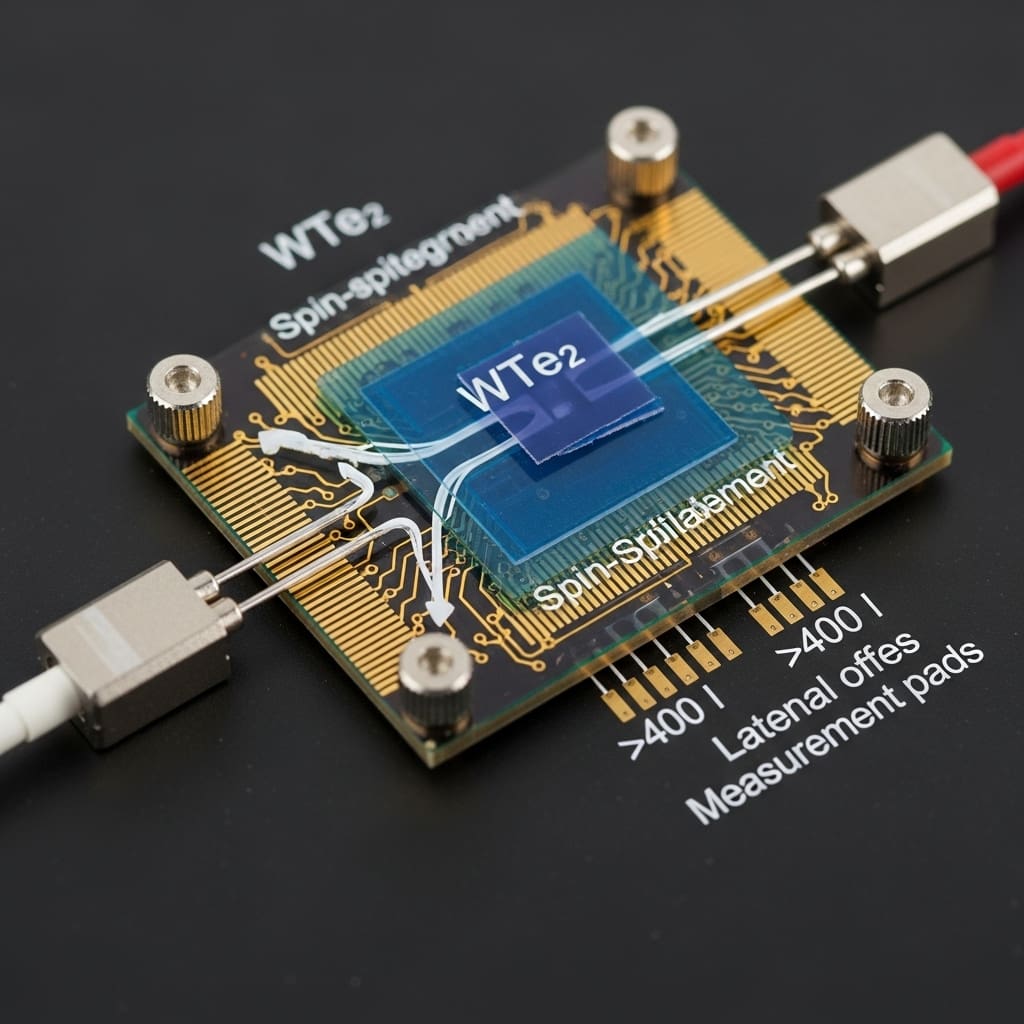
The ability to manipulate light’s spin at the nanoscale promises advances in controlling electronic properties within two-dimensional materials, and recent work explores this potential in tungsten ditelluride (WTe2). Qiaoyun Ma, Hui Dou, Yiting Chen, and colleagues investigate the photonic spin Hall effect (PSHE) in monolayer WTe2, revealing how transitions between specific energy levels, known as Landau levels, dramatically influence the effect. Their theoretical results demonstrate that the PSHE exhibits markedly different behaviours depending on these Landau level transitions and external magnetic fields, with the largest observed shifts exceeding 400times the wavelength of incident light. This research establishes a strong link between the Hall angle of the material and the magnitude of the photonic spin Hall shift, offering fundamental insights into how light interacts with spin-orbit coupling in systems where time-reversal symmetry is broken.
The study demonstrates how Landau quantization, the formation of quantized energy levels in a magnetic field, significantly influences the PSHE, allowing for active manipulation by controlling the Landau level index. Researchers also explore the connection between the PSHE and the material’s topological properties, providing a pathway for developing novel optoelectronic devices. The findings reveal a strong coupling between the PSHE in WTe2 and its Landau levels, meaning the energy levels of electrons in a magnetic field directly affect how light’s spin is separated.
This tunability is a significant advantage for potential applications, and linking the PSHE to the material’s topological properties provides deeper insight into the underlying physics. This work, based on solid theoretical foundations and detailed calculations, demonstrates the potential for developing new optoelectronic devices, such as spin-based sensors, modulators, and switches. The findings could guide the design of new materials with enhanced PSHE properties and pave the way for nanoscale optical devices. This research provides a significant contribution to understanding the photonic spin Hall effect in two-dimensional materials and opens up new possibilities for developing advanced optoelectronic devices. Investigating the PSHE in other two-dimensional materials with different electronic properties could lead to new discoveries.
Photonic Spin Hall Effect in WTe2 Monolayers
Scientists have achieved a breakthrough in understanding how light interacts with two-dimensional materials, specifically monolayer WTe2, by engineering the photonic spin Hall effect (PSHE) using Landau levels. This work demonstrates precise control over the steering of light’s spin through manipulation of quantum mechanical states within the material. The study reveals that giant spin Hall shifts, exceeding 400times the incident wavelength, can be achieved at specific Landau level transitions, particularly when the Hall angle approaches zero. This confirms a strong link between the Hall angle and the magnitude of the photonic spin Hall effect, providing insights into the fundamental interplay between light and spin-orbit interactions in these materials. Researchers developed a response theory framework to calculate the material’s optical properties and predict its behavior under varying conditions, constructing a detailed Hamiltonian to incorporate the effects of band inversion and electron interactions. This model accounts for the specific orbital contributions from tungsten and tellurium atoms within the WTe2 lattice.
Photonic Spin Hall Effect in WTe2 Monolayers
Scientists have achieved a breakthrough in understanding how light interacts with two-dimensional materials, specifically monolayer WTe2, by engineering the photonic spin Hall effect (PSHE) using Landau levels. This work demonstrates precise control over the steering of light’s spin through manipulation of quantum mechanical states within the material. Experiments revealed that the variation in photonic spin Hall shifts closely mirrors changes in the Hall angle as the Landau level index changes. Notably, the team observed giant PSHE, with the largest in-plane displacement exceeding 400times the incident wavelength, occurring at a specific Landau level transition. Further analysis demonstrated that in-plane and transverse spin-dependent displacements reach their maximum values at the same incident angles when the Hall angle is near zero, with deviations increasing as the absolute value of the Hall angle increases. These measurements unambiguously confirm the strong influence of the Hall angle on the PSHE, providing critical insights into the fundamental spin-orbit interaction of light in materials lacking time-reversal symmetry.
Landau Levels Drive Photonic Spin Hall Effect
This research demonstrates a strong connection between Landau level engineered photonic spin Hall effect and the Hall angle in monolayer WTe2. Scientists discovered that manipulating transitions between Landau levels induces distinct behaviors in the photonic spin Hall effect, depending on the specific energy level changes. Notably, the largest observed displacement of light polarization exceeded 400times the incident wavelength at a specific Landau level transition. This finding establishes a foundation for manipulating light at the nanoscale and developing advanced optical technologies based on two-dimensional materials.
👉 More information
🗞 Landau-level-dependent photonic spin Hall effect in monolayer WTe2
🧠 ArXiv: https://arxiv.org/abs/2511.20311