

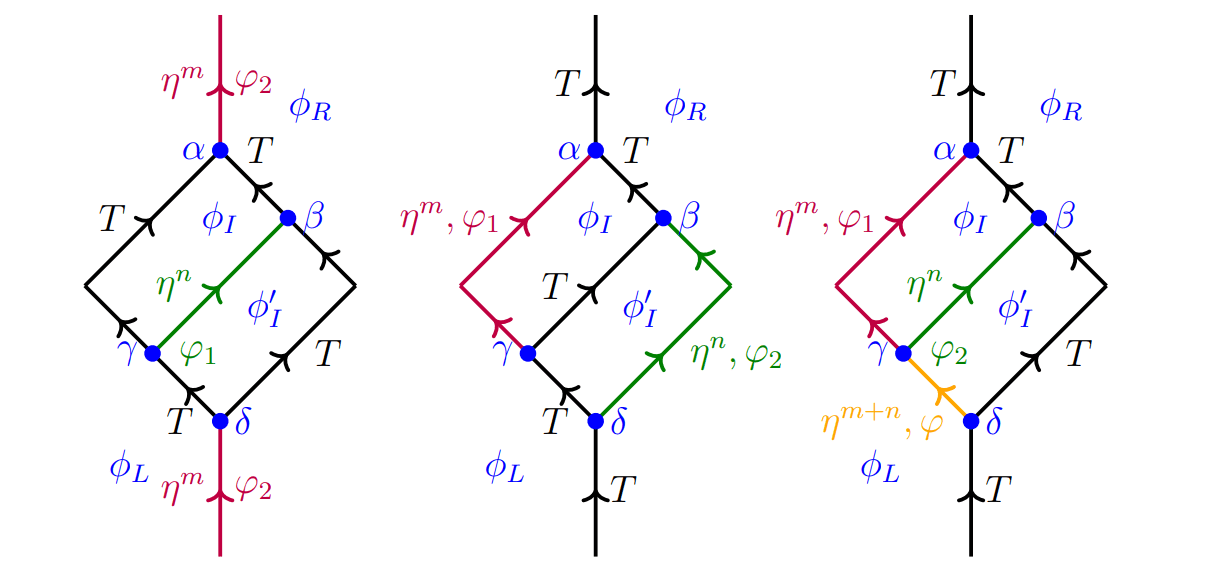
The subtle architecture of symmetry governs the behaviour of physical systems, and increasingly, physicists recognise that symmetry is more than just a list of transformations; it’s defined by how defects interact and combine. Seolhwa Kim, Orr Sela, and Zhengdi Sun, working at the University of California, Los Angeles and the Ecole Polytechnique Federale de Lausanne, investigate this ‘higher structure’ of symmetry in theories possessing non-invertible symmetries, symmetries that do not allow for a simple reversal of transformations. Their work demonstrates how to construct explicit descriptions of networks of these symmetry-implementing defects directly from the underlying equations of motion, revealing a powerful new way to understand and calculate the complex rules governing their interactions. By applying this method to both established theories and more exotic systems like Maxwell’s theory, the team recovers known mathematical structures and provides a pathway to explore the hidden symmetries of a wider range of physical phenomena.
The research investigates the symmetry and fusion rules of theories, alongside the topological networks these symmetries form, collectively termed the higher structure of the symmetry. This work focuses on theories possessing non-invertible symmetries with explicit Lagrangian descriptions, employing these to study their higher structure. Beginning with a two-dimensional model and its non-invertible duality defects, the team constructs descriptions of networks of defects, subsequently recovering all the mathematical structures of the Tambara-Yamagami category. The same approach is then applied to four-dimensional Maxwell theory to compute mathematical symbols associated with its non-invertible duality and triality defects.
Non-Invertible Symmetries and Duality Defects
This work delves into the fascinating and complex world of non-invertible symmetries, duality defects, and their connections to topological quantum field theories and condensed matter physics. The research explores symmetries that, unlike traditional symmetries like rotations, do not have inverses, a relatively new area with profound implications for understanding quantum field theories and their possible phases. Duality defects are topological defects arising when a symmetry becomes local, exhibiting exotic behavior not seen with ordinary symmetries and relating to fusion and tensor categories. Fusion and tensor categories are mathematical structures describing the properties of anyons, particles exhibiting unusual exchange statistics, and how they braid and fuse together, providing a powerful framework for understanding duality defects.
Topological quantum field theories, whose observables remain unchanged under continuous deformations of spacetime, are closely related to fusion categories and provide a natural setting for studying duality defects. Gauging a symmetry, making it local by introducing gauge fields, is standard in physics, but can lead to interesting phenomena when applied to non-invertible symmetries. Modular tensor categories, a special type of fusion category, satisfy certain mathematical properties and are closely related to the representation theory of modular transformations, playing a key role in constructing topological quantum field theories. These mathematical structures are also relevant to the study of anyons in condensed matter systems, such as fractional quantum Hall states.
The paper presents a comprehensive exploration of the interplay between non-invertible symmetries, duality defects, and their mathematical underpinnings. It outlines the growing interest in non-invertible symmetries and their potential to reveal new physics beyond the Standard Model, emphasizing the importance of understanding the mathematical structures that govern these symmetries. The work reviews the mathematical tools needed to study non-invertible symmetries and duality defects, including detailed explanations of fusion categories, tensor categories, modular tensor categories, and representation theory. It explores how duality defects arise when non-invertible symmetries are gauged, discussing the challenges and subtleties involved.
A key theme is the relationship between duality defects and topological quantum field theories, demonstrating how duality defects can be used to construct and classify these theories. This work challenges the conventional notion of symmetry by exploring non-invertible symmetries, opening up new possibilities for understanding the fundamental laws of physics. The use of fusion categories and duality defects provides a new way to classify quantum field theories, potentially leading to the discovery of new phases of matter and physical phenomena. The research bridges the gap between different areas of physics and mathematics, including quantum field theory, condensed matter physics, topology, and representation theory. The exploration of non-invertible symmetries could have profound implications for understanding the Standard Model and beyond, potentially providing clues to the nature of dark matter, dark energy, and other mysteries of the universe.
F-symbols and Non-Invertible Defect Networks Calculated
This research presents a breakthrough in understanding the higher structure of symmetries arising from non-invertible defects in field theories, achieving explicit calculations of crucial mathematical objects called F-symbols. Scientists successfully constructed descriptions of networks of these defects, enabling the computation of F-symbols for the well-known Tambara-Yamagami category, confirming previously known results and validating the methodology. The team then extended this approach to four-dimensional Maxwell theory, calculating F-symbols associated with duality and triality defects, which represent two-dimensional topological field theories and constitute new results. Experiments revealed that the calculated F-symbols for Maxwell theory are not unique, with multiple two-dimensional theories potentially corresponding to a single F-symbol depending on the chosen boundary conditions during computation.
Detailed analysis of the triality defects for even integer parameter values yielded explicit F-symbols, while a complementary group-theoretical approach was used to compute F-symbols for certain odd values, demonstrating consistency between the two methods. The results demonstrate that the group-theoretical and description-based approaches yield matching F-symbols, except in cases where the final result depends on whether the parameter is even or odd. The team constructed topological junctions between defects, including fusion junctions where two defects combine into a third, carefully accounting for boundary conditions and terms at these junctions. These junctions served as building blocks for constructing topological configurations of defects, which were then shrunk to interfaces to obtain the desired F-symbols. This method, while focused on F-symbols, can be extended to compute higher associators, opening avenues for further exploration of symmetry structures in field theories. The calculations provide a powerful tool for analyzing non-invertible symmetries and their implications for theoretical physics.
Defect Networks Reveal Symmetry Structure
This work demonstrates that the higher symmetry structure of a field theory, determined by how defects connect and interact, can be fully described by examining networks of these defects and their associated fusion rules. Researchers successfully constructed descriptions for networks of defects in both two and four-dimensional theories, recovering known mathematical structures called Tambara-Yamagami categories in the two-dimensional case. Furthermore, they extended this approach to four-dimensional Maxwell theory, calculating relevant mathematical symbols associated with duality and triality defects. The team also validated their method by independently calculating some of these symbols using a different, group-theoretical approach, confirming the consistency of their results. They showed how to define specific fusion outcomes by introducing additional junctions within these defect networks, and established conditions for gauge invariance and consistency at these junctions.
👉 More information
🗞 Higher structure of non-invertible symmetries from Lagrangian descriptions
🧠 ArXiv: https://arxiv.org/abs/2509.20540

