The unusual electrical properties of ‘strange metals’, materials exhibiting behaviour that defies conventional metallic descriptions, continue to challenge condensed matter physics. A key puzzle lies in understanding the nature of charge carriers within these systems, with evidence suggesting the breakdown of the traditional ‘quasiparticle’ picture, a concept describing electrons behaving as effectively independent entities. Recent experiments measuring ‘shot noise’ – the quantum fluctuations in electrical current – in heavy fermion strange metals, a prominent example of these materials, offer a new avenue for investigation. Researchers at Rice University, Princeton University, and the Vienna University of Technology, led by Yiming Wang, Shouvik Sur, Fang Xie, Haoyu Hu, Silke Paschen, Douglas Natelson, and Qimiao Si, present a theoretical study detailed in their article, ‘Suppression of shot noise at a Kondo destruction quantum critical point’, which explores the origins of these current fluctuations and demonstrates a significant reduction in shot noise near a specific type of quantum phase transition known as Kondo destruction criticality. This work utilises a theoretical model to explain experimental observations and provides insight into the fundamental behaviour of electrons in these complex materials.
Strange metals exhibit an atypical relationship between electrical resistance and temperature, deviating from the behaviour expected in conventional materials. Recent research focuses on understanding the microscopic mechanisms driving this unusual conductivity, specifically investigating the role of Kondo destruction in suppressing electrical noise. The Kondo effect, typically observed at low temperatures, arises from the interaction between conduction electrons and localised magnetic moments within a material. Kondo destruction refers to the suppression of this effect, potentially leading to altered charge transport properties.
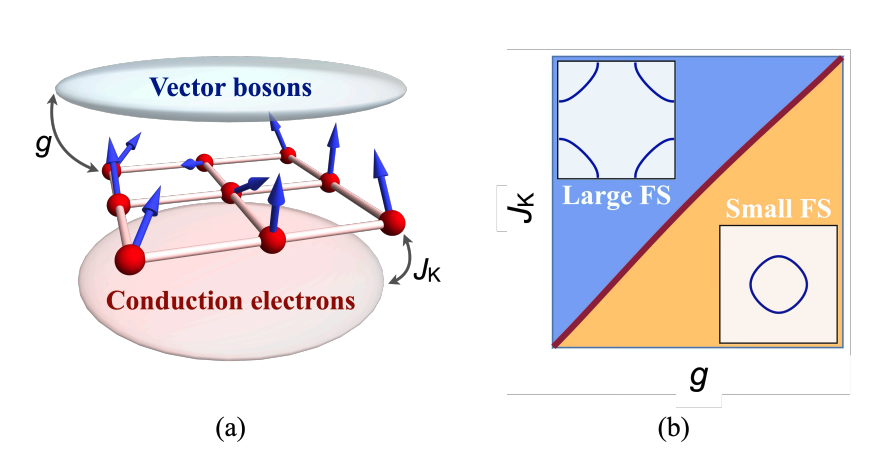
Researchers employ the Bose-Fermi Kondo lattice model, a theoretical framework describing interacting electrons and magnetic impurities arranged in a lattice structure, to simulate the behaviour of these materials. This model incorporates both fermionic electrons, which obey the Pauli exclusion principle, and bosonic excitations, which do not. Kinetic equations, mathematical descriptions of the rates of change in particle distributions, are then used to analyse the system’s dynamics. These equations allow scientists to predict how the system evolves over time and under different conditions.
Simulations reveal a marked suppression of shot noise,
Simulations reveal a marked suppression of shot noise, random fluctuations in electrical current, as the system nears a critical point associated with Kondo destruction. Shot noise arises from the discrete nature of electrical charge and provides information about the mechanisms governing charge transport. The observed reduction in shot noise aligns with experimental data obtained from measurements on actual strange metals, suggesting the Bose-Fermi Kondo lattice model accurately captures key aspects of their behaviour.
This research supports the hypothesis that the loss of quasiparticles, composite particles arising from the interactions of electrons within a material, is central to understanding the properties of strange metals. Quasiparticles effectively represent the collective behaviour of electrons and their interactions, and their disappearance signifies a fundamental change in the material’s electronic structure. The findings contribute to a growing body of evidence suggesting that unconventional mechanisms, beyond traditional electron-phonon interactions, govern charge transport in these complex materials.
🗞 Suppression of shot noise at a Kondo destruction quantum critical point
🧠 DOI: https://doi.org/10.48550/arXiv.2507.00960