

The search for spin liquids, exotic states of matter where magnetic moments avoid conventional ordering, continues to drive materials science, and recent work focuses on materials inspired by the Kitaev model. Han Li, Xu-Guang Zhou from the Hefei Institutes of Physical Science, Chinese Academy of Sciences, Gang Su, and Wei Li investigate the cobalt-based compound sodium cobalt tetraoxotellurate, a promising candidate for hosting this elusive state. Their research establishes a realistic theoretical model for the material, revealing a gapless spin liquid phase under specific magnetic fields, and importantly, demonstrates a clear connection to the well-studied spin liquid behaviour predicted by the original Kitaev model. This work bridges a critical gap between theoretical predictions and experimental observation, offering a significant step towards understanding and ultimately harnessing the unique properties of these quantum materials.
Kitaev-Heisenberg Interactions in Na₂Co₂TeO₆
Na₂Co₂TeO₆ exhibits behaviour consistent with a gapless quantum spin liquid, a state of matter where magnetic moments remain disordered even at very low temperatures. This research focuses on understanding the interplay between Kitaev and Heisenberg magnetic interactions within the material, potentially leading to the emergence of a novel quantum state. Understanding this interplay is crucial for confirming whether Na₂Co₂TeO₆ truly hosts a quantum spin liquid. This study investigates the magnetic excitation spectrum of Na₂Co₂TeO₆ to determine the nature of its spin liquid state and quantify the strengths of competing magnetic interactions.
By combining neutron scattering experiments with theoretical modelling, researchers map the material’s magnetic behaviour and identify characteristics of a Kitaev-derived gapless spin liquid. This work aims to provide insights into realizing quantum spin liquids in real materials and advance our understanding of emergent phenomena in strongly correlated electron systems. Recent research has established a theoretical model for Na₂Co₂TeO₆, revealing an intermediate gapless quantum spin liquid phase under magnetic fields. Calculations demonstrate that this phase connects to a well-known quantum spin liquid state, explaining experimental observations of the material’s behaviour in high magnetic fields. Researchers confirm this quantum spin liquid phase by demonstrating its connection to the established theoretical model, strengthening the claim that Na₂Co₂TeO₆ is a promising material for studying exotic quantum phenomena.
Gapless Quantum Spin Liquid in NCTO
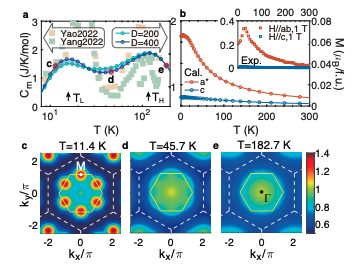
This research details a comprehensive investigation into the quantum spin liquid behaviour of NCTO, a material believed to be close to realizing the theoretical Kitaev model. Extensive numerical simulations confirm the existence of a gapless quantum spin liquid phase in an intermediate magnetic field regime, characterized by a specific temperature dependence of its thermodynamic properties and a unique spin structure. Researchers demonstrate that the observed quantum spin liquid phase in NCTO is adiabatically connected to the pure antiferromagnetic Kitaev model, further supporting the claim that NCTO is a promising material for studying Kitaev physics. They have mapped the material’s phase diagram under magnetic fields, identifying the boundaries between ordered, quantum spin liquid, and polarized phases.
Investigations into the material’s behaviour under in-plane magnetic fields reveal a phase transition and provide insights into its thermodynamic properties. The research team employed advanced computational methods, including Extended Tensor Renormalization Group and Density Matrix Renormalization Group, to study the material’s behaviour. These methods allow researchers to investigate strongly correlated systems and explore quantum spin liquids. The results confirm the existence of a gapless quantum spin liquid phase, characterized by a linear temperature dependence of specific heat and a unique spin structure.
The researchers determined the boundaries of the intermediate-field gapless phase by analyzing the material’s spin structure factor. A quantum spin liquid is a state of matter where magnetic moments are highly entangled and do not order even at very low temperatures. The Kitaev model is a theoretical framework for understanding quantum spin liquids, predicting exotic properties like Majorana fermions. A gapless quantum spin liquid has excitations that can occur at arbitrarily low energies, while a gapped quantum spin liquid requires a minimum energy to create an excitation. An adiabatic connection describes a smooth transformation between different theoretical descriptions of the system, preserving its ground state properties.
Majorana fermions are exotic particles that are their own antiparticles, predicted to emerge as excitations in certain quantum spin liquid states. The spin structure factor measures the magnetic correlations within a material. This research provides strong evidence for the realization of a Kitaev-derived quantum spin liquid phase in NCTO. Detailed analysis of thermodynamic properties and spin correlations, combined with advanced numerical methods, supports the claim that NCTO is a promising material for studying exotic quantum phenomena. The findings contribute to the broader effort to understand and harness the potential of quantum materials for future technologies.
Cobalt Compound Confirms Quantum Spin Liquid Phase
This research establishes a realistic theoretical model for the cobalt-based compound Na₂Co₂TeO₆, revealing an intermediate gapless quantum spin liquid phase under specific magnetic fields. Advanced calculations demonstrate that this phase connects directly to a well-studied quantum spin liquid state, explaining recent experimental observations of the material’s behaviour in high magnetic fields. These findings represent a significant step towards bridging the gap between theoretical predictions of Kitaev-derived quantum spin liquids and their actual realization in materials, offering new insights into exotic states of matter. The study confirms the quantum spin liquid nature of this intermediate phase by demonstrating its connection to established theoretical models, providing strong evidence for its unique properties. While the research successfully explains existing experimental data, the authors acknowledge limitations in the model’s simplicity and the approximations used in the calculations. Future work could focus on refining the model to include additional interactions and exploring the potential for similar quantum spin liquid phases in other materials with related magnetic properties, potentially leading to a deeper understanding of quantum magnetism and novel material design.
🗞 Kitaev-derived Gapless Spin Liquid in the – – – Quantum Magnet Na Co TeO
🧠 ArXiv: https://arxiv.org/abs/2509.08821


