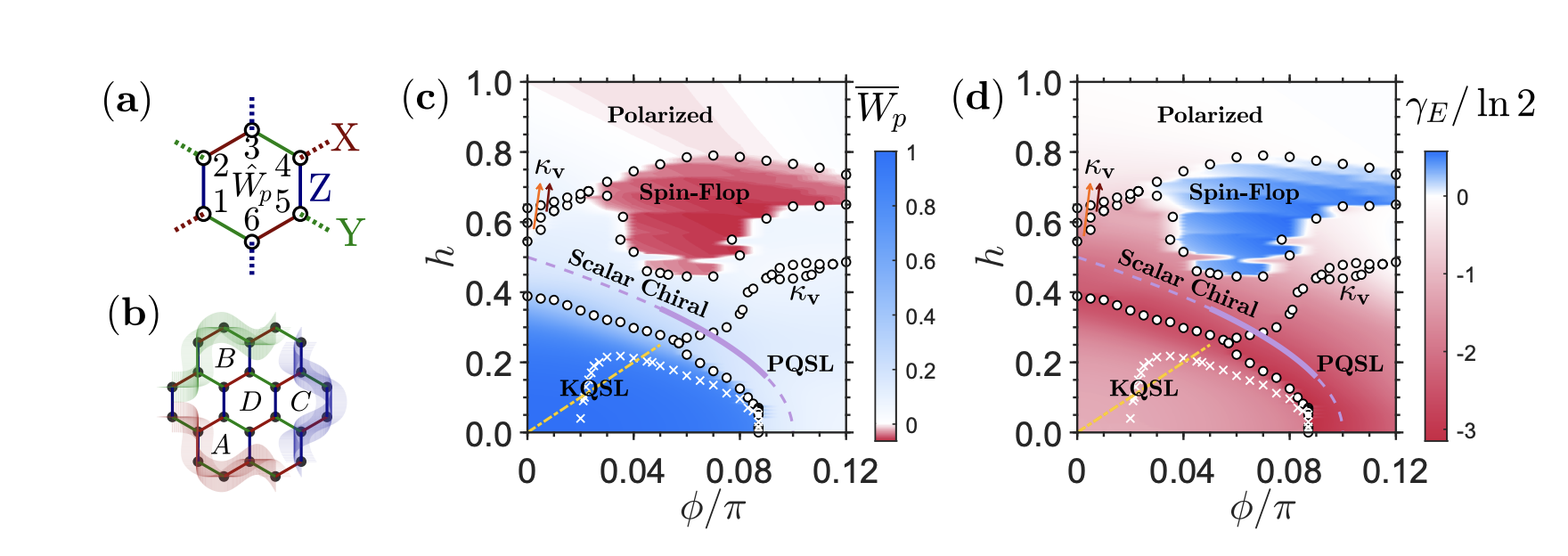
Kitaev magnets represent a fascinating frontier in the study of frustrated magnetism, offering a unique environment where interactions between electrons drive exotic quantum behaviour. Shuai Liu, Hao Wu, and Jinbin Li, along with colleagues at their respective institutions, now shed light on the complex interplay between these interactions and external magnetic fields within these materials. Their research reveals the emergence of a quantum spin liquid state, where electron spins remain disordered even at extremely low temperatures, alongside a previously unobserved spin-flop phase, a dramatic reorientation of magnetic moments. These findings not only resolve longstanding puzzles regarding the behaviour of Kitaev magnets, but also provide crucial guidance for identifying and understanding similar quantum phenomena in future material discoveries.
Kitaev magnets have emerged as pivotal systems for investigating frustrated magnetism, providing a unique platform to explore quantum phases governed by the interplay between bond-dependent anisotropy and external magnetic fields. This work performs unbiased exact diagonalization calculations of the Kitaev, Γ model in a magnetic field on a C6-symmetric 24-site cluster. By calculating the Z2 flux density and the topological entanglement entropy, the researchers reveal multiple phase transitions and identify signatures of both scalar and vector chiral orders.
Kitaev Materials and Quantum Spin Liquids
This collection of research papers demonstrates a deep involvement in the study of quantum magnetism, particularly focusing on materials that exhibit or are predicted to exhibit Kitaev physics and related phenomena. The core themes revolve around the Kitaev model and the search for quantum spin liquids, exotic phases of matter where spins are highly entangled and do not order even at zero temperature. A central focus is the emergence of fractionalized excitations, particularly Majorana fermions, which are predicted to be key players in Kitaev quantum spin liquids and potential building blocks for topological qubits. Research also concentrates on magnetic transitions and phase diagrams, alongside the development of advanced computational techniques to study these complex quantum systems.
There is a growing interest in extending the Kitaev model to include additional interactions and exploring the resulting phase diagrams and emergent phenomena, as well as the discovery and characterization of new materials that may host Kitaev physics. The papers can be broadly categorized into theoretical/computational studies, materials-specific studies, and general quantum magnetism research. Theoretical work focuses on the properties of the Kitaev model and its variants, alongside the development of computational methods and calculations of phase diagrams. Materials-specific studies largely center on α-RuCl3 and other ruthenium compounds, alongside investigations of other potential candidate materials and their synthesis.
General quantum magnetism research explores spin liquids beyond the Kitaev model, magnetic transitions, and data management tools. This collection suggests several exciting research directions, including engineering materials that fully realize the Kitaev model, developing experimental techniques to probe Majorana fermions, understanding the role of disorder in these materials, and exploring Kitaev-like interactions on different lattice geometries. Close collaboration between theorists and experimentalists is crucial to guide materials discovery and interpret experimental results, alongside the development of new computational tools and investigation of the interplay between spin-orbit coupling, magnetism, and topology. This comprehensive collection reflects the vibrant and rapidly evolving field of quantum magnetism and the search for topological quantum materials, highlighting the challenges and opportunities in this exciting area of research.
Kitaev Magnet Phases and Quantum Spin Liquids
Scientists have achieved a significant breakthrough in understanding the complex behavior of Kitaev magnets, materials believed to host exotic quantum states of matter. Through detailed computational modeling, the team meticulously mapped out the quantum phase diagram of a Kitaev-Γ model, revealing a rich landscape of competing magnetic orders and topological phases. The research delivers crucial insights into the intermediate regimes between the Kitaev spin liquid and fully polarized states, areas previously poorly understood. Experiments revealed five distinct phases within the model, characterized by unique magnetic properties and topological order.
The team identified a Kitaev quantum spin liquid alongside a proximate quantum spin liquid exhibiting a distinctive three-peak specific heat signature. Furthermore, the calculations demonstrated the existence of scalar and vector chiral orders, alongside a spin-flop phase appearing at moderate magnetic fields, and a fully polarized phase at high fields. Narrow regions of vector chiral order were also discovered near specific parameter values. To characterize these phases and pinpoint transitions between them, scientists employed two key physical quantities: flux density and topological entanglement entropy.
The flux density, calculated by averaging the behavior of hexagonal plaquettes, proved sensitive to changes in magnetic order. Simultaneously, the topological entanglement entropy, computed using a sophisticated partitioning scheme, provided a robust indicator of quantum phase transitions. The concurrence of singularities in both quantities unambiguously defined consistent phase boundaries within the model. Data confirms that the topological entanglement entropy remains constant within a given phase but varies across different phases, allowing for precise identification of transitions. The team’s findings pave the way for the search for emergent quantum phenomena in real materials, offering a detailed roadmap for experimental investigations of Kitaev magnets and their potential applications in quantum technologies. This research represents a substantial step forward in unraveling the mysteries of frustrated magnetism and realizing the promise of topological quantum materials.
Kitaev Model Reveals Exotic Quantum Phases
This research investigates the Kitaev model, a system crucial for understanding frustrated magnetism and the emergence of exotic quantum phases. Through detailed calculations, the team mapped out a complex phase diagram for the model in a magnetic field, revealing several distinct quantum phases including chiral states and a potential quantum spin liquid. They identified signatures of both scalar and vector chiral orders in the intermediate field regime, demonstrating the interplay between magnetic fields and bond-dependent interactions. Notably, the calculations suggest that a specific quantum spin liquid phase exists proximate to a spin-flop transition, exhibiting a three-peak specific heat signature at low magnetic fields.
The study also clarifies a point of contention in the field, demonstrating that the appearance of double peaks in specific heat measurements does not definitively indicate the presence of a quantum spin liquid, as previously suggested. This conclusion is supported by observations in other materials exhibiting similar double peaks within a spin-flop phase. While the calculations provide valuable insight into the behavior of the Kitaev model, the authors acknowledge that the precise nature of the potential quantum spin liquid requires further investigation. Future research should focus on exploring the dynamical and thermal magnetic properties of these newly identified phases and searching for evidence of these phases in real materials, potentially guiding the discovery of novel quantum materials.
🗞 Emergence of quantum spin liquid and spin-flop phase in Kitaev antiferromagnets in a [111] magnetic field
🧠 ArXiv: https://arxiv.org/abs/2509.04141