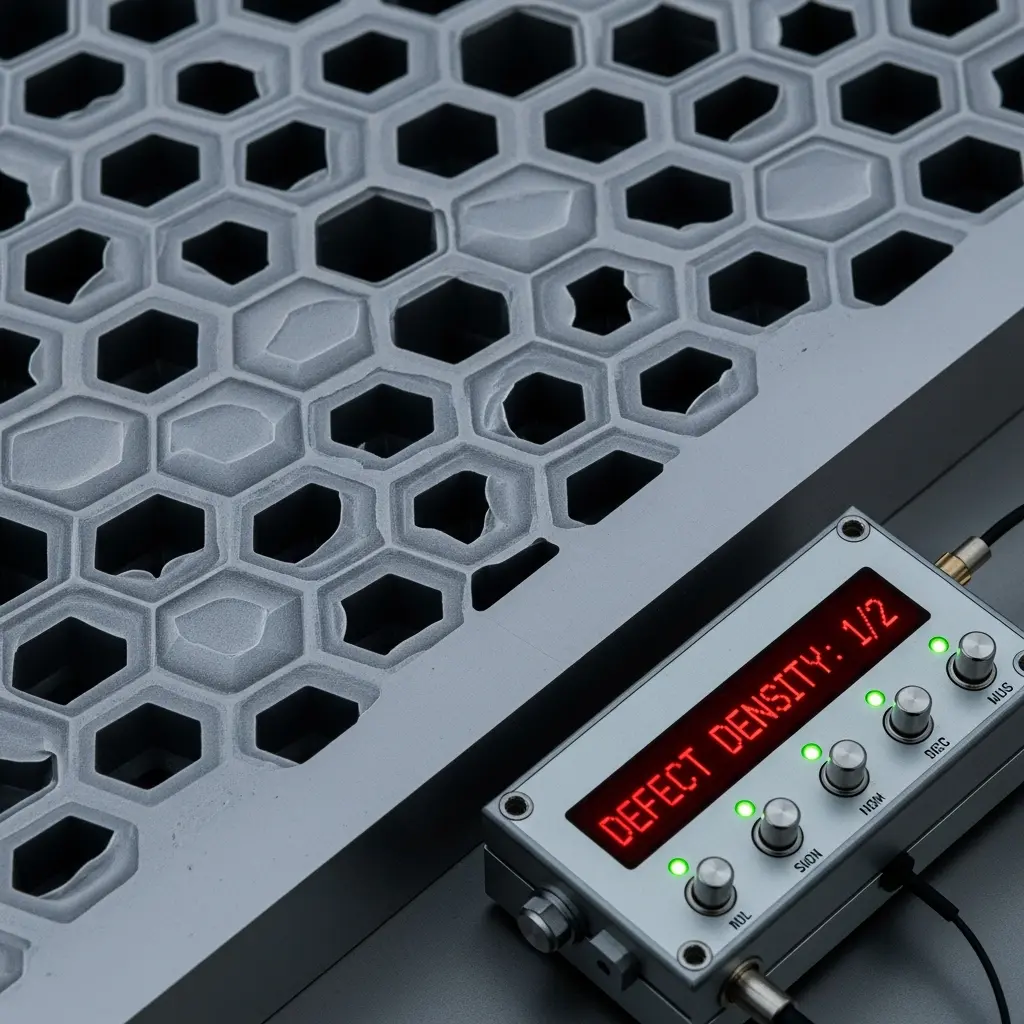
The search for exotic states of matter continues with new insights into the behaviour of quantum magnets, and recent work by Arnab Seth, Fay Borhani, and Itamar Kimchi from the Georgia Institute of Technology reveals a surprising instability in a prominent model system. The team investigates the Kitaev honeycomb model, a theoretically important magnet known for hosting a spin liquid state, and demonstrates that even a small number of common crystallographic defects fundamentally alters its behaviour. Their findings show that these defects trigger a transition to a chiral spin liquid, a state characterised by ordered spins and emergent magnetic properties, and importantly, this occurs even though the perfect model exhibits no such ordering. This disorder-driven instability opens new avenues for understanding and potentially harnessing topological properties in quantum materials, with implications for future technologies based on manipulating electron behaviour.
Disorder Drives Phase Transitions in Quantum Spin Liquids
This research investigates how imperfections influence quantum spin liquids, revealing that even small amounts of disorder can induce a genuine phase transition. Introducing a level of disorder creates a critical temperature at which the material transforms, resulting in a non-Abelian chiral quantum spin liquid state exhibiting scalar spin chirality and electron orbital magnetization, strongest near imperfections. This disorder-driven instability relies on an emergent long-range ferromagnetic interaction between these imperfections, mediated by nearly gapless fermions, and generates topology in Dirac cones, fluctuating their mass terms. These findings demonstrate the significant role of crystallographic defects in influencing highly entangled quantum spin liquid phases.
Kitaev Model and Quantum Spin Liquid Research
This body of work compiles research concerning topological materials and quantum spin liquids, particularly those described by the Kitaev model, and related phenomena like the anomalous and topological Hall effects. The research explores how defects and impurities impact these materials, which possess unique surface states protected by their topology, leading to robust electronic properties. Defects, such as those found in graphene, can dramatically alter material properties, sometimes inducing new topological phases, and chirality plays a crucial role, especially in the context of spin chirality. Berry curvature contributes to the anomalous velocity of electrons, while skyrmions can act as carriers of topological charge, and spin-orbit coupling couples spin and orbital degrees of freedom, crucial for realizing topological phases.
Defects Induce Majorana Gap and Chirality
Scientists discovered that introducing Stone-Wales-type defects into a spin-1/2 Kitaev honeycomb material generates a Majorana gap, a significant finding as the pristine material lacks this feature. This gap supports the emergence of a non-Abelian chiral spin liquid state exhibiting scalar spin chirality and electron orbital magnetization, both peaking near the lattice defects. The team measured an emergent long-range ferromagnetic interaction between defect chiralities, mediated by nearly-gapless fermions, crucial for generating topology in Dirac cones and fluctuating mass terms. Analysis reveals that each Stone-Wales defect possesses a pair of degenerate ground state flux configurations, termed “Lieb-flux” states, related by time reversal symmetry, and numerical calculations demonstrate that these defects generate a topological mass term dominating over trivial mass terms, leading to a Chern number of μz = ±1, directly linked to the defect’s chirality.
Defects Induce Robust Topological Order
Researchers have demonstrated that introducing local defects into the Kitaev honeycomb spin liquid can unexpectedly create a topological state with a measurable energy gap, absent in the pristine material. This emergence of a topological state is driven by an emergent ferromagnetic interaction between the defects, mediated by the material’s nearly gapless fermions, and results in both scalar spin chirality and electron orbital magnetization concentrated near the defects. The study reveals that these defects support localized Majorana fermions with a quantized Chern number, indicating robust topological order, and the defects can be mathematically modeled as an impurity potential, allowing for analysis of their impact on the Majorana band structure and confirming the dominance of topological mass terms. The team further showed that the defects exhibit a “Lieb-flux” state, consistent with an extension of Lieb’s theorem and supported by numerical results.
🗞 Chiral spin liquid instability of the Kitaev honeycomb model with crystallographic defects
🧠 ArXiv: https://arxiv.org/abs/2511.19409