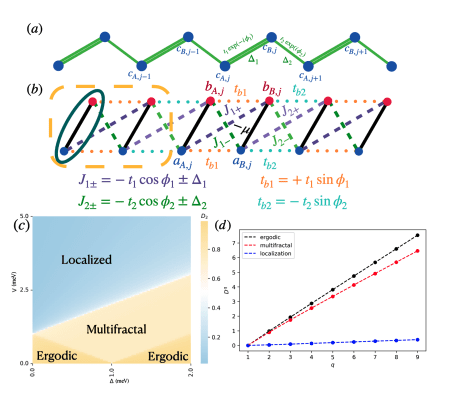
In a study published on April 10, 2025, researchers Jinkun Wang and colleagues examined how quasiperiodic and Anderson disorders affect localization and topology in noncentrosymmetric superconductors. Their findings revealed energy-dependent state transitions and the robustness of topological phases while proposing an experimental setup using Josephson junctions to engineer such systems, with implications for quantum computing.
The study investigates a dimerized topological noncentrosymmetric superconductor under quasiperiodic and Anderson disorders. It identifies energy-dependent transitions between ergodic, multifractal, and localized states, with localization sensitivity varying across energy bands. Using real-space polarization, alternating topological and trivial phases are observed as the quasiperiodic potential increases, differing from typical diagrams. Topological states exhibit robustness against Anderson disorder. The research proposes an experimental setup using superconducting Josephson junctions to engineer NCS-like behaviour, offering insights into Majorana zero modes and implications for topological encryption.
Advancements in Superconductivity and Topological States: Implications for Quantum Computing
Superconductivity, a phenomenon where materials exhibit zero electrical resistance at extremely low temperatures, has long fascinated scientists. Recent research has deepened our understanding of superconducting states, particularly in the context of topological materials and their potential applications in quantum computing. These advancements are paving the way for more robust and scalable quantum technologies.
The Josephson effect, a cornerstone of modern superconductivity research, describes the flow of supercurrents across a junction between two superconducting materials. This phenomenon has been instrumental in the development of quantum bits, or qubits, which are the building blocks of quantum computers. Recent studies have explored how the Josephson effect can be harnessed to create devices with unique properties, such as superconducting diodes and transistors, which could revolutionize the way information is processed.
One of the most exciting developments in this field is the discovery of Majorana fermions—particles that are their antiparticles—in superconducting materials. These exotic quasiparticles exhibit non-Abelian statistics, making them ideal candidates for implementing fault-tolerant quantum computing architectures. Researchers have demonstrated how Majorana modes can be induced at the boundaries of topological superconductors, offering a pathway to realize stable qubits that are immune to decoherence.
Topological superconductors, materials with non-trivial topological order and superconducting properties, have emerged as a promising platform for quantum computing. These materials host protected surface states that can be used to encode quantum information in a way that is inherently robust against local perturbations. Recent experiments have shown how these states can be manipulated using magnetic fields and other external parameters, opening new avenues for controlling and reading out quantum information.
While significant progress has been made, several challenges remain. For instance, the realization of large-scale topological superconductors with long coherence times is still an open problem. Additionally, the integration of these materials into practical quantum computing architectures requires further innovation in device fabrication and control techniques. Despite these hurdles, the potential rewards are immense: fault-tolerant quantum computers capable of solving problems that are intractable for classical machines.
The interplay between superconductivity and topology is unlocking new possibilities for quantum computing. From the Josephson effect to Majorana fermions and topological superconductors, these advancements are laying the groundwork for a future where quantum technologies become an integral part of our daily lives. As researchers continue to push the boundaries of what is possible, we can expect even more groundbreaking discoveries in this rapidly evolving field.
👉 More information
🗞 Localization and Topology in Noncentrosymmetric Superconductors with Disorder
🧠 DOI: https://doi.org/10.48550/arXiv.2504.07930