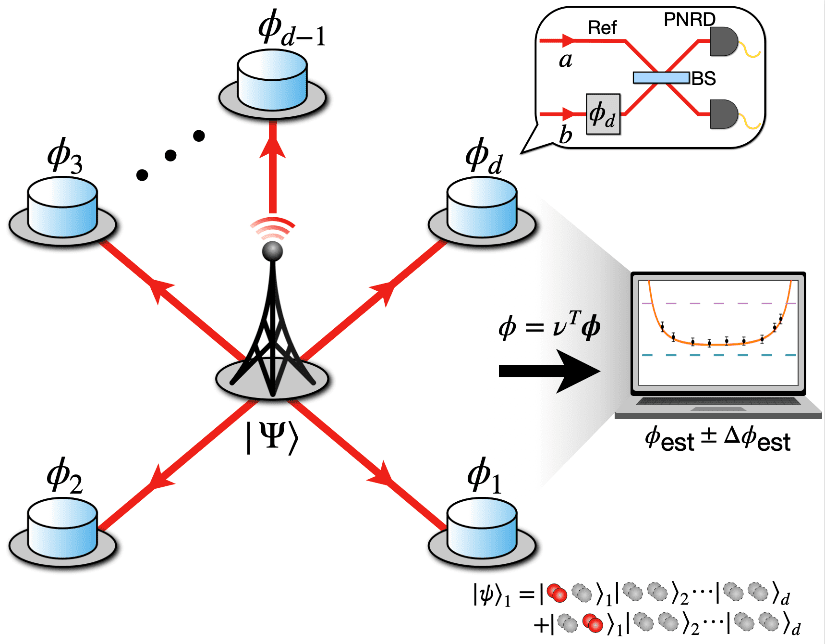
Hyang-Tag Lim’s research team at the Center for Quantum Technology, Korea Institute of Science and Technology (KIST), has demonstrated the world’s first ultra-high-resolution distributed quantum sensor network. By employing a special quantum-entangled state, the “multi-mode N00N state”, the team simultaneously enhanced both precision and resolution in their sensor system. This breakthrough surpasses the limitations of conventional sensor technologies and approaches the “Heisenberg limit,” paving the way for advancements in life sciences, semiconductor manufacturing, and space observation.
Quantum Entanglement Enhances Sensor Precision and Resolution
Precise metrology is fundamental to advancements in fields like bioimaging and space telescope observations, but conventional sensor technologies face limitations imposed by the standard quantum limit. To overcome this barrier, researchers are exploring distributed quantum sensors, which link spatially separated sensors into a single quantum system for highly precise measurements. Hyang-Tag Lim’s research team at the Center for Quantum Technology, Korea Institute of Science and Technology (KIST), recently demonstrated the world’s first ultra-high-resolution distributed quantum sensor network, achieving simultaneous enhancement of both precision and resolution through quantum entanglement. This breakthrough represents a significant step toward realizing the full potential of quantum sensors.
The KIST team applied a special quantum-entangled state, known as the “multi-mode N00N state,” to their distributed sensor network. Previous distributed quantum sensors relied on single-photon entangled states, which improve precision but are limited for high-resolution measurements requiring fine discrimination of interference patterns. However, the “multi-mode N00N state” utilizes multiple entangled photons along specific paths, creating much denser interference fringes. Consequently, the resolution is significantly enhanced, allowing for the detection of even the smallest physical changes with increased sensitivity, according to the findings.
This technique not only approaches the Heisenberg limit, the ultimate level of precision attainable with quantum technology, but also demonstrates potential for applications in super-resolution imaging. Building on this achievement, Korea is positioning itself to compete internationally in the rapidly developing field of quantum sensors, as major countries like the United States and European nations are making substantial investments. Hyang-Tag Lim’s work at KIST suggests that Korea can secure a leading position in this next-generation strategic technology, potentially impacting diverse fields requiring ultra-precise measurements.
“In the future, when combined with silicon-photonics-based quantum chip technology, it could be applied to a wide range of everyday applications.”
Dr. Hyang-Tag Lim, KIST
New Quantum Sensor Network Approaches Heisenberg Limit for Imaging
Building on this advancement in distributed quantum sensing, Hyang-Tag Lim’s research team at the Center for Quantum Technology, KIST, successfully demonstrated a technique utilizing a “multi-mode N00N state.” This state, involving multiple entangled photons along specific paths, generates significantly denser interference fringes than previously achievable with single-photon states. The resulting increase in fringe density is directly correlated with enhanced resolution, enabling the detection of finer details within the measured sample. This approach represents a departure from earlier distributed sensor designs focused primarily on precision enhancement.
The KIST researchers achieved a resolution boost by manipulating the quantum entanglement to create these multi-mode N00N states. Unlike conventional methods limited by the wavelength of light, this technique effectively reduces the “effective wavelength,” allowing for measurements beyond the diffraction limit. According to the team, this advancement brings the sensor network demonstrably closer to the “Heisenberg limit,” representing the theoretical maximum precision attainable with any quantum measurement. This is a critical step toward realizing super-resolution imaging capabilities, previously unattainable with distributed quantum sensors.
This demonstration of a high-resolution distributed quantum sensor network is particularly significant given the growing international focus on quantum sensor technology. With major nations investing heavily in this field, KIST’s achievement positions Korea as a key player in the development of next-generation metrology tools. The ability to approach the Heisenberg limit, coupled with enhanced resolution, unlocks potential applications in diverse fields, including advanced materials science, nanoscale imaging, and potentially even improvements in space-based telescope observations.
This advancement from the Korea Institute of Science and Technology (KIST) demonstrates a critical step toward practical quantum sensors. By simultaneously enhancing both precision and resolution, Hyang-Tag Lim’s team unlocks new possibilities for applications demanding high-accuracy imaging.
For industries relying on precise metrology, including life sciences, semiconductor diagnostics, and space telescope observations, this represents a significant leap forward. KIST’s distributed quantum sensor network could enable substantially improved imaging capabilities and more detailed analysis across these vital fields.