

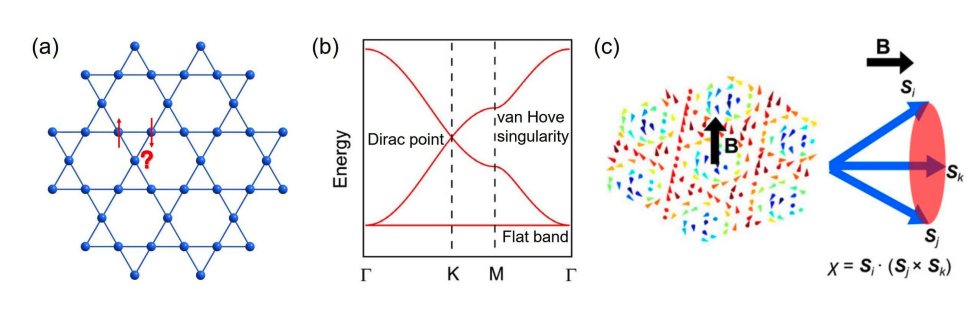
The pursuit of novel quantum materials continues to yield systems exhibiting unusual electronic properties, and recent attention focuses on those incorporating the kagome lattice, a two-dimensional pattern of corner-sharing triangles. This geometric arrangement fosters intense magnetic frustration and supports the emergence of topological electronic states, offering a fertile ground for exploring complex interactions between spin, charge, and orbital degrees of freedom. Qi Wang, from ShanghaiTech University, Hechang Lei, from Renmin University of China, and colleagues present a comprehensive review of recent progress in kagome topological materials, systematically outlining current understanding and potential future research directions in their article, ‘Intriguing kagome topological materials’. The work offers a valuable synthesis of a rapidly evolving field within condensed matter physics.
The study of kagome lattices represents a rapidly expanding area within condensed matter physics, attracting considerable research attention due to their distinctive geometric arrangement and potential to host unusual quantum states. These two-dimensional lattices, characterised by a repeating pattern of corner-sharing triangles, exhibit intense magnetic frustration and support diverse topological electronic states, prompting active investigation into the interplay between magnetism, topology, and strong electron correlations.
Kagome lattices uniquely combine strong magnetic frustration with topological electronic states, offering advantages in exploring magnetism, topology, and strong correlation effects when spin, charge, or orbital degrees of freedom are introduced. The unusual electronic structure arises from the specific atomic arrangement, leading to Van Hove singularities, points of high density of electronic states that can significantly enhance the potential for superconductivity, a phenomenon where materials exhibit zero electrical resistance.
A central theme concerns the competition and coexistence
A central theme concerns the competition and coexistence of charge density waves (CDWs) and superconductivity. CDWs represent a periodic modulation of electron density, forming an electronic instability that can either suppress or enhance superconductivity. The geometric frustration inherent in the kagome lattice further complicates this relationship, leading to novel behaviours. Researchers also explore realising the Quantum Anomalous Hall (QAH) effect within these lattices, a topological state exhibiting quantized Hall conductance without an external magnetic field. This pursuit collectively pushes the boundaries of understanding quantum matter and opens avenues for developing novel quantum technologies.
Beyond superconductivity, kagome lattices provide a platform for exploring quantum spin liquids (QSLs), which are favoured by the lattice’s frustrated nature. In a QSL, magnetic moments do not order even at very low temperatures, instead exhibiting long-range quantum entanglement.
Current research demonstrates a dominance of studies focused on AV3Sb5 compounds, indicating their central role in ongoing investigations. The rapid growth in publications from 2021 to 2023 clearly demonstrates the intense interest and accelerated development characterising this field. Supporting these experimental efforts, a strong emphasis exists on theoretical modelling and computational simulations aimed at understanding the observed phenomena, and researchers note a clear trend towards understanding the interplay between topology, strong correlations, and emergent phenomena.
The development of advanced experimental techniques to probe the subtle interplay between different degrees of freedom in these materials remains crucial, including techniques like angle-resolved photoemission spectroscopy (ARPES), scanning tunnelling microscopy (STM), and neutron scattering. ARPES measures the energy and momentum of electrons, STM visualises the electronic structure at the atomic scale, and neutron scattering probes magnetic structures. A deeper theoretical understanding of the complex many-body interactions in kagome materials is crucial for guiding future experimental efforts and predicting new phenomena.
The exploration of different chemical compositions and doping
The exploration of different chemical compositions and doping strategies allows researchers to tune the electronic and magnetic properties of these materials, opening up possibilities for tailoring them to specific applications. The development of new materials with even more pronounced topological features and stronger electron correlations represents a promising research direction.
The kagome lattice, therefore, continues to be a vibrant and rapidly evolving field with the potential to revolutionise our understanding of condensed matter physics and pave the way for new technological innovations.
🗞 Intriguing kagome topological materials
🧠 DOI: https://doi.org/10.48550/arXiv.2507.02571


