Kagome magnets, materials arranged in a distinctive woven pattern, exhibit complex magnetic behaviour with potential applications in novel technologies, and researchers are actively seeking to understand and control these properties. Zhen Zhang, Kirill Belashchenko, and Xiaoyi Su, alongside colleagues at Iowa State University and the University of Nebraska-Lincoln, investigate the magnetic characteristics of lithium-iron-germanium compounds with kagome structures. Their work reveals a competition between different magnetic arrangements within these materials, predicting both traditional antiferromagnetic states and more exotic, swirling spin spirals, depending on the specific compound. This detailed understanding of magnetic interactions, confirmed by experimental observations on a lithium-iron-germanium crystal exhibiting magnetic ordering at high temperatures, establishes a foundation for designing future materials with tailored magnetic properties and potentially uncovering unconventional magnetism.
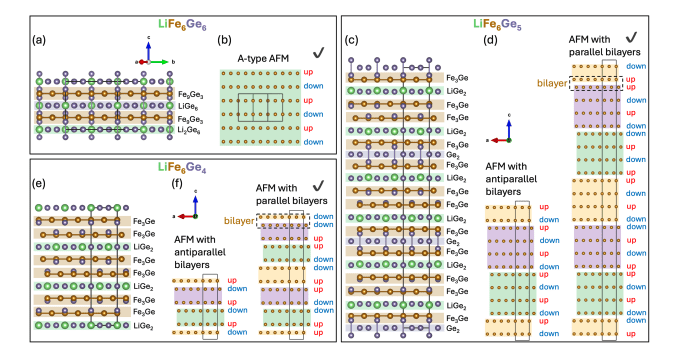
Competing interlayer magnetic interactions in kagome magnets can lead to diverse magnetic phases, which enable various promising topological or quantum material properties. This research investigates the electronic structure and magnetic properties of the LiFe₆Ge₆, LiFe₆Ge₄, and LiFe₆Ge₅ compounds, all sharing a kagome iron-germanium layer motif but differing in their interlayer arrangements. The team predicts that LiFe₆Ge₄ and LiFe₆Ge₅ will exhibit collinear antiferromagnetic ground states, involving a combination of ferromagnetic and antiferromagnetic interlayer orientations. This work aims to understand how subtle changes in interlayer stacking influence the overall magnetic behaviour of these materials, potentially guiding the design of novel magnetic systems
Material Synthesis and Characterisation Techniques
This research centres around intermetallic compounds and alloys, with a strong emphasis on their synthesis, structural determination, and magnetic properties. A significant portion of the work involves computational methods, specifically Density Functional Theory, to predict material properties. Techniques like X-ray diffraction and Rietveld refinement are crucial for analysing crystal structures. The frequent appearance of references to heavy fermion systems suggests an interest in materials with complex magnetic behaviour. Overall, the work combines experimental characterisation with theoretical modelling to explore the relationship between structure, composition, and magnetic behaviour.
Kagome Lattices Exhibit Room Temperature Antiferromagnetism
Researchers have uncovered a fascinating interplay of magnetism in a family of materials, lithium, iron, and germanium compounds, that exhibit kagome lattice structures. These materials, specifically LiFe₆Ge₆, LiFe₆Ge₅, and LiFe₆Ge₄, display a complex magnetic order arising from the arrangement of iron and germanium atoms within their layered structures. The team’s investigations, combining theoretical calculations and experimental measurements, reveal that these compounds are antiferromagnetic at room temperature, meaning their magnetic moments align in opposing directions. The research demonstrates that the magnetic behaviour is strongly influenced by the interlayer spacing and arrangement within the kagome lattices.
Within the layers, iron atoms interact ferromagnetically, aligning their magnetic moments in the same direction, while the interactions between layers are antiferromagnetic, leading to an overall cancellation of magnetism. Calculations predict that LiFe₆Ge₆ is particularly interesting, existing in a state very close to a simple antiferromagnetic order, but also exhibiting a slightly lower energy state with a more complex, spiraling magnetic arrangement. Experimental measurements on single crystals of LiFe₆Ge₆ confirm the antiferromagnetic ordering at approximately 540 Kelvin, a relatively high temperature for this type of magnetic behaviour. Furthermore, the team observed a transition around 270 Kelvin, indicating a change in the magnetic state, potentially involving a shift between collinear and non-collinear magnetic phases. These discoveries are significant because they expand our understanding of how magnetism arises in kagome lattices, structures known for hosting exotic electronic and magnetic properties. The ability to control and tune the magnetic order in these materials opens doors for potential applications in novel magnetic devices and the exploration of unconventional magnetism, including topological magnetism, where the magnetic order is intertwined with the material’s electronic structure.
Kagome Compounds Show Interlayer Ordering Effects
This research investigates the magnetic properties of three compounds, LiFe₆Ge₆, LiFe₆Ge₄, and LiFe₆Ge₅, which share a common kagome lattice structure but differ in their interlayer arrangements. Calculations and experiments both demonstrate that LiFe₆Ge₆ exhibits a complex magnetic order, transitioning from a paramagnetic state to an antiferromagnetic phase at approximately 540 K, followed by a spin-reorientation transition below 270 K. The observed magnetic behaviour of LiFe₆Ge₆, specifically the predicted incommensurate cycloidal spin spiral state, suggests potential for exploring unconventional magnetic phenomena, such as anomalous or topological Hall effects. The team found that LiFe₆Ge₄ and LiFe₆Ge₅, in contrast, stabilize in collinear antiferromagnetic states.
These findings highlight how subtle changes in interlayer ordering can significantly influence the magnetic ground state within kagome lattices. The authors acknowledge that further research is needed to fully understand the complex interplay of magnetic interactions within these materials and propose that exploring related kagome compounds with similar structural motifs could reveal even more exotic magnetic properties. These materials, therefore, represent a promising platform for investigating and potentially harnessing unconventional and topological magnetism.
👉 More information
🗞 Competing Magnetic Phases in Li-Fe-Ge Kagome Systems
🧠 ArXiv: https://arxiv.org/abs/2508.04095