

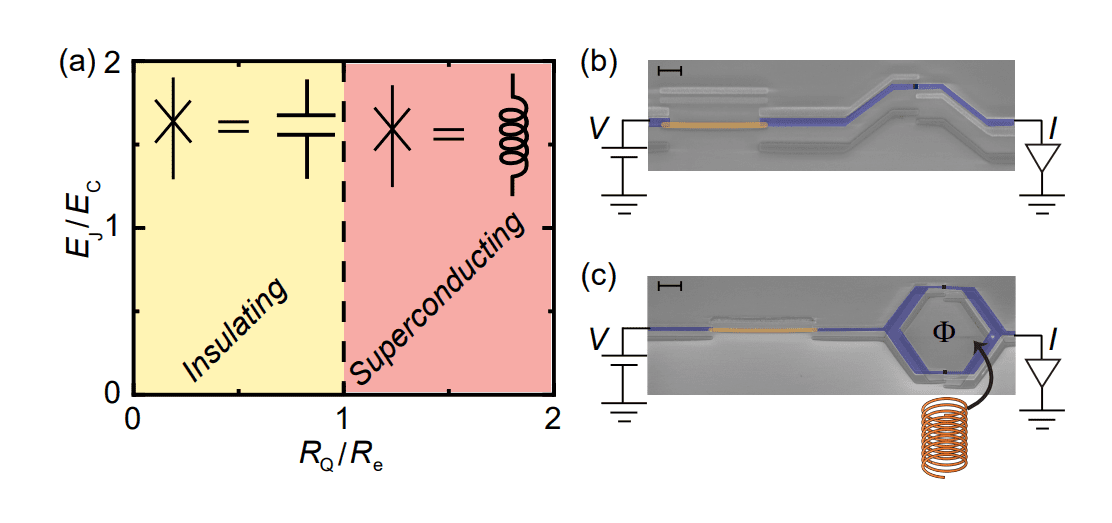
The behaviour of superconducting materials transitioning between states remains a fundamental question in physics, and the precise nature of this shift, known as the Schmid-Bulgadaev transition, continues to spark debate amongst researchers. Diego Subero, Yu-Cheng Chang, and Miguel Monteiro, working at Aalto University with colleagues including Ze-Yan Chen and Jukka P. Pekola, now present compelling evidence that clarifies this long-standing problem. Through meticulous experiments on Josephson junctions, the team systematically investigates how these devices behave under varying conditions, crucially performing measurements within a realistic resistive environment. The results demonstrate that the transition occurs when the electrical resistance reaches a specific value determined by fundamental constants governing Cooper pairs, confirming a prediction made decades ago and providing a robust understanding of the crossover from superconductivity to an insulating state, even at non-zero temperatures.
Revisiting dissipation-driven phase transition in a Josephson junction Despite extensive experimental and theoretical work, the Schmid-Bulgadaev quantum phase transition remains a subject of debate. This research revisits this problem by performing systematic experiments on low-frequency current-voltage characteristics of Josephson junctions over a wide range of parameters. The experiments are conducted in a controlled resistive environment created using a specially designed circuit, allowing for precise control of energy dissipation. This approach enables detailed investigation of the transition between superconducting and resistive states, revealing subtle features obscured in previous studies. The team demonstrates that the transition exhibits critical behaviour consistent with theoretical predictions, with deviations arising from the interplay between quantum and classical effects. These findings contribute to a more complete understanding of dissipation-driven phase transitions in superconducting circuits and provide insights relevant to the development of novel quantum devices.
Dissipative Phase Transition in High-Impedance Josephson Junctions
This research investigates the dissipative quantum phase transition (DQPT) in Josephson junctions, tiny superconducting circuits. This transition isn’t driven by temperature, but by dissipation, the loss of energy to the environment. Specifically, the researchers are looking at what happens when a Josephson junction is connected to an environment that resists the flow of energy. The central question is whether a true quantum phase transition occurs in these systems when strongly coupled to a resistive environment. The researchers present experimental data suggesting that a DQPT does occur in their Josephson junction devices, observing a change in electrical properties as they vary the resistance of the environment.
This change appears abrupt, supporting the idea of a phase transition. The high-impedance environment is crucial, enhancing the effects of dissipation and making the DQPT more observable. The experimental results align with models predicting a sharp DQPT, although some discrepancies remain. The paper addresses criticisms of previous experiments and theoretical work, arguing that their setup and analysis are more robust and provide stronger evidence for the DQPT. The researchers highlight the role of quantum fluctuations in driving the transition, inherent in quantum mechanics and significant in small, highly resistive circuits.
Resistance Defines Superconductor-Insulator Transition
This research successfully demonstrates a clear transition in Josephson junctions between superconducting and insulating states, confirming a key prediction of the Schmid-Bulgadaev theory. Through systematic low-frequency transport measurements, the team established that the transition occurs when the environmental resistance surrounding the junction reaches a specific quantum value, approximately 6. 5 kΩ. This finding supports the long-standing theory and resolves discrepancies arising from recent microwave experiments that failed to observe an insulating phase, thereby strengthening the understanding of dissipation in quantum systems and the behaviour of Josephson junctions. The experiments consistently revealed a superconducting state when resistance fell below the critical value and an insulating state when it exceeded it, providing strong evidence for the predicted transition point. The team’s approach, utilizing on-chip resistors, offers a robust method for investigating this phenomenon.
👉 More information
🗞 Revisiting dissipation-driven phase transition in a Josephson junction
🧠 ArXiv: https://arxiv.org/abs/2509.20480

