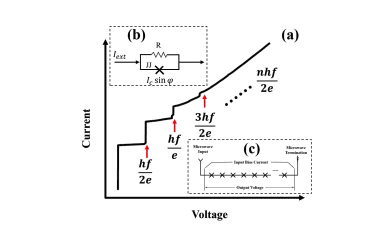
Precise voltage metrology utilising Josephson junction arrays demands tight control over junction parameter uniformity. Numerical analysis of 10,000 junctions at 50 GHz reveals a critical current standard deviation must remain below 25% to maintain a 0.88 mA first Shapiro step height, and resistance variation below 1.5% for 0.6 mA.
The precise realisation of voltage standards underpins numerous scientific and technological applications, from fundamental physics experiments to advanced electronic instrumentation. Current international standards rely heavily on arrays of superconducting Josephson junctions, devices that exhibit quantum mechanical properties, allowing for extraordinarily accurate voltage definition. A team led by researchers at the Shanghai Institute of Microsystem and Information Technology, Chinese Academy of Sciences, now presents a detailed quantitative analysis of how variations in the properties of individual junctions within these arrays impact overall performance. Guanghong Wen, Yi Zhu, Yingxiang Zheng, Shuhe Cui, Ji Wang, Yanyun Ren, Hao Li, Guofeng Zhang, and Lixing You investigate the tolerance to parameter spread within these junctions, publishing their findings in a study titled ‘The impact of parameter spread of high-temperature superconducting Josephson junctions on the performance of quantum-based voltage standards’. Their work utilises the resistively shunted junction (RSJ) model, a common simplification used to describe Josephson junction behaviour, to establish upper limits on acceptable variations in critical current and resistance, ensuring the reliable operation of quantum voltage standards.
Josephson junctions, superconducting devices exhibiting unique quantum phenomena, remain central to maintaining international voltage standards and are increasingly investigated for applications extending to quantum technologies. These junctions consist of two superconductors separated by a thin insulating barrier, allowing Cooper pairs – pairs of electrons – to tunnel through, creating a supercurrent even with zero voltage applied. The precise voltage generated across a Josephson junction array, a series of these junctions, forms the basis of a highly accurate and reproducible voltage standard.
Current research prioritises optimising these arrays for enhanced reliability and precision, with a particular focus on the impact of variations in junction parameters. A critical current standard deviation exceeding 25% demonstrably compromises the ability to reliably reproduce voltage standards, reducing the height of the first Shapiro step – a key indicator of junction performance – below 0.88 milliamperes. The Shapiro step arises from the application of microwave radiation to the junction, creating discrete voltage steps related to the frequency of the radiation. Maintaining a Shapiro step height exceeding 0.6 milliamperes necessitates keeping the standard deviation of junction resistance below 1.5%. These tolerances highlight the sensitivity of the system and the need for precise fabrication control.
Advancements in material science are actively pursued to broaden the practical application of Josephson junctions. Research explores the use of high-temperature superconductors, such as yttrium barium copper oxide (YBCO), to reduce the substantial cooling requirements traditionally associated with superconducting devices. Conventional superconductors require cooling to temperatures near absolute zero using liquid helium, which is expensive and logistically challenging. Magnesium diboride (MgB2) also receives attention as a potential alternative high-temperature superconductor.
Fabrication techniques are evolving to achieve nanoscale junctions with improved characteristics. Focused Helium Ion Beam milling and Focused Ion Beam (FIB) techniques are prominent methods employed to create these structures with increasing precision. These techniques allow for the creation of extremely small and well-defined junctions, crucial for achieving the required performance tolerances.
Computational modelling plays a vital role in understanding and optimising junction performance. The resistively shunted junction (RSJ) model, a widely used circuit equivalent, simulates the behaviour of a Josephson junction, allowing researchers to investigate the relationship between junction parameters and overall performance. This modelling assists in predicting and mitigating the effects of variations in critical current and resistance.
Beyond their role as voltage standards, Josephson junctions are integral to superconducting quantum interference devices (SQUIDs), highly sensitive magnetometers used in diverse scientific and medical applications, including biomagnetism and non-destructive evaluation. Furthermore, the unique quantum properties of these junctions are being leveraged in the development of future quantum computers, where they serve as fundamental building blocks for qubits, the quantum equivalent of bits.
👉 More information
🗞 The impact of parameter spread of high-temperature superconducting Josephson junctions on the performance of quantum-based voltage standards
🧠 DOI: https://doi.org/10.48550/arXiv.2506.12989