

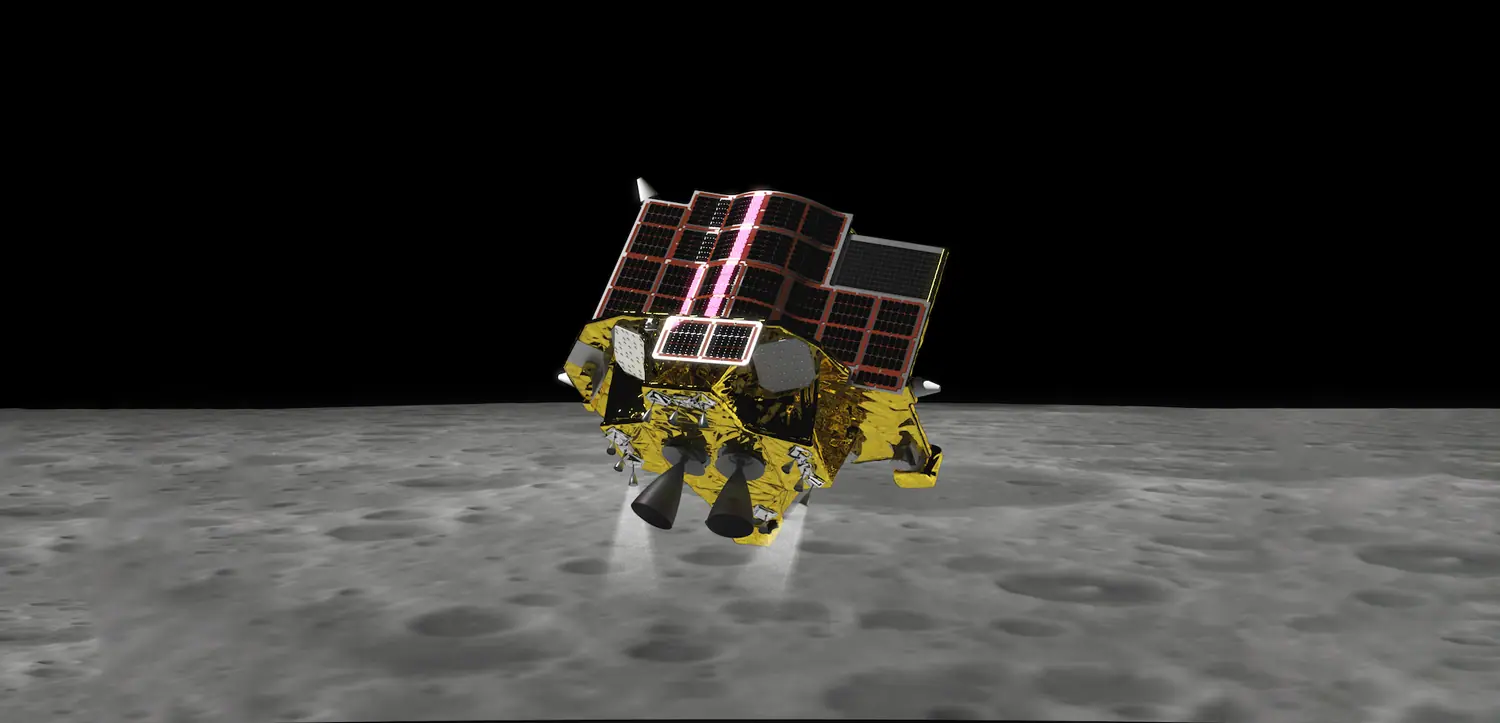
Japan has become the fifth country to land a spacecraft on the moon, with its Smart Lander for Investigating Moon (SLIM) making a soft landing. However, officials from Japan’s space agency, including Hitoshi Kuninaka, head of the Institute of Space and Astronautical Science, are still analyzing whether the mission’s priority of a pinpoint landing was achieved as reported by the JapanTimes.
The craft’s solar panel failed to generate power, limiting its activity on the moon. SLIM, the size of a passenger vehicle, was aiming for a target of just 100 meters, promising greater control than previous moon landings.
Joining the United States, the Soviet Union, China, and India, Japan has become the fifth country to successfully land a spacecraft on the moon. The spacecraft, known as the Smart Lander for Investigating Moon (SLIM), made a soft landing on the lunar surface early Saturday. However, Japanese space officials have stated that they need more time to analyze whether SLIM achieved its mission priority of making a pinpoint landing.
Despite the successful landing, the mission faced some technical challenges. The spacecraft’s solar panel failed to generate power, which could potentially shorten its activity on the moon. Hitoshi Kuninaka, head of the Institute of Space and Astronautical Science, a unit of Japan’s space agency, stated that SLIM’s solar battery wasn’t generating power and that it had only a few more hours of battery life. The priority now is for the craft to gather as much data about its landing and the moon as possible on the remaining battery.
Space officials believe that SLIM’s small rovers were launched as planned and that data was being transmitted back to Earth. However, there was a tense wait for news after the Japan Aerospace Exploration Agency’s mission control initially said that SLIM was on the lunar surface, but that it was still “checking its status.” No further details were given until a news conference nearly two hours later.
SLIM was using “pinpoint landing” technology that promises far greater control than any previous moon landing. While most previous probes have used landing zones about 10 kilometers (six miles) wide, SLIM was aiming at a target of just 100 meters (330 feet). For the mission to be considered fully successful, space officials need to confirm whether SLIM made a pinpoint landing. Kuninaka said that while more time is needed, he personally thinks it was most likely achieved, based on his observation of data showing the spacecraft’s movement until the landing and its ability to transmit signals after landing.

Preliminary Success and Future Analysis
Despite the technical issues, Kuninaka stated that he believes that Japan’s space program at least achieved “minimum” success with the SLIM mission. The spacecraft landed on the moon at about 12:20 a.m. Tokyo time on Saturday (1520 GMT Friday). Further analysis will be needed to confirm the full success of the mission and to gather as much data as possible from the remaining battery life of the spacecraft.
But he said that SLIM’s solar battery wasn’t generating power and that it had only a few more hours of battery life. He said that the priority now was for the craft to gather as much data about its landing and the moon as possible on the remaining battery.” Kuninaka said he believes that Japan’s space program at least achieved “minimum” success.
For the mission to be considered fully successful, space officials need to confirm whether SLIM made a pinpoint landing. Kuninaka said that while more time is needed, he personally thinks it was most likely achieved, based on his observation of data showing the spacecraft’s movement until the landing and its ability to transmit signals after landing.
Summary
Japan has become the fifth country to land a spacecraft on the moon, although officials are still analysing whether the mission’s priority of a pinpoint landing was achieved. The spacecraft, named SLIM, has a limited battery life due to a failure in its solar panel and is currently transmitting data back to Earth.
- Japan has become the fifth country to land a spacecraft on the moon, following the US, Soviet Union, China, and India.
- The spacecraft, named Smart Lander for Investigating Moon (SLIM), made a soft landing on the lunar surface.
- The mission’s success is yet to be confirmed as officials need more time to analyse whether SLIM achieved its priority of making a pinpoint landing.
- The spacecraft’s solar panel failed to generate power, which could limit its activity on the moon.
- Despite this, Hitoshi Kuninaka, head of the Institute of Space and Astronautical Science, a unit of Japan’s space agency, believes that the mission achieved at least “minimum” success.
- SLIM, about the size of a passenger vehicle, was using “pinpoint landing” technology that promises far greater control than any previous moon landing.
- Unlike previous probes that have used landing zones about 10 kilometers wide, SLIM was aiming at a target of just 100 meters.


