A team led by Naoki Takeuchi from Japan’s National Institute of Advanced Industrial Science and Technology has developed a NbN-based half-flux-quantum (HFQ) circuit element compatible with NbN-based superconducting qubits. The development aims to overcome the limitations of cable count and cooling power in dilution refrigerators, which hinder the increase of superconducting qubits. The HFQ circuit element was successfully tested at 4.2 K in liquid helium, demonstrating its potential for integration with superconducting qubits. This research could lead to the development of scalable quantum processors, advancing quantum computing technology.
What is the Significance of the NbN-based Half-flux-quantum Element for Superconducting Qubits?
The research article discusses the development of a NbN-based half-flux-quantum (HFQ) circuit element that is compatible with NbN-based superconducting qubits. The team of researchers, led by Naoki Takeuchi from the Global Research and Development Center for Business by QuantumAI Technology, National Institute of Advanced Industrial Science and Technology (AIST), Japan, aims to integrate superconducting qubits with qubit-interface circuits to build scalable quantum processors.
Superconducting quantum processors have been extensively developed for fault-tolerant quantum computing. However, increasing the number of superconducting qubits in a dilution refrigerator is challenging due to the limitations of the cable count and cooling power of the refrigerator. To overcome this, it is crucial to integrate superconducting qubits with qubit-interface circuits that can control multiple qubits with sufficiently low-power dissipation inside the dilution refrigerator.
Various types of qubit interface circuits have been proposed using superconductor logic families such as single-flux-quantum (SFQ) logic and adiabatic quantum-flux-parametron logic. These superconducting digital circuits can operate with low energy dissipation at cryogenic temperatures.
How Does the Half-flux-quantum (HFQ) Logic Work?
The HFQ logic is a superconductor logic family comprising conventional Josephson junctions (0JJs) and p-Josephson junctions (pJJs). The energy scale of HFQ logic can be flexibly reduced by phase shifts owing to pJJs, making HFQ circuits a promising building block for qubit interface circuits.
A 0-0-p SQUID, which is a superconducting quantum interference device, comprises two conventional Josephson junctions (0JJs) and a large pJJ behaving as a p-phase shifter. It operates as a low-critical-current, i.e., low-energy device with a half-supercurrent-phase cycle. It is expected that the critical current of 0-0-p SQUIDs can be reduced to a few lA for 10mK operation in a dilution refrigerator.
To adopt HFQ circuits to qubit interface circuits, it is crucial to develop HFQ circuits fabricated with the same material as qubits. This is because monolithic integration of qubits and interface circuits is a solid approach to scalable quantum processors.
What is the Role of NbN in the Development of HFQ Circuits?
NbN-based Josephson junctions are promising elements for high-coherence superconducting qubits owing to their high crystal quality and relatively large superconducting gap. Furthermore, superconducting digital circuits can be miniaturized by exploiting the relatively large kinetic inductance of NbN wires. Hence, NbN technology provides benefits to both qubits and interface circuits.
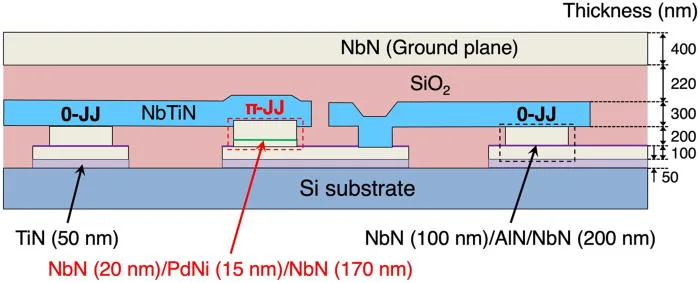
The researchers developed a prototype of an NbN-based 0JJ-pJJ hybrid fabrication process for designing HFQ circuits. This process is based on the previously reported NbN 0JJ process and includes an additional NbN-PdNi-NbN trilayer for forming pJJs as well as an NbN-AlN-NbN trilayer for 0JJs.
The critical current density of the 0JJs can be significantly reduced to design qubits on the same chip as the HFQ circuits. The researchers found that the 0JJs had small deviations with regard to critical current density and that the pJJs had sufficiently high critical current densities to form p-phase shifters.
How was the HFQ Circuit Element Tested?
The researchers fabricated an HFQ SQUID, one of the most fundamental elements in HFQ circuits, and demonstrated its basic operation at 4.2 K in liquid helium as a preliminary test. Because HFQ SQUIDs are used as building blocks for designing HFQ circuits, the demonstration of the HFQ SQUID’s operation is a significant step towards the development of HFQ circuits.
The researchers observed clear HFQ-period modulation in the magnetic flux dependence of the maximum current at 4.2 K. This indicates that the HFQ SQUID was functioning as expected, demonstrating the potential of the NbN-based HFQ circuit element for integration with superconducting qubits.
What are the Implications of this Research?
The development of the NbN-based HFQ circuit element compatible with NbN-based superconducting qubits is a significant advancement in the field of quantum computing. The successful integration of superconducting qubits with qubit-interface circuits could lead to the development of scalable quantum processors, overcoming the current limitations of cable count and cooling power in dilution refrigerators.
The use of NbN in the fabrication of HFQ circuits offers several advantages, including high crystal quality and relatively large superconducting gap for high-coherence superconducting qubits, and large kinetic inductance for miniaturizing superconducting digital circuits.
The successful demonstration of the HFQ SQUID’s operation at 4.2 K in liquid helium is a promising step towards the development of HFQ circuits. This research opens up new possibilities for the design and fabrication of HFQ circuits and their integration with superconducting qubits, paving the way for the advancement of quantum computing technology.
Publication details: “NbN-based half-flux-quantum element for integration with superconducting qubits”
Publication Date: 2024-04-08
Authors: Naoki Takeuchi, Mikiya Naruse, Shigeyuki Miyajima, D. Pham, et al.
Source: Applied physics letters
DOI: https://doi.org/10.1063/5.0203046