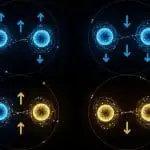
Quantum annealing (QA) is a computational method that uses quantum mechanics to solve complex optimization problems. However, a challenge in QA is verifying the adiabaticity of a system. Researchers from Japan’s National Institute of Advanced Industrial Science and Technology have proposed a method to evaluate the adiabatic condition during QA without the need to diagonalize the Hamiltonian. The method involves using an oscillating field during QA to measure the transition matrix element and the energy gap. This could improve the performance of QA and contribute significantly to the field of quantum computing.
What is Quantum Annealing and Why is it Important?
Quantum annealing (QA) is a computational method that utilizes quantum mechanics to solve complex optimization problems. It was first proposed by Apolloni et al. and has since been studied extensively from various perspectives, including computational speed, implementation methods, and algorithms. The commercial use of QA machines was first introduced by D-Wave Systems Inc., a Canadian quantum computing company. Since then, proposals for their use in research and applications in various fields have emerged, including quantum chemistry, machine learning, and high-energy physics.
The adiabatic theorem, a crucial result in quantum mechanics first introduced by Ehrenfest in 1916 and later proved by Born and Fock in 1928, plays a significant role in QA. The theorem states that if an initial state is prepared in the ground state of the Hamiltonian, it will remain in the ground state as long as the change in the Hamiltonian is slow enough. This theorem is the basis for the process of QA, where the Hamiltonian changes over time, and the final state will be the ground state of the problem Hamiltonian if the alteration of the Hamiltonian is gradual enough.
However, one of the challenges in QA is that there is no known efficient method for checking whether the adiabaticity is satisfied or not. In principle, if we can diagonalize the Hamiltonian, we can use an approximate version of the adiabatic conditions. But in the case of applying QA to practical problems, it is unworkable to diagonalize the Hamiltonian using a classical computer.
How Can We Evaluate the Adiabatic Condition?
Yuichiro Mori, Shiro Kawabata, and Yuichiro Matsuzaki from the National Institute of Advanced Industrial Science and Technology in Japan propose an experimental method for evaluating the adiabatic condition during QA. The adiabatic condition consists of the transition matrix element and the energy gap. Their method simultaneously provides information about these components without diagonalizing the Hamiltonian.
The key idea is to measure the power spectrum of a time domain signal by adding an oscillating field during QA. From the measurement output, we can estimate the values of the transition matrix element and energy gap. This method provides a powerful experimental basis for analyzing the performance of QA.
What is the Proposed Method for Evaluating the Adiabatic Condition?
The proposed method involves utilizing an oscillating field during quantum annealing to induce a Rabi oscillation between the ground and excited states. By performing Fourier transformation on a time domain signal, we obtain a power spectrum and extract relevant information from the data. These steps enable us to evaluate the values of the numerator and denominator of the adiabatic condition.
This method is significant because, to the researchers’ knowledge, no studies have been conducted to measure the numerator of the adiabatic condition, i.e., the size of the transition matrix element of the time derivative of the Hamiltonian. The proposed method allows for simultaneous measurement of both the numerator and denominator of the adiabatic condition.
How Does the Proposed Method Work in Practice?
The researchers conducted numerical simulations with noise to quantify the performance of their method in realistic cases. The results of these simulations are not detailed in the provided excerpt, but they would provide valuable insights into the practicality and effectiveness of the proposed method.
The researchers’ method for evaluating the adiabatic condition during quantum annealing could have significant implications for the field of quantum computing. By providing a way to measure both the transition matrix element and the energy gap without the need for diagonalizing the Hamiltonian, this method could make it easier to verify the adiabaticity of a system and thus improve the performance of QA.
What are the Future Directions for this Research?
The researchers conclude by summarizing their results and discussing possible directions for open questions. While the specifics of these future directions are not provided in the excerpt, they likely involve further refining the proposed method, testing it under different conditions, and exploring its potential applications in various fields.
The work of Mori, Kawabata, and Matsuzaki represents a significant contribution to the field of quantum computing. Their method for evaluating the adiabatic condition during quantum annealing could pave the way for more efficient and effective use of QA in solving complex optimization problems. As the field of quantum computing continues to evolve, research like this will be crucial in pushing the boundaries of what is possible.
Publication Date: 2024-04-08
Authors: Yuichi Mori, Shiro Kawabata and Yuichiro Matsuzaki
Source: Scientific reports
DOI: https://doi.org/10.1038/s41598-024-58286-2