The James Webb Space Telescope (JWST) has discovered the most distant galaxy, named JADES-GS-z14-0. An international team, including key members from the University of Oxford announced the discovery. The light from this galaxy has been stretched out by the universe’s expansion, indicating its enormous distance. The galaxy is seen when the universe was only 290 million years old, providing a glimpse 98% of the way back to the Big Bang. The discovery was led by Dr. Stefano Carniani of the Scuola Normale Superiore in Pisa and has been submitted to the journal Nature.
Discovery of the Most Distant Galaxy by James Webb Space Telescope
An international team of astronomers, including key contributors from Oxford, announced the discovery of the most distant galaxy yet observed. The observations were made using the James Webb Space Telescope (JWST), which was launched on Christmas Day 2021. The JWST has since been surveying the universe to unprecedented distances. The latest record-breaking discovery was made by the JWST Advanced Deep Extragalactic Survey (JADES) team, who identified a galaxy named JADES-GS-z14-0 in the constellation of Fornax.
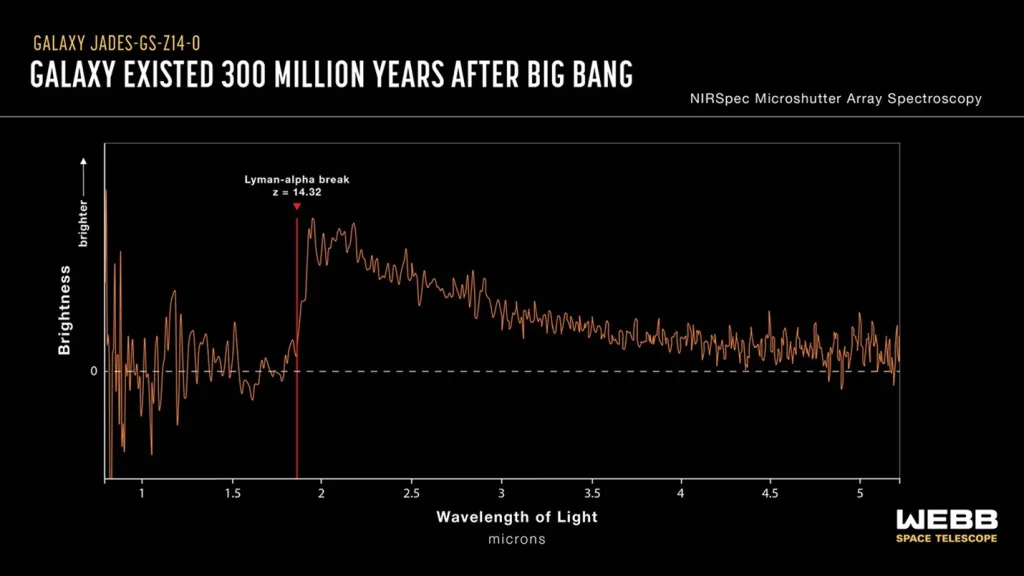
The primary evidence supporting the claim of this being the most distant object comes from its spectrum. The Near Infrared Spectrograph (NIRSpec) on JWST was used to demonstrate that the wavelengths of light from this galaxy had been stretched out by a factor of 15 due to the expansion of the Universe, indicating its enormous distance. This was explained by Prof Andrew Bunker of the University of Oxford, a member of the Instrument Science Team for NIRSpec and a founding member of the JADES team.
The Role of NIRSpec and NIRCam in the Discovery
The NIRSpec and the NIRCam camera on JWST played crucial roles in the discovery of this distant galaxy. Dr Alex Cameron, a postdoctoral researcher at Oxford responsible for choosing targets for the JADES team, explained that the team had identified this galaxy as potentially being very distant due to its very red colors in very sensitive images from the NIRCam camera on JWST. This made it an excellent target for spectroscopy with NIRSpec.
The galaxy is seen when the Universe was only 290 million years old, meaning that we are looking back in time 98 percent of the way back to the Big Bang. The photons left this distant galaxy well before the Sun and Earth formed, as stated by Dr Aayush Saxena, a postdoctoral researcher at Oxford and member of JADES.
The Puzzle of the Brightness of the Most Distant Galaxy
One intriguing aspect of this discovery is the brightness of this record-breaking galaxy, which is brighter than expected. It is a challenge to explain the formation of such a large number of stars so early in the history of the Universe. This was explained by JADES member Dr Jacopo Chevallard, a postdoctoral researcher at Oxford who used the spectrum to measure the age and number of stars in JADES-GS-z14-0.
The Power of JWST and the Future of Space Exploration
The detection of this galaxy underscores the power of JWST. By taking one of the most sensitive observations ever in the infrared, we are able to detect light that has been traveling for an extreme distance, and discover one of the first galaxies to form in the Universe. This was stated by Dr Gareth Jones of the JADES team, who is a postdoctoral researcher at Oxford.
The discovery paper from the JADES team, led by Dr. Stefano Carniani of the Scuola Normale Superiore in Pisa, was posted on the arXiv preprint server and has been submitted to the journal Nature. This discovery marks a significant milestone in our understanding of the Universe and sets the stage for future explorations and discoveries.
External Link: Click Here For More