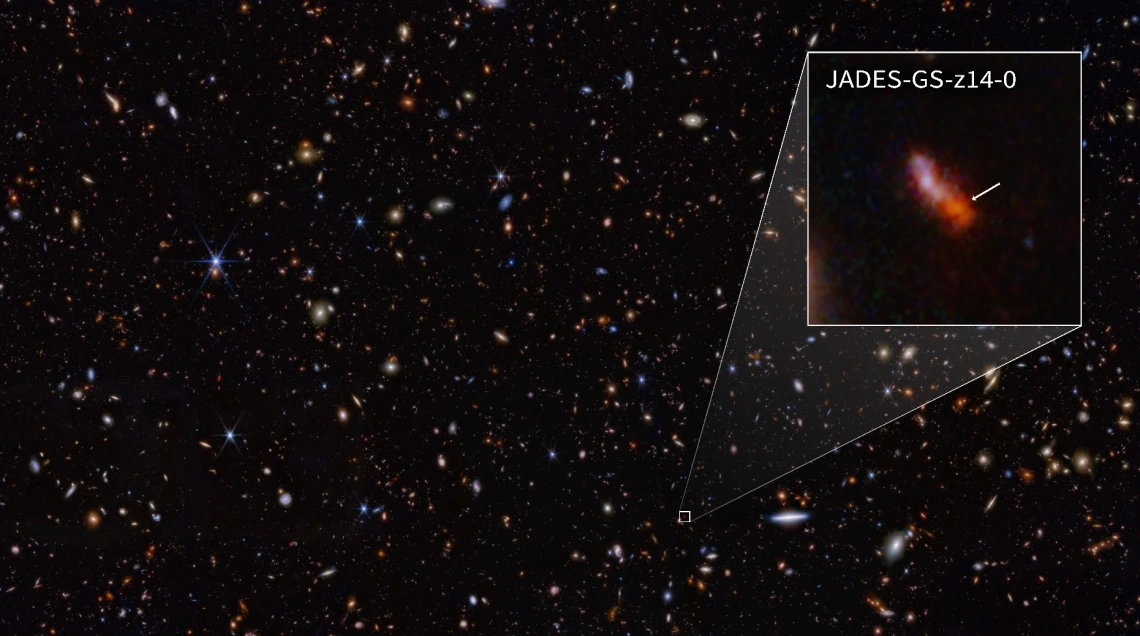
The James Webb Space Telescope has identified a galaxy named JADES-GS-z14-0, which existed when the universe was approximately 300 million years old. This discovery highlights unexpected chemical complexity, including substantial oxygen levels, suggesting earlier star formation than previously believed. The research, conducted by University of Arizona astronomers as part of the JWST Advanced Deep Extragalactic Survey (JADES), provides insights into early cosmic evolution and challenges existing timelines for galaxy formation.
Astronomers have identified a galaxy, JADES-GS-140, observed just 300 million years after the Big Bang. This galaxy exhibits unexpectedly high levels of oxygen, a heavy element typically produced through stellar fusion and dispersed via supernovae. The presence of such oxygen suggests rapid chemical enrichment, indicating multiple generations of stars formed and evolved quickly.
The discovery of oxygen in JADES-GS-140 reveals significant star formation activity occurring much earlier than previously anticipated. This galaxy, observed at just 300 million years post-Big Bang, exhibits high levels of oxygen, a heavy element typically produced through stellar fusion and dispersed via supernovae. The presence of such oxygen suggests rapid chemical enrichment, indicating multiple generations of stars formed and evolved quickly.
The discovery of oxygen in the galaxy JADES-GS-140 by the James Webb Space Telescope (JWST) reveals significant star formation activity occurring much earlier than previously anticipated. This galaxy, observed at just 300 million years post-Big Bang, exhibits high levels of oxygen, a heavy element typically produced through stellar fusion and dispersed via supernovae. The presence of such oxygen suggests rapid chemical enrichment, indicating multiple generations of stars formed and evolved quickly.
University of Arizona’s Leadership in Infrared Astronomy
The discovery of oxygen in galaxy JADES-GS-140, observed just 300 million years post-Big Bang, indicates rapid star formation and chemical enrichment. Oxygen, a heavy element produced by stellar fusion and dispersed via supernovae, suggests that stars formed and evolved quickly, challenging previous assumptions about slower enrichment processes.
The James Webb Space Telescope detected emission lines from ionized gas using its MIRI instrument, highlighting its capability to observe distant galaxies through dust in the early universe. This finding implies that galaxies were more active earlier than previously thought, with star formation occurring faster.
This discovery impacts our understanding of galaxy evolution and potentially broader astrophysical phenomena. Faster chemical enrichment could mean life-supporting elements were present earlier, influencing conditions for planetary systems. It also raises questions about the role of chemically evolved galaxies in mergers and structure formation.
The findings necessitate adjustments to theoretical models and simulations, emphasizing the need to account for accelerated star formation rates in the early universe. This underscores JWST’s pivotal role in advancing astrophysics by revealing previously unseen aspects of cosmic evolution.
More information
External Link: Click Here For More