

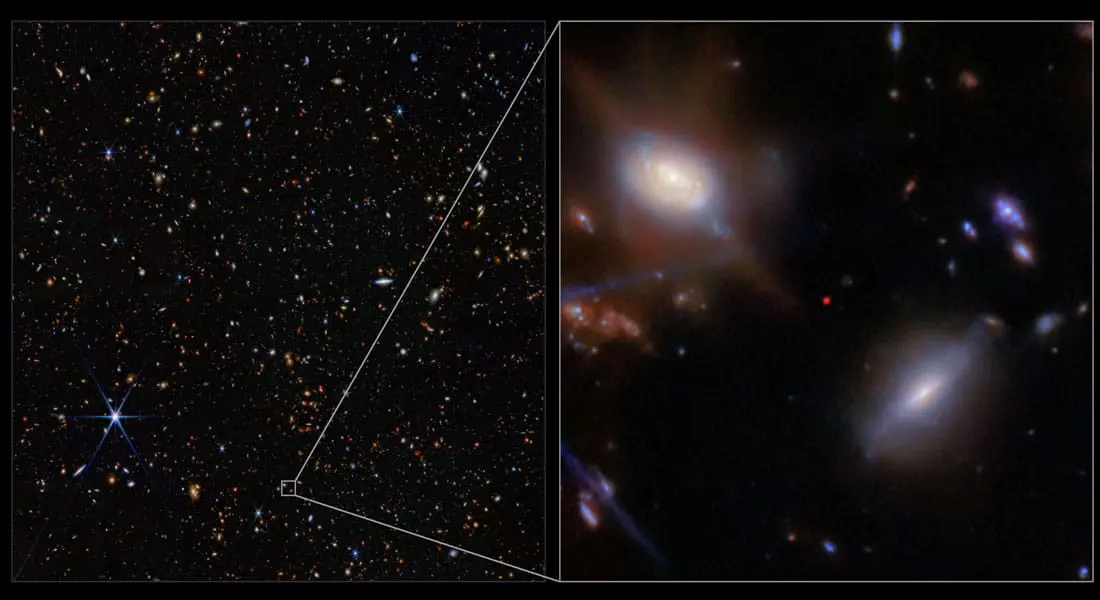
The James Webb Space Telescope has detected the earliest sign of the Universe becoming transparent during the Epoch of Reionization. A team led by astronomers at the Cosmic Dawn Center in Copenhagen observed a galaxy, JADES-GS-z13-1, just 330 million years after the Big Bang, which formed a bubble of ionized gas, indicating reionization began earlier than previously believed. This discovery, published in Nature, provides new insights into the Universe’s early evolution.
The Early Universe And The Fog Of Neutral Gas
The early universe was a hot, dense plasma that cooled as it expanded, eventually forming neutral hydrogen gas. This foggy medium obscured the first galaxies, making them difficult to observe. The Epoch of Reionization marks the period when ultraviolet light from these galaxies ionized the surrounding gas, rendering the universe transparent.
Prior research suggested that reionization began around 500 million years after the Big Bang. However, recent findings using the James Webb Space Telescope have identified a galaxy, JADES-GS-z13-1, that formed an ionized bubble much earlier. This discovery indicates that reionization started sooner than previously believed.
The detection of Lyman alpha emission from this galaxy signifies the presence of an ionized bubble, as such light cannot escape through neutral gas. This finding challenges existing timelines and suggests either stars or black holes may have initiated reionization. The sensitivity of James Webb was crucial in making these observations possible, highlighting its role in advancing our understanding of cosmic history.
Challenges In Detecting The First Galaxies
The early universe was filled with neutral hydrogen gas that obscured the light from the first galaxies. This dense medium absorbed ultraviolet radiation, making it difficult for these galaxies to be observed directly. The presence of this fog limited our ability to study the earliest stages of galaxy formation and evolution.
The Epoch of Reionization marked a critical transition when ultraviolet light from young stars or black holes ionized the surrounding gas, creating bubbles of transparency. These bubbles gradually expanded and merged, allowing light to traverse the universe freely. Detecting these early ionized regions is challenging due to their faintness and immense distance.
The James Webb Space Telescope has proven instrumental in overcoming these challenges. Its advanced spectroscopy capabilities enable detailed analysis of galaxy emissions, such as Lyman alpha radiation, which is a tracer for ionized bubbles. By observing these features, astronomers can reconstruct the timeline of reionization and understand its drivers, whether stars or black holes.
This work underscores the importance of sensitive instruments in unravelling cosmic history. The ability to detect faint signals from the early universe provides critical insights into how galaxies influenced their environments and shaped the evolution of the cosmos.
Implications For The Epoch Of Reionization
The discovery of an ionized bubble around JADES-GS-z13-1 suggests reionization began earlier. This finding challenges existing timelines and implies stars or black holes could have initiated this transformative epoch. The sensitivity of the James Webb Space Telescope has enabled unprecedented probing of these early cosmic phenomena, offering new insights into their drivers and timing.
This work extends our understanding of how light first traversed the universe, illuminating conditions under which galaxies formed and evolved in the early epochs of cosmic history. Researchers can reconstruct processes that shaped galaxy evolution and the intergalactic medium during reionization by identifying faint signals from the early cosmos.
The Role Of James Webb In Unlocking Cosmic Secrets
The James Webb Space Telescope has proven instrumental in overcoming challenges associated with detecting ionized regions in the early universe. Its advanced spectroscopy capabilities enable detailed analysis of galaxy emissions, such as Lyman alpha radiation, which serves as a tracer for ionized bubbles. By observing these features, astronomers can reconstruct the timeline of reionization and understand its drivers, whether stars or black holes.
This work underscores the importance of sensitive instruments in unravelling cosmic history. The ability to detect faint signals from the early universe provides critical insights into how galaxies influenced their environments and shaped the evolution of the cosmos.
More information
External Link: Click Here For More


