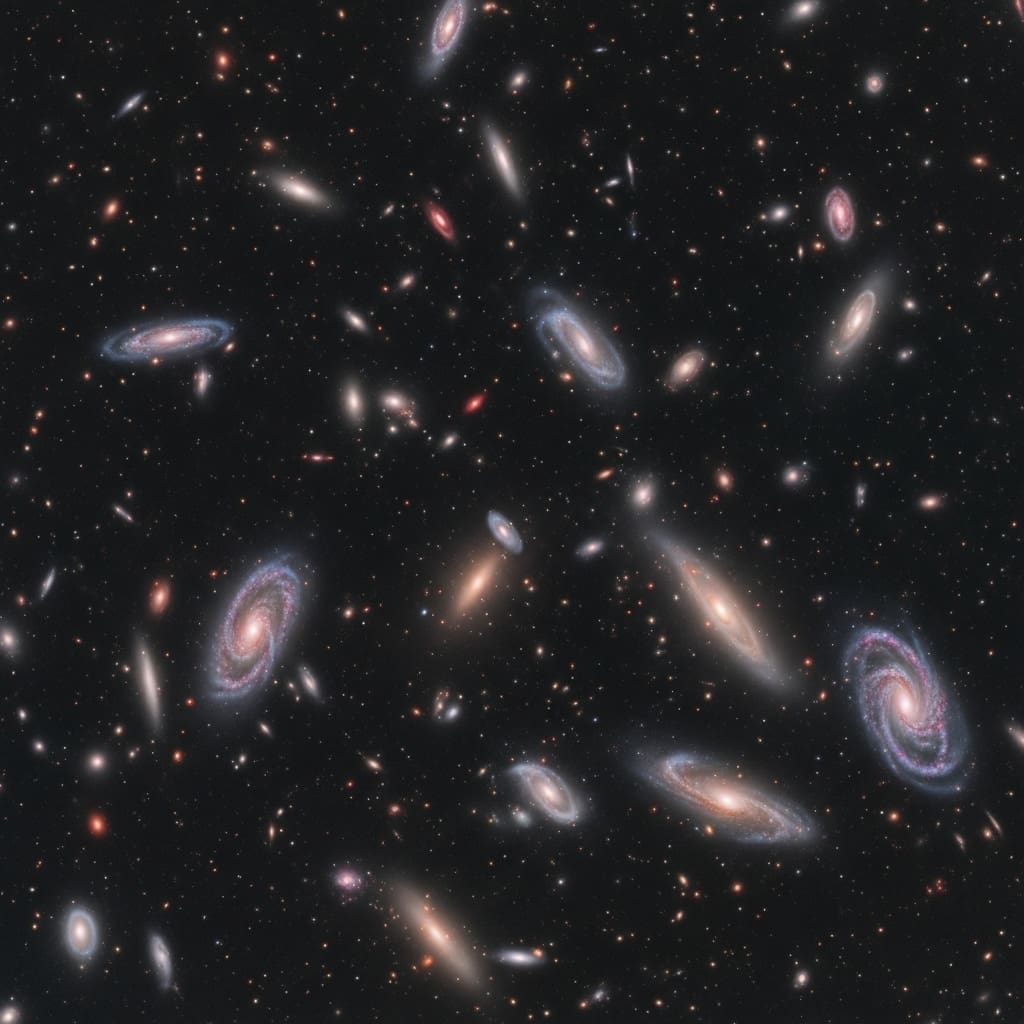
Understanding how galaxies assemble their structures over cosmic time remains a fundamental challenge in astronomy. Researchers Courtney Carreira, Brant E. Robertson, and A. Lola Danhaive, alongside colleagues Ji, Rieke, Tacchella et al., have now released a comprehensive morphological dataset from the JWST Advanced Deep Extragalactic Survey (JADES), utilising incredibly detailed imaging from the James Webb Space Telescope’s NIRCam instrument in the GOODS-N and GOODS-S fields. This new data release , comprising over 3 million Sérsic profile fits for nearly 25,000 galaxies , represents one of the largest extragalactic morphological catalogues ever created, and will allow astronomers to trace the evolution of galactic structure with unprecedented precision, revealing how galaxy sizes and components have changed over billions of years.
The research team modelled the surface brightness profiles of these distant sources using single-component Sérsic profiles, employing Bayesian inference to determine key structural parameters. This involved fitting each source individually with every available JWST/NIRCam wide-band filter, resulting in the computation of over 3 million Sérsic profiles, a monumental undertaking in extragalactic astronomy.
The study meticulously analysed the rest-frame optical redshift evolution of the effective radius and the surface luminosity density within a 1 kiloparsec radius for 24,692 galaxies at redshifts greater than 1. Researchers discovered that the effective radius evolves as reff ∝(1 + z)−0.635±0.013 kpc, indicating that galaxies were, on average, smaller at higher redshifts. Simultaneously, the surface luminosity density within 1 kpc remained relatively constant over time, suggesting that the central concentration of light in these galaxies did not significantly change with redshift. This finding challenges previous assumptions about the evolution of galactic structure and provides new constraints on models of galaxy formation.
Furthermore, the team explored bulge-disk decomposition for a subset of 8,390 galaxies within the Hubble Ultra Deep Field, revealing intriguing details about the internal structure of these systems. They found that the effective radius of bulge components increased marginally with time, while the disk components exhibited a more pronounced evolution, with sizes decreasing as reff,disk ∝(1 + z)−1.091±0.043. This differential evolution suggests that bulges and disks formed and grew through distinct pathways, offering valuable clues about the assembly history of galaxies. Future. This ambitious undertaking involved fitting each source individually with single-component Sérsic profiles using the pysersic Python package, a tool designed for Bayesian inference of galaxy structural parameters. The study pioneered a robust approach to uncertainty estimation, delivering precise measurements of key structural parameters including half-light (effective) radius, Sérsic index, and axis ratio for each galaxy, all performed separately for each wide-band filter.
This innovative technique allows for size measurements in diverse rest-frames, probing varying physical characteristics within each galaxy and providing a multi-wavelength view of galactic morphology. Researchers harnessed the posterior distributions for these parameters, intending to equip the wider astronomical community with the data needed for advanced statistical analyses. The JADES imaging reduction pipeline, detailed in a companion paper, relies on the jwst pipeline for initial data processing, followed by astrometric calibration and background subtraction to ensure accurate measurements.
This meticulous data reduction process delivers the pristine imaging data essential for reliable morphological modeling. To demonstrate the power of their morphological catalogs, the team characterized the redshift evolution of these parameters for 24,692 galaxies at redshifts greater than 1, finding an effective radius of kpc, while the surface luminosity density remained relatively constant over time. Furthermore, bulge-disk decomposition was performed on a subset of 8,390 galaxies within the Hubble Ultra Deep Field, revealing that bulge-component effective radii increased marginally with time, whereas disk-component sizes evolved as . Experiments revealed the rest-frame redshift evolution of the effective radius and surface luminosity density within a 1 kiloparsec radius for 24,692 galaxies at redshifts greater than 1.
Measurements confirm an effective radius of kpc, while the surface luminosity density remained relatively constant across time, a surprising finding that challenges previous assumptions about galaxy growth. The team meticulously measured these parameters, utilizing advanced Bayesian inference techniques to account for uncertainties in the data and model fitting, ensuring robust and reliable results. These precise measurements offer a new window into the physical processes governing galaxy formation and evolution in the early universe. Further analysis involved bulge-disk decomposition on a subset of 8,390 galaxies within the Hubble Ultra Deep Field, revealing intriguing trends in galactic structure.
Tests prove the effective radius of bulge components increased marginally with time, evolving as, while disk-component sizes evolved as . Scientists recorded these changes by carefully separating the light contributions from bulges and disks, allowing them to track the growth of each component independently, a complex undertaking requiring sophisticated image modeling techniques. The breakthrough delivers detailed insights into how galaxies assemble their mass and structure over cosmic timescales, providing crucial constraints on theoretical models of galaxy formation0.03 arcseconds per pixel, enabling high-resolution studies of distant galaxies, a significant improvement over previous observations. Researchers employed a custom reduction pipeline to correct for instrumental effects and create high-quality mosaics, ensuring the accuracy and reliability of the morphological measurements. This meticulous data processing, combined with advanced photometric techniques, has enabled the creation of a uniquely comprehensive and accurate catalog of galaxy properties.
Galaxy Size Evolution at High Redshifts
Scientists have generated morphological catalogues for sources detected in the JADES Data Release 5 imaging, utilising data from the GOODS-N and GOODS-S fields. Through Bayesian inference and modelling with single-component Sérsic profiles, they analysed over 3 million profiles, creating one of the largest extragalactic morphological datasets to date. This extensive dataset includes posterior distributions for each structural parameter, enabling statistically robust analysis of diverse galaxy populations. The research demonstrates that at redshifts greater than one, galaxies exhibit smaller rest-optical sizes than those observed at lower redshifts, with effective radii around 0.6 kpc at z ≈ 7 increasing to 1.45 kpc by z ≈ 1.
This evolution follows a power-law relationship, and analysis of a subset of 8,390 galaxies revealed that bulge-component sizes remain relatively constant with time, while disk-component radii increase significantly, by a factor of 4.5 between z ≈ 7 and z ≈ 1. The authors acknowledge a limitation in directly comparing the power-law normalisation with other studies due to the inclusion of both star-forming and quiescent galaxies in their sample. Future work will focus on releasing catalogues of structural parameters from multi-component surface brightness profile modelling, promising even more detailed insights into the morphological evolution of high-redshift galaxies.
👉 More information
🗞 JWST Advanced Deep Extragalactic Survey (JADES) Data Release 5: Catalogs of inferred morphological properties of galaxies from JWST/NIRCam imaging in GOODS-N and GOODS-S
🧠 ArXiv: https://arxiv.org/abs/2601.15957