A team of scientists have demonstrated the practical usage of a high fidelity multipartite gate, the iToffoli gate, in quantum computation. The iToffoli gate reduces circuit depth by 50% and circuit execution time by 40% compared to traditional gate sets, while providing comparable or better accuracy. This research, affiliated with The University of New South Wales, contributes to the broader goal of quantum computing technologies, which is to simulate quantum many-body systems that are challenging for classical computers.
What is Quantum Computation of Molecular Response Properties?
Quantum computation of molecular response properties is a topic of significant interest in the field of quantum computing. This process involves computing these properties directly in the frequency domain, which is desirable but challenging due to the large circuit depth required if the typical hardware gate set, consisting of single and two-qubit gates, is used. The integration of high fidelity multipartite gates into quantum simulation and the demonstration of improved accuracy of the observable properties remains a key area of exploration.
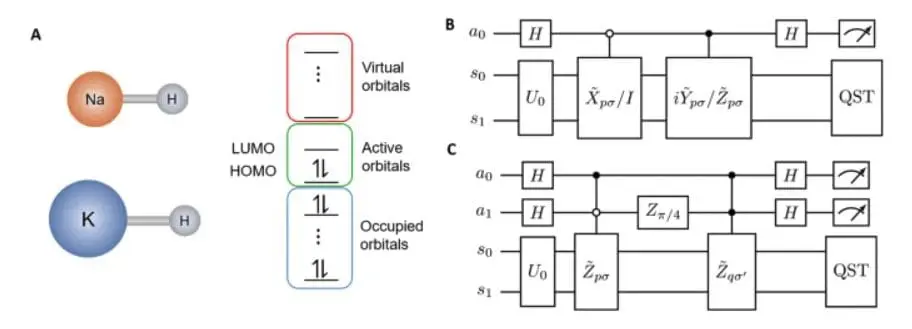
The article discusses the application of a high fidelity multipartite gate, the iToffoli gate, to the computation of frequency-domain response properties of diatomic molecules. The iToffoli gate enables a 50% reduction in circuit depth and a 40% reduction in circuit execution time compared to the traditional gate set. The molecular properties obtained with the iToffoli gate exhibit comparable or better agreement with theory than those obtained with the native CZ gates. This work is among the first demonstrations of the practical usage of a native multi-qubit gate in quantum simulation, with diverse potential applications to near-term quantum computation.
What is the Primary Goal of Emerging Quantum Computing Technologies?
The primary goal of emerging quantum computing technologies is to enable the simulation of quantum many-body systems that are challenging for classical computers. Early experimental demonstrations of quantum simulation algorithms have focused on computing ground and excited state energies of small molecules or few-site spin and fermionic models.
More recently, the scale of quantum simulation experiments has increased in terms of numbers of qubits, diversity of gate sets, and complexity of algorithms. This is evident in the simulation of models based on real molecules and materials, various phases of matter such as thermal, topological, and many-body localized states, as well as holographic quantum simulation using quantum tensor networks.
As quantum advantages in random sampling have been established on quantum hardware, focus has turned to the experimental demonstration of quantum advantages in practical applications. This shift in focus is a significant step forward in the field of quantum computing, as it moves from theoretical exploration to practical application.
Who are the Key Players in this Research?
The research was conducted by a team of scientists including ShiNing Sun, Brian Marinelli, Jin Ming Koh, Yosep Kim, Long B Nguyen, Larry Chen, John Mark Kreikebaum, David I Santiago, Irfan Siddiqi, and Austin J Minnich. The team is affiliated with various institutions, including The University of New South Wales.
The team’s work is among the first demonstrations of the practical usage of a native multi-qubit gate in quantum simulation. Their research has diverse potential applications to near-term quantum computation, making it a significant contribution to the field of quantum computing.
What is the Significance of the iToffoli Gate in Quantum Computation?
The iToffoli gate is a high fidelity multipartite gate used in quantum computation. Its application to the computation of frequency-domain response properties of diatomic molecules has been demonstrated in this research. The iToffoli gate enables a 50% reduction in circuit depth and a 40% reduction in circuit execution time compared to the traditional gate set.
The molecular properties obtained with the iToffoli gate exhibit comparable or better agreement with theory than those obtained with the native CZ gates. This suggests that the iToffoli gate could be a more efficient and accurate tool for quantum computation of molecular response properties.
What are the Potential Applications of this Research?
The research has diverse potential applications to near-term quantum computation. The use of the iToffoli gate in quantum computation could lead to more efficient and accurate computations, particularly in the computation of molecular response properties.
This could have significant implications for various fields, including materials science, chemistry, and physics, where accurate computation of molecular properties is crucial. Furthermore, the research contributes to the broader goal of quantum computing technologies, which is to enable the simulation of quantum many-body systems that are challenging for classical computers.
What are the Future Directions for this Research?
The research represents a significant step forward in the field of quantum computing, but there is still much work to be done. The integration of high fidelity multipartite gates into quantum simulation and the demonstration of improved accuracy of the observable properties remains a key area of exploration.
The team’s work with the iToffoli gate provides a promising direction for future research. Further exploration of the practical usage of native multi-qubit gates in quantum simulation could lead to more efficient and accurate quantum computations. This could ultimately contribute to the realization of the full potential of quantum computing technologies.
Publication Date: 2024-05-31
Authors: Shang Sun, Brian Marinelli, Jin Koh, Yosep Kim, et al.
Source: npj quantum information
DOI: https://doi.org/10.1038/s41534-024-00850-9